

Analysis: Russia’s Shadow Fleet – Can Confronting Moscow Help Starmer Reclaim His Image?

Analysis: Russia's Shadow Fleet – Can Confronting Moscow Help Starmer Reclaim His Image?
The oil tanker SMYRTOS left the Russian port of Ust-Luga on the Baltic Sea flying the flag of Cameroon.
Its destination was Port Said, Egypt.
But its journey ended in the English Channel.
In the early hours of Sunday morning, Royal Marines, supported by officers from the National Crime Agency, boarded the vessel, which British authorities say forms part of Russia’s so-called “shadow fleet” used to circumvent Western sanctions.
The operation lasted around six hours. The tanker was subsequently detained off Britain’s southern coast while officials examined documents, records and onboard equipment for evidence of sanctions breaches.

In an ordinary week, that alone would have been a major story.
This was not an ordinary week for Keir Starmer.
Back in London, the prime minister was grappling with the image of a weakened leader: a damaging dispute with Defence Secretary John Healey over military spending that culminated in Healey’s resignation, mounting pressure within the Labour Party, and growing questions about Starmer’s ability to finance both his security commitments and domestic promises at a time of increasing international instability and shrinking fiscal room for manoeuvre.
The timing, therefore, became part of the story.
A military operation of this scale, arriving just as Starmer faced accusations that he lacked the resolve to protect national security, offered a striking counter-image to the narrative promoted by his critics.
At sea, the optics looked very different.
Special forces boarding a vast tanker.
A ship carrying Russian oil detained near British waters.
A message to Moscow that financing the war in Ukraine would not pass quietly through the English Channel.
The operation did not need to be designed for Starmer’s political benefit to produce political consequences.
At moments of domestic weakness, every display of resolve abroad becomes an opportunity to redefine a leader in the eyes of both supporters and opponents.
From Ust-Luga to Port Said: How the Shadow Fleet Operates

The route taken by SMYRTOS illustrates the problem.
A tanker departs from a Russian port, sails under the flag of an African state, passes through one of the world’s busiest maritime corridors and heads towards the eastern Mediterranean.
This was not merely a commercial voyage.
It was a condensed example of how Russia’s shadow fleet functions: Russian oil transported under foreign flags through complex shipping networks designed to keep revenues flowing despite sanctions.
Moscow does not necessarily need warships to wage this battle.
Sometimes all it requires is a shipment of oil moving along the right route, under the right flag and accompanied by paperwork sufficient to navigate ports, straits and shipping lanes.
More importantly, the detention of SMYRTOS highlights a broader transformation in the nature of Western sanctions.
For decades, sanctions resembled financial and administrative instruments: blacklists, banking restrictions and regulatory measures.
Britain now appears to be signalling that sanctions are no longer merely words on paper.
They can become enforceable power at sea.
The contest is no longer only about a single vessel.
It is about the network that enables that vessel to move.
A War Economy Disguised as Commerce

The shadow fleet is not a military fleet in the conventional sense.
There are no obvious Russian warships, no declared battlefield and no formal declaration of war.
Instead, there are tankers, intermediaries, shell companies, foreign registries and lengthy maritime routes.
Their purpose is straightforward: to keep Russian oil flowing and provide Moscow with revenues that help sustain the war in Ukraine.
That is the danger of the grey zone.
The tanker is not an obvious military target.
Oil is not a weapon in itself.
The English Channel is not a battlefield.
Yet oil revenues can ultimately become ammunition, soldiers’ salaries, drones and missiles that strike Ukrainian cities and deepen Europe’s security anxieties.
The confrontation with Russia is therefore no longer confined to the front lines in Ukraine.
It increasingly revolves around who monitors the seas, who enforces sanctions and who is willing to bear the risks of intercepting what appears, on the surface, to be a commercial vessel that has become part of a wartime economy.
It is a conflict that stops short of calling itself war.
But it no longer resembles peace either.
A Moment of Strength Does Not End a Crisis of Weakness
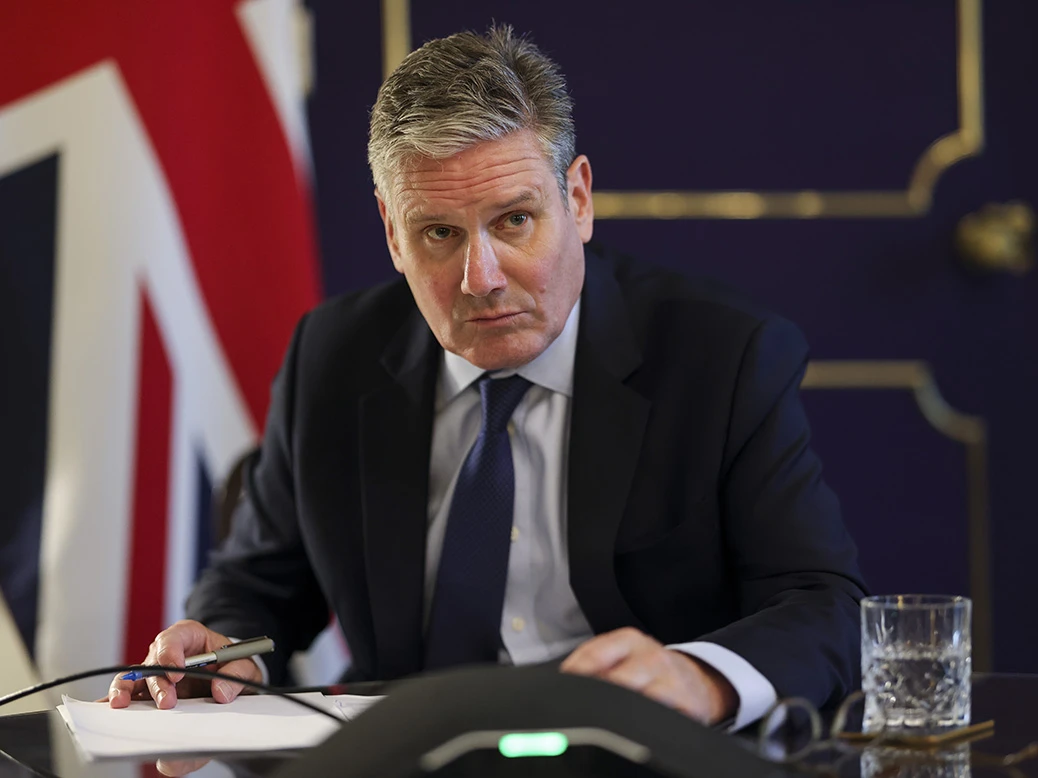
Success at sea does not erase vulnerability at home.
For Starmer, the image of firmness is not a public relations luxury.
It is a political necessity.
The operation followed one of the most damaging defence rows of his premiership, with John Healey’s resignation evolving into a broader accusation that the government was failing to provide what Britain needs to protect itself in a more dangerous world.
The link between the naval operation and the domestic political crisis therefore became almost inevitable.
Critics who accused Starmer of weakness on defence suddenly found themselves confronted with an example of the British state demonstrating operational competence in an area directly linked to national security.
Yet the larger questions remain unresolved.
Will the government increase defence spending?
Can it strengthen security without undermining the welfare state?
Can Starmer still maintain discipline within his party?
Does he possess sufficient political authority to confront internal rivals, the opposition, hostile newspapers, financial markets and frustrated voters simultaneously?
Standing up to the shadow fleet gives Starmer a powerful image.
It does not necessarily give him renewed authority within Labour.
Voters may welcome toughness towards Moscow.
But they eventually return to the issues that shape everyday life: the economy, immigration, public services, energy bills, and the implications of seeing senior defence figures resign from a government that insists it takes national security seriously.
More Than an Oil Tanker
This is why the story of SMYRTOS is about more than an oil tanker.
It is a story about a war changing its shape.
About sanctions evolving from financial pressure into operational enforcement.
About a state attempting to adapt to that transformation.
And about a prime minister searching for moments in which he can appear decisive while the political space around him narrows at home.
The real question may not be whether Britain can intercept another tanker.
It may be whether Keir Starmer can convert moments of decisiveness abroad into durable political confidence at home.
Modern conflicts can provide leaders with powerful images.
They do not necessarily provide the legitimacy they struggle to build within their own countries.
As attention turns towards Russia’s shadow fleet, Starmer’s most difficult challenge remains on land rather than at sea: persuading Britons that the determination they witnessed on their television screens can translate into leadership they feel in their everyday lives.
Because it is there — in hospitals and schools, in energy bills and ballot boxes — that the political battles no security operation, however dramatic, can win on its own are ultimately decided.
Read more:
- Analysis: Has the Post-Starmer Era Already Begun – Or Is Blairism Returning Through the Back Door?
- Analysis: Revolt in Britain’s Ministry of Defence – Or Exploiting Starmer’s Moment of Weakness?
- Analysis: From Romania to London – Why Britain Is Talking About War More Than at Any Time Since the Cold War
ShortURL ⬇