

The Brexit Curse: Why Downing Street Keeps Consuming Its Prime Ministers
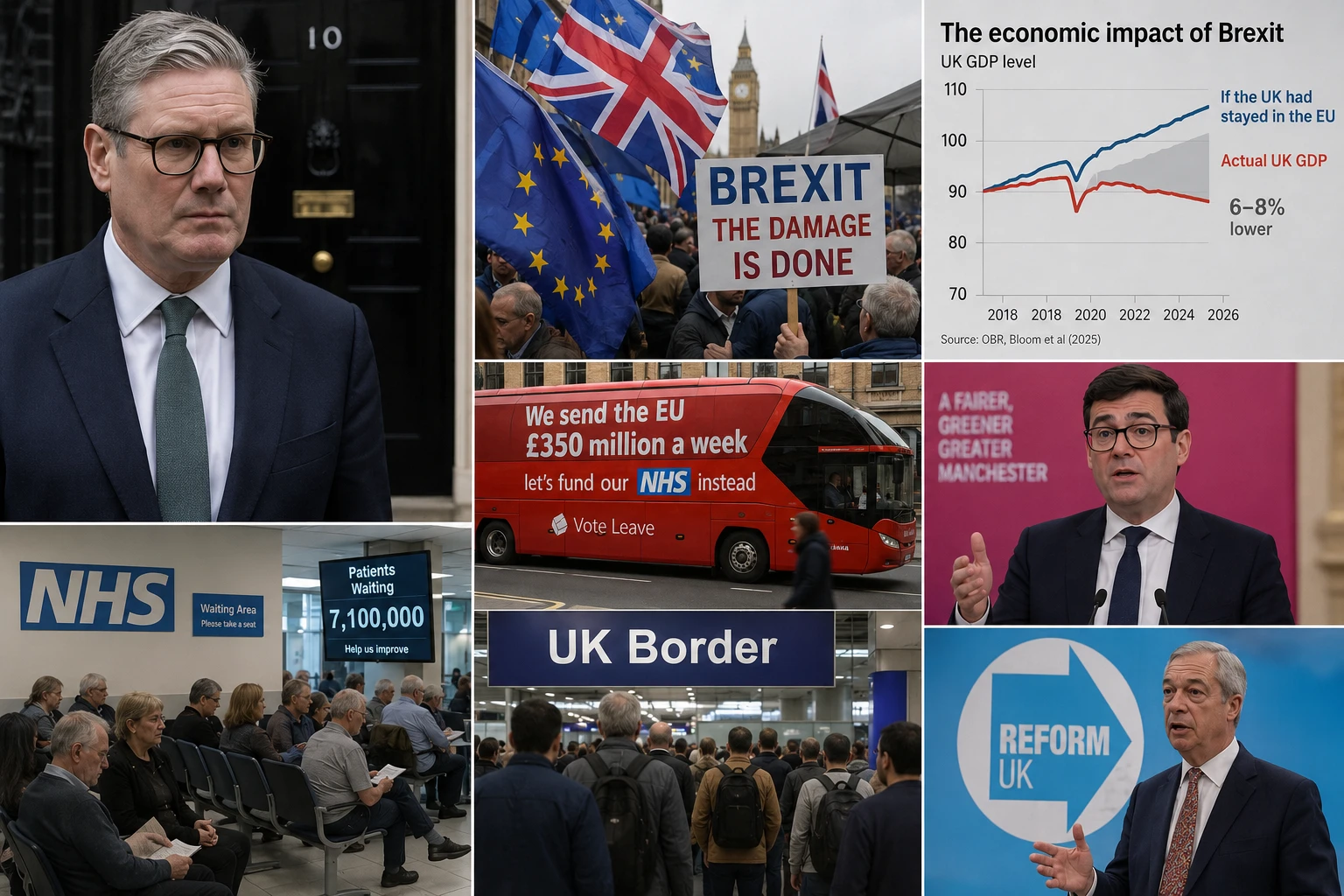
The Brexit Curse: Why Downing Street Keeps Consuming Its Prime Ministers
Keir Starmer has finally resigned.
The man who spent months insisting he would fight to stay in office ultimately confronted the same reality that had undone so many of his predecessors: since Brexit, Downing Street has become one of the least secure addresses in British politics.
Britain entered the 2016 referendum promising to “take back control.”
Nearly a decade later, it has yet to regain it—politically or economically.
One by one, prime ministers have fallen.
David Cameron resigned after losing the referendum he had called.
Theresa May was consumed by attempts to deliver a Brexit that satisfied no one.
Boris Johnson promised to “get Brexit done” before becoming another casualty of the political turmoil he helped create.
Liz Truss sought a radical economic break and lasted only weeks.
Rishi Sunak inherited an exhausted party and an increasingly frustrated country.
Then came Keir Starmer, promising something different: competence, stability and quieter government.
But stability has proved elusive in a country that never truly left the Brexit moment behind.

Now, with Starmer’s resignation marking Britain’s seventh prime minister in a decade, the story is becoming larger than the fate of one political leader.
It is the story of a political system that has struggled to regain its balance since the 2016 referendum.
Brexit Never Really Ended
Legally, Britain left the European Union years ago.
Politically, however, Brexit never disappeared. It simply changed form.
The Office for Budget Responsibility has long estimated that, over time, UK trade would remain around 15% lower than if Britain had stayed in the EU, reducing the economy’s long-term productivity by roughly 4%.
More recent research by Nicholas Bloom and colleagues suggests the economic impact may be even greater, estimating that GDP now stands between 6% and 8% below the level expected under continued EU membership.
These are not abstract economic forecasts.
They translate into weaker growth, tighter public finances and fewer resources for governments already struggling to fund overstretched public services.
Brexit did not end when Britain formally left the EU.
It became the political landscape every government has since been forced to navigate.
The Promise of Control

The central promise of Brexit was simple: take back control.
For many voters, the years that followed felt like the opposite.
Control over immigration remained politically contentious.
Net migration fell sharply to 171,000 in 2025 after peaking at 944,000 in the year to March 2023, yet immigration continued to dominate political debate, becoming a wider symbol of frustration with borders, government and the political establishment.
Economic control proved equally difficult.
Inflation, having peaked at 11.1% in October 2022, eased to 2.8% in May 2026—still above the Bank of England’s 2% target. For households, lower inflation did not mean prices were falling. It simply meant they were rising more slowly.
By May 2026, around two-thirds of British adults still reported that their cost of living had increased compared with the previous month, while real wages were growing by only around 1%, leaving many families feeling that recovery remained painfully slow.
Public services continued to struggle.
NHS waiting lists remained around 7.1 million cases, with the 18-week treatment target still far from being consistently achieved.
The economy did not collapse in the way some critics predicted.
Nor does Brexit explain every challenge Britain faces.
The country gained greater regulatory and trade flexibility outside the European Union.
Yet those advantages have not translated into the widespread sense of control or renewed prosperity that many voters expected.
Why the Anger Reached Starmer
Starmer did not create Brexit.
He inherited its consequences.
That is the central tragedy of his premiership.
He entered office offering something deceptively simple: no more drama.
After Johnson, Truss and Sunak, calm itself appeared to be a political asset.
But calm is rarely enough when voters believe the country remains stuck in crisis.
They wanted stronger growth.
Better public services.
Lower living costs.
And above all, evidence that government had regained the ability to act.
The frustration directed at Starmer was not because he caused the country’s problems.
It was because he promised to move Britain beyond them, yet increasingly appeared to be managing the crisis rather than escaping it.
Polling reflected that disappointment.
At times Reform UK moved ahead of Labour, with some surveys placing Nigel Farage’s party on around 27% compared with Labour’s 18%.
Other polls showed Starmer’s personal ratings falling sharply, while Andy Burnham increasingly emerged as the Labour figure many supporters viewed as better placed to revive the party.
The problem was not simply that Starmer failed to inspire.
It was that he promised to end an era of instability while appearing trapped inside it.
From Conservatives to Labour
This is why the Brexit curse no longer belongs solely to the Conservative Party.
The Conservatives paid the political price for making the promise.
Labour is paying the price for governing after it.
Reform UK continues to thrive on many of the same political forces that fuelled Brexit: concerns over borders, national identity and hostility towards political elites.
Labour, meanwhile, has found itself governing a country shaped by those grievances without discovering a convincing political language to address them.
Starmer could hardly argue that Brexit itself remained part of Britain’s difficulties without reopening one of the country’s deepest political divisions.
Yet neither could he ignore its consequences, visible across the economy, immigration, public services and Britain’s relationship with Europe.
Burnham and the Same Chair

Andy Burnham may soon arrive at Downing Street.
He may appear more energetic and more closely connected to voters than Starmer.
But he will inherit the same chair.
A sluggish economy.
Persistent immigration pressures.
Overstretched public services.
A complicated relationship with Europe.
And a Labour Party increasingly worried about Reform UK.
The occupant of Number 10 may change.
The conditions surrounding the office will not.
Britain Is Still Living with Brexit
That is why Starmer’s resignation represents more than another prime minister leaving office.
It marks another chapter in a story that began in 2016 and has yet to reach its conclusion.
Britain chose to leave the European Union.
It has still not fully decided what it wants to become afterwards.
Its political class promised control.
Instead, it discovered that governing a post-Brexit Britain is considerably harder than campaigning for one.
Starmer has become another leader brought down not simply by his own mistakes, but by the unsettled political landscape Brexit created.
The curse was never that Britain left the European Union.
It was that it dismantled one political settlement before constructing another capable of replacing it.
Since then, every prime minister who has walked through the doors of Downing Street has encountered the same reality.
The office is no longer stable.
The country has yet to recover.
And politically, at least, Brexit is still unfinished.
Read more:
ShortURL ⬇