

Burnham Wins. Did Starmer Lose Despite Labour’s Victory?
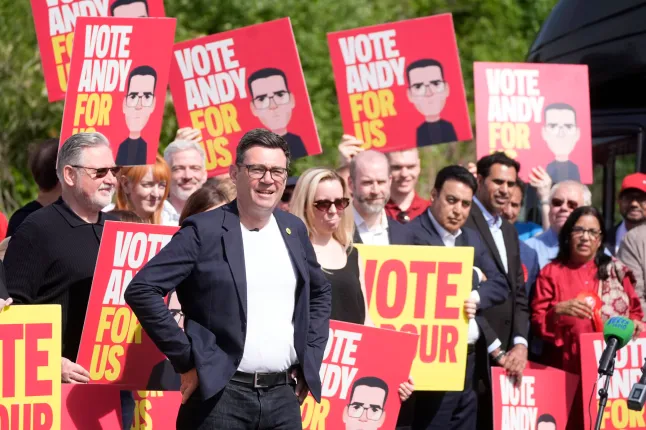
Burnham Wins. Did Starmer Lose Despite Labour's Victory?
The Makerfield by-election offered Keir Starmer no comfortable outcome.
There were only two bad ones.
Had Labour lost the seat, it would have extended a run of setbacks that began with the local elections, reinforcing the impression that the governing party could no longer defend even its traditional heartlands.
But if Andy Burnham won, victory itself would create a different problem: the return of Labour’s most formidable potential rival to Westminster, opening the door to a direct contest over both the party leadership and the premiership.
Now that Burnham has won, that threat is no longer hypothetical.
He is back in Parliament.
Not through a narrow victory or a symbolic result, but with more than half the vote.
The former Mayor of Greater Manchester secured 54.8% of the vote in Makerfield, comfortably outperforming his rivals combined. Reform UK’s Rob Kenyon won 34.5%, while Rebecca Shepherd of Restore Britain secured 6.8%. Together, they reached 41.3% — well short of Burnham’s total.
That makes the result far more significant than Labour simply holding a safe seat.
It marks the emphatic return of a politician whom the party leadership had previously tried to keep out of Parliament, now returning with an electoral mandate stronger than any opinion poll predicted during the campaign.
And with him comes something else.
Labour has entered the post-Starmer era, even if Starmer himself remains in Downing Street.

An Election With No Safe Outcome
It is unusual for a prime minister to face an election in which defeat would be damaging but victory could prove even more dangerous.
That is precisely what happened in Makerfield.
Starmer knew that losing the seat would reinforce the narrative of a government steadily losing public confidence. With Reform UK gaining ground and Labour struggling in many post-industrial constituencies, defeat would have been interpreted as further evidence that the party had lost touch with the voters who returned it to power.
Yet Burnham’s victory offered little comfort.
The winner is not simply another Labour MP adding to the government’s parliamentary majority.
He is the former Mayor of Greater Manchester, one of the party’s best-known political figures outside Westminster, often described within Labour as the “King of the North”, and one of the few politicians with the profile to present himself as a credible national alternative to Starmer.
In other words, Labour’s victory in Makerfield did not rescue Starmer.
It returned his strongest internal challenger to the very institution from which he could seek to replace him.
The Numbers That Made Victory More Dangerous
Had Burnham scraped through by a narrow margin, Starmer might have been able to play down the significance of the result.
He could have argued that Labour had survived only narrowly, that voters remained deeply dissatisfied, and that Burnham had yet to demonstrate he could defeat Reform or rebuild public confidence.
The figures leave little room for such an argument.
Winning 54.8% of the vote means Burnham did not simply prevail.
He comfortably exceeded expectations.
More importantly, he achieved that result despite a strong Reform challenge, despite Labour’s difficult national position, and despite opinion polls that never projected such a commanding victory.
This was not a defensive performance.
It was an offensive one.
Burnham has returned to Westminster carrying a political message that many Labour MPs will struggle to ignore.
He has demonstrated that he can attract support beyond Labour’s traditional base, compete successfully against Reform, and present himself not as a risk to the party, but as an opportunity.
That is what makes the result particularly uncomfortable for Starmer.
It does not present Burnham as a rebel.
It presents him as the politician who might rescue Labour from decline at a time when Reform has become the party’s most serious electoral threat across many of Labour’s traditional constituencies.
The Rival Starmer Tried to Keep Out

This is not the first time Starmer has had to deal with the political problem called Andy Burnham.
In January 2026, Labour’s National Executive Committee blocked Burnham from contesting an earlier by-election that would have returned him to the House of Commons.
The official explanation was organisational and financial: his candidacy would have triggered an early mayoral election in Greater Manchester.
Many inside the party, however, saw something different.
Keeping Burnham outside Westminster also kept him away from the parliamentary platform needed to transform leadership speculation into a direct challenge.
At the time, Starmer appeared to have closed the door.
This time, he did not.
Burnham returned through Makerfield with a commanding majority at precisely the moment the Prime Minister faces the most fragile period of his premiership.
That makes this more than an electoral victory.
It removes the final barrier separating Burnham from becoming not merely a theoretical alternative, but a practical one.
More Than a By-Election Victory

Burnham did not win simply because he carried the Labour label in a traditional constituency.
He won at a moment when parts of both the party and the electorate appear eager for a different message.
After months of declining poll ratings, internal tensions and public frustration with the government’s performance, Burnham has positioned himself as someone able to say what Starmer increasingly cannot: that Labour itself must change before voters decide to change it from outside.
That is his political advantage.
He does not present himself as Labour’s opponent.
He presents himself as Labour’s last opportunity.
His message to MPs is not to overthrow the government.
It is to save it from its current leader.
For nervous Labour MPs contemplating the next election, that may prove more persuasive than open rebellion.
It offers an escape route that appears constructive rather than destructive: change the leader before voters decide to change the government.
The Battle Inside Labour Begins
Burnham’s victory does not mean Starmer’s premiership is over.
Politics rarely works that quickly.
Leaders do not usually fall when they lose office.
They begin to fall long before election day, when they lose the confidence of the alliances that sustain them.
When MPs begin repositioning themselves.
When donors start looking elsewhere.
When trade unions and newspapers devote more energy to discussing the next government than defending the current one.
That is the territory Starmer now enters.
He is no longer confronting only the opposition, Reform UK, difficult economic conditions or voter dissatisfaction over living standards, public services and immigration.
He is now confronting a rival inside his own political family — one who has returned to Parliament with an electoral mandate that cannot easily be dismissed.
This is no longer simply an argument over Labour’s policy direction.
It is becoming a contest over who is best placed to keep Labour in government.
Downing Street Faces Its Hardest Test
Starmer’s dilemma is now both simple and unforgiving.
Either he reasserts his authority over both the government and his party, or he begins preparing for the possibility that others will prepare for life after him.
Makerfield gave Burnham more than a parliamentary seat.
It gave him a platform.
It gave Starmer’s critics inside Labour a figure around whom they can rally.
And it gave wavering MPs a reason to move from private doubt towards political action.
Burnham’s victory has not merely opened a new chapter in his own political career.
It has opened a new chapter in Starmer’s crisis.
The Prime Minister feared Labour might lose the seat.
Instead, he secured what may prove the more dangerous outcome: Labour won — with the man who could ultimately end his leadership.
That is the paradox.
Sometimes it is not defeat that begins a leader’s downfall.
Sometimes victory itself marks the beginning of the end.
Read more:
ShortURL ⬇