

Analysis: Is the British State Returning Through the Back Door?
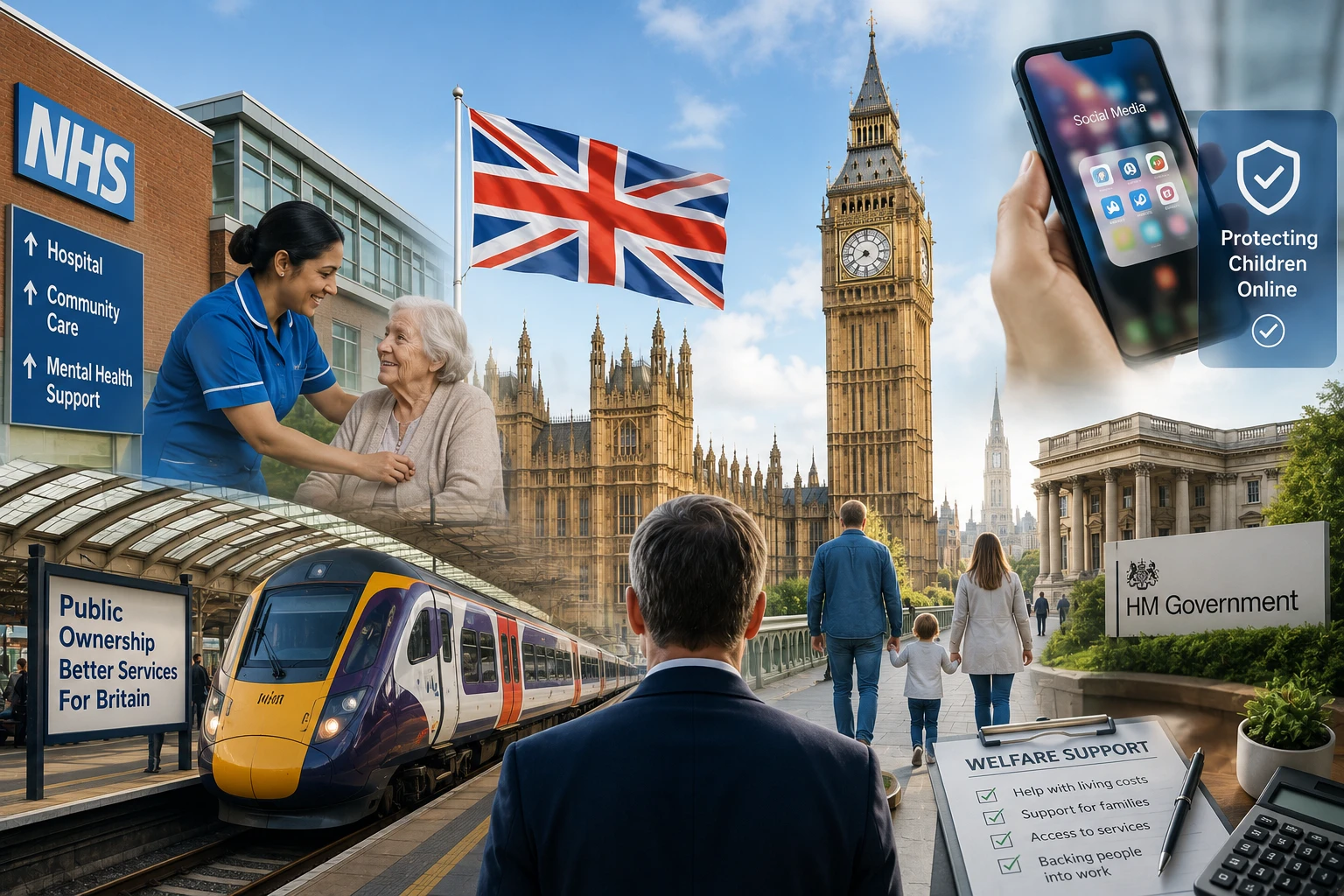
Analysis: Is the British State Returning Through the Back Door?
When Britain privatised its railways, liberalised markets and reduced the role of the state, it seemed as though the direction of history had been settled.
The idea was simple: let the market work.
Yet decades later, the state is quietly returning to areas many assumed it had permanently left behind. It is re-entering the railway system after years of privatisation, debating restrictions on what children can see on their phones, and intervening in questions surrounding welfare spending.
Behind these seemingly unrelated debates lies a larger question: is Britain beginning to bring the state back into spaces from which it spent decades trying to withdraw?
From Margaret Thatcher onwards — and later in a more flexible form under Tony Blair — British politics was shaped by the belief that markets could manage large parts of public life more efficiently than government. The state’s role was not to disappear entirely, but to become less direct and more regulatory.
What is happening today suggests a movement in the opposite direction.
It is not being presented as a grand ideological rupture. Rather, it is emerging through a series of policy debates: transport, welfare, technology, trade and child protection.
From Market Solutions to State Intervention

The railways provide perhaps the clearest example of this shift.
Britain’s legislation to bring passenger rail services back into public ownership has set in motion the gradual dismantling of the franchising model that defined the sector for decades. This is not simply a transport policy. It is the reopening of one of Britain’s longest-running political arguments.
The railways were among the most visible battlegrounds of the privatisation era, embodying wider debates about efficiency, competition and whether essential services should be governed primarily by commercial incentives or public need.
The return of the state to the railways does not, by itself, mark the end of the Thatcher-Blair settlement. It does, however, suggest that the long retreat of the state is no longer treated as self-evidently desirable.
As pressures accumulate across public services, an old question is returning: did these sectors struggle because markets were never given enough freedom, or because the state became too absent?
Welfare and the Limits of Protection

The debate over welfare raises the same question from a different angle.
The issue is not simply the cost of benefits or the rules governing eligibility. It is about the limits of the state’s responsibility towards vulnerable citizens in a society facing rising living costs, strained public services, and growing social and health pressures.
Here, an old British tension reappears in a new form.
Government is under pressure to contain spending, yet it is simultaneously expected to provide greater protection for citizens who increasingly feel economically insecure.
As welfare costs rise, the question inevitably returns: is the problem excessive dependence on the state, or the erosion of the economic and social conditions that once allowed people to depend less on it?
This is why the welfare debate is about more than public finances. It has become part of a broader argument about the social contract itself.
What does the state owe its citizens? At what point does protection become dependency? And when does reducing support become an admission of deeper failures elsewhere in the economy and society?
The State Versus the Platforms

The same dynamic can be seen in the debate over children’s use of social media.
A few years ago, this issue barely featured in mainstream political discussion. Digital platforms largely presented themselves as global spaces operating beyond the reach of national governments.
Today, the state is increasingly positioning itself as the last line of defence against companies with extraordinary influence over the lives of children and teenagers.
This is not merely an economic intervention. It reaches into family life, into the relationship between children and screens, and into questions about corporate responsibility for mental and social wellbeing.
That marks a significant shift.
The question is no longer whether governments have the right to intervene.
It is what happens if they do not.
Viewed this way, the social media debate is about more than technology. It forms part of a broader return to the idea of public protection after decades in which individual choice was often treated as the guiding principle and digital markets largely wrote their own rules.
Labour and the Question of the State
Against this backdrop, Labour’s internal disagreements appear to be about far more than leadership or factional rivalry.
The governing party finds itself confronting a deeper question: is it managing a post-free-market era, or merely trying to repair the old model from within?
Arguments over welfare, taxation and Britain’s relationship with Europe reflect a wider uncertainty running through British politics.
There is a growing recognition that the state must do more. What remains unclear is where the limits of that “more” should lie.
Should government intervene to protect children from digital platforms? Should it take greater ownership of essential services? Should it expand welfare provision or tighten it? Should Britain move closer to Europe, or continue pursuing the idea of complete regulatory independence?
This is the real dilemma.
Modern Britain lacks the economic capacity simply to recreate the post-war welfare state. Yet neither can it rely exclusively on market solutions.
Instead, it appears to be searching for a third model: less ideological, more pragmatic, and driven by necessity rather than doctrine.
A state returning not because it wants to, but because it can no longer remain absent.
A Return Without a Declaration
Viewed together, these debates begin to resemble a single political story.
The railways. Welfare. Children and digital platforms. Labour’s internal arguments.
All revolve around the same theme: the return of the state to the centre of British politics.
Yet it is a cautious, hesitant and largely undeclared return.
Few politicians are willing to admit openly that the long era of shrinking the state may have reached its limits. And yet almost every new crisis seems to push government in the same direction: more regulation, more protection, more intervention, and more questions about whether markets alone can govern an increasingly anxious and fragmented society.
Britain may not be entering a new age of state power comparable to the decades following the Second World War.
It is, however, gradually moving away from an era in which reducing the role of the state was considered the default answer to almost every political question.
One of the defining dilemmas of modern Britain lies precisely here: large sections of the electorate increasingly want the protections once associated with the welfare state, while the economy struggles to sustain those expectations.
For that reason, the central political argument is no longer simply about the size of the state.
It is about what functions citizens expect it to perform in a society that feels more uncertain, more vulnerable and less confident than it did a generation ago.
The question is no longer whether the state is returning.
It is what kind of state is returning, whom it will serve, and at what cost.
Read more:
ShortURL ⬇