

London Was Never Built for This Heat. Is Britain Falling Behind in Adapting to a New Climate?
London Was Never Built for This Heat. Is Britain Falling Behind in Adapting to a New Climate?
Heatwaves are no longer simply weather stories in London.
They have become political ones.
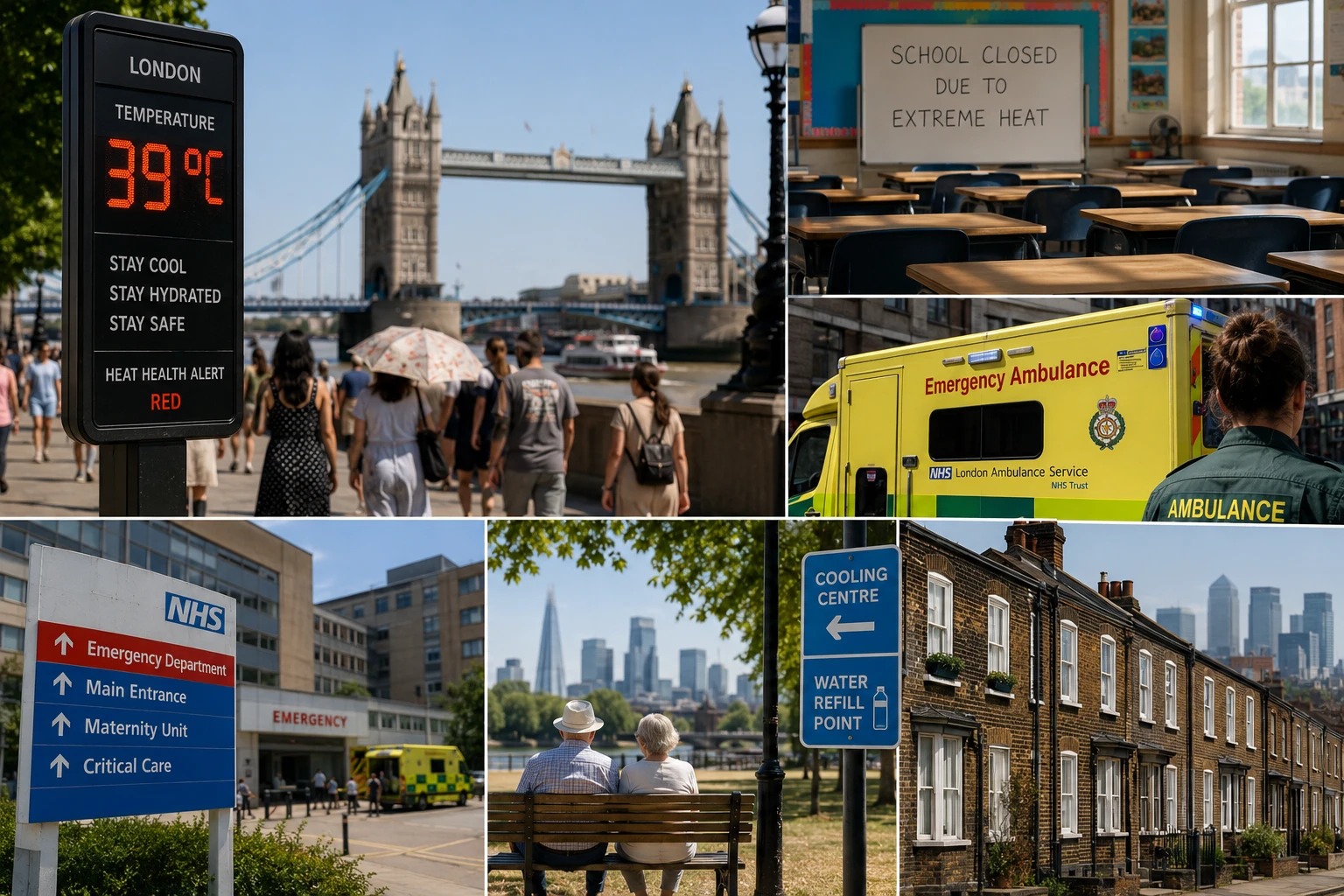
When British newspapers report that more than 1,300 schools have either closed or shortened the school day, when the London Ambulance Service records the highest number of life-threatening emergencies in its history, and when hospitals, care homes and ageing housing stock all become part of the danger zone, extreme heat stops being a seasonal inconvenience.
It becomes a question of public policy.
That is why Heat Ready London, Mayor Sadiq Khan’s new climate adaptation strategy, is more than another environmental document.
It is an admission that London was built for a different climate—and that climate change is no longer a distant scientific projection but a daily pressure on schools, hospitals, transport networks and homes.

A Cold City Enters an Age of Heat
For generations, Britain understood extreme weather as cold, rain and fog.
Homes were designed to retain warmth. Schools, hospitals and transport infrastructure were built for a country whose greatest weather-related concern was winter, not summer.
Recent heatwaves have turned that assumption upside down.
The challenge is no longer simply that temperatures are rising. It is that the city itself struggles to function when they approach 40°C—especially if such extremes become more frequent or last longer.
Homes built to trap heat in winter become stifling during summer. Older trains, deep Underground stations and overcrowded buses are poorly equipped for prolonged periods of extreme heat.
Schools, hospitals and care homes—where children, patients and older people spend much of their time—find themselves confronting risks they were never designed to manage.
The real question is no longer how hot today will be.
It is whether London was built for a pre-climate-change world.
From Weather Advice to Public Policy

Until recently, official responses to heatwaves were relatively straightforward: drink more water, close your curtains, stay out of direct sunlight and check on elderly neighbours.
That approach is no longer enough.
Extreme heat has evolved from an individual health concern into sustained pressure on infrastructure, public services and neighbourhoods.
Heat Ready London represents an attempt to move the debate beyond seasonal advice and into mainstream public policy.
According to the Greater London Authority, the strategy includes expanding cooling spaces, increasing urban shade, improving access to drinking water, protecting vulnerable communities, upgrading buildings and strengthening the resilience of transport, health and social care services.
The shift matters.
Climate adaptation is no longer the forgotten companion of emissions reduction.
It has become the other half of climate policy.
The question is no longer only how to slow future warming.
It is how to protect people from the heat that has already arrived.
The Numbers Reveal the Scale of the Challenge
The figures accompanying the strategy show that this is far more than another hot summer.
The Heat Ready London plan estimates that around one million homes across the capital face a risk of overheating. It also identifies 1,361 schools, 60 hospitals and 351 care homes located in areas with elevated heat risk.
It is, in effect, a map of urban vulnerability.
At the height of the recent heatwave, the London Ambulance Service handled 642 Category One emergencies—the highest-priority, life-threatening incidents—in a single day. It received almost 7,900 emergency calls, treated around 3,600 patients and deployed more than 400 additional ambulance crews.
Heat is no longer simply uncomfortable.
It is becoming a direct burden on emergency services and on the city’s ability to protect its residents when high temperatures become a public health emergency.
Nor is London alone.
The UK Health Security Agency estimated that approximately 1,504 heat-related deaths occurred across England during five heatwaves in the summer of 2025, with London accounting for around 317 of those deaths.

Climate change has therefore become not simply a question of comfort, but increasingly one of life and death.
Heat as a Question of Inequality
Extreme heat does not affect everyone equally.
Those living in spacious, well-insulated homes with air conditioning—or those able to work remotely—experience heatwaves very differently from people living in cramped social housing, poorly ventilated flats or those working outdoors while relying on crowded public transport.
At that point, climate change becomes a question of social inequality.
Cities do not heat evenly.
Neither do people’s chances of escaping the heat.
Some can buy comfort.
Others depend on the state to provide it—or fail to.
That is why Sadiq Khan’s strategy matters.
But it is not enough on its own.

Adaptation requires long-term investment in housing, transport, healthcare, green spaces, building regulations and protections for vulnerable communities and outdoor workers.
A New Test for the State
The UK Health Security Agency’s red heat-health alert was no routine warning.
Such alerts indicate that extreme temperatures threaten not only vulnerable groups but the wider population, with potential disruption extending across transport, energy supplies, water systems and economic activity.
In other words, the state itself comes under pressure.
Can schools remain safely open?
Can cities provide shade, drinking water and cooling spaces—not only in affluent neighbourhoods, but where they are needed most?
These are no longer environmental questions alone.
They are questions of governance, planning and public investment.
For years, British politics largely treated climate change as a future problem—something associated with 2030 targets, 2050 net-zero ambitions and international climate summits.
Heatwaves have brought that future forward.
Climate policy has become an immediate administrative challenge rather than a distant political promise.
Britain Can No Longer Rely on Emissions Cuts Alone
London is not unique.
The Climate Change Committee has repeatedly warned that Britain was built for a climate that no longer exists. Adaptation assessments suggest that up to 92% of existing homes could face overheating risks during more intense heatwaves, while heat-related deaths—which exceeded 3,000 during the summer of 2022—could rise to around 10,000 annually by the middle of the century without further adaptation measures.
Those projections force climate policy to confront a new reality.
Reducing emissions remains essential.
But it is no longer sufficient.
Even if Britain succeeds in cutting its carbon output, it must now adapt to a climate that is already changing: hotter summers, warmer nights, greater pressure on healthcare, transport and housing, and widening inequalities in people’s ability to cope.
Seen in that light, Heat Ready London is less a bold innovation than a necessary acknowledgement of reality.
A major global city can no longer be governed as though British summers still belong to another era.
Will Politics Move Fast Enough?

London possesses advantages many cities do not.
It has resources, institutions and planning capacity.
The question is not whether adaptation is possible.
It is whether it can happen quickly enough.
Heat Ready London should therefore be seen not as the conclusion of the debate, but as its political beginning.
The capital has begun to recognise extreme heat as an urban, public health and social challenge.
Recognition alone, however, will not cool homes, protect schools or reduce pressure on ambulance services.
What London—and Britain alongside it—now needs are policies that treat heat not as an occasional anomaly, but as part of a new climate that is already testing the state’s ability to protect its citizens.
Read more:
ShortURL ⬇