

Why Did Clans Die Out in the West While Surviving in the East?
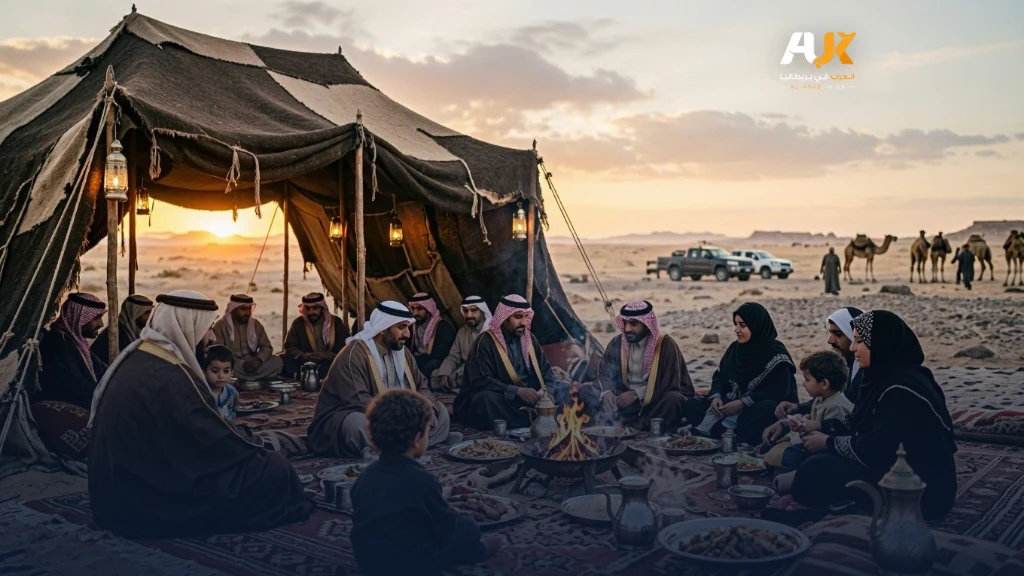
In almost any gathering of Arabs in London, Manchester or Birmingham, the question comes quickly: “Which family are you from? And where are you from?” Your English neighbour, by contrast, may not know the name of their great-great-grandfather—and may not care much about it.
Does that mean Britain has no clans or ancient families? No. Britain has real clans that are still recognised by law, as well as families nearly a thousand years old that continue to own a substantial share of the land.
The difference is that, here, the clan has evolved from a system governing people’s lives into a form of heritage, memory and social association. This report addresses five questions: Who are these clans? Where do they live? Why did they weaken in the West? Why have they remained strong in our societies? And what does this mean for us as Arabs in Britain?
Does Britain Still Have Clans?
Yes. The clearest example is Scotland’s clans. The word “clan” comes from Gaelic and means “children” or “offspring”—roughly equivalent to the Arabic expression “the children of so-and-so”. Scottish law still recognises clans and their chiefs, with recognition handled through the Court of the Lord Lyon, which deals with genealogy and heraldry (Wikipedia, Clan Carruthers).
Today, clan chiefs have an official body known as the Standing Council of Scottish Chiefs. Founded in 1951, it includes 135 clan chiefs (official website). In July 2026, the council issued a statement denying any connection with a political movement calling itself “Unite the Clans” (council statement).
Some of Scotland’s best-known clans and their historic seats:
| Clan | Region | Historic seat |
| Campbell | Argyll, western Scotland | Inveraray Castle |
| MacDonald | Western Isles, Skye and Islay | Armadale, Isle of Skye |
| MacLeod | Isle of Skye | Dunvegan Castle |
| Fraser | Around Inverness | Beauly area |
| Mackenzie | Ross, northern Highlands | Ross and Cromarty |
| Cameron | Lochaber | Achnacarry |
| Stewart | Central Scotland | Former royal family of Scotland |
Note: The names of these clans remain rooted in the landscape, but most of their members now live in cities or have emigrated to Canada, the United States and Australia. The council therefore works with clan societies in those countries (official website).
How was the Scottish clan system broken? By force. After the clans were defeated at the Battle of Culloden near Inverness on 16 April 1746, Parliament passed laws intended to dismantle the clan system. Carrying weapons and wearing Highland dress were prohibited, while chiefs lost their judicial and military authority over their followers (UK Parliament). Chiefs were left with the right to collect rents, turning them into “landowners”. The Highland Clearances followed, displacing thousands of families (Who Do You Think You Are?).
Who Are England’s “Great Families”?
England has no clans in the Scottish sense, but it does have ancient aristocratic families. Their power rests not on numbers or blood ties, but on land and titles. Many trace their origins to the Norman Conquest of 1066, when William the Conqueror declared all English land to belong to the Crown and then distributed it among his followers (IEMA).
Some of England’s best-known aristocratic families:
| Family | Title | Region and seat |
| Howard | Duke of Norfolk | Arundel Castle, West Sussex |
| Percy | Duke of Northumberland | Alnwick Castle, north-east England |
| Cavendish | Duke of Devonshire | Chatsworth House, Derbyshire |
| Grosvenor | Duke of Westminster | Mayfair and Belgravia, London; Eaton Hall, Cheshire |
| Cecil | Marquess of Salisbury | Hatfield House, Hertfordshire |
| Spencer | Earl Spencer | Althorp, Northamptonshire (the family of Princess Diana) |
A striking figure: According to Who Owns England?, a 2019 book by researcher Guy Shrubsole, around 25,000 landowners—less than 1% of the population—own close to half of England’s land. The aristocracy and the old rural elite alone own around 30%, while ordinary homeowners own only about 5% (Love Money; IEMA).
What has kept land in their hands? The rule of primogeniture: the eldest son inherits the entire estate, rather than the land being divided among siblings as often happens in our societies (RIBA Journal). The result is that the land remains intact, but the extended family does not. Younger sons leave to build lives of their own.
Why Did the Clan Disappear in the West?
One of the best-known recent studies on this subject was published in the journal Science in 2019 under the title “The Church, Intensive Kinship, and Global Psychological Variation”, by Jonathan Schulz, Joseph Henrich and colleagues (Harvard University). Henrich expanded on the idea in his influential 2020 book, The WEIRDest People in the World.
In brief, the argument is that the Western Church in the Middle Ages prohibited marriages between relatives, including cousins, and banned polygamy. People increasingly married outside their extended families, and clan structures gradually fragmented into smaller households.
What did the study find?
- The researchers developed an “intensive kinship” index that measures cousin marriage, polygamy and co-residence in extended families together (Arnold Kling’s blog).
- Every additional 500 years under the Western Church was associated with an approximately 91% decline in cousin marriage (same source).
- As cousin marriage declined, individualism increased, conformity to the group decreased, and trust in strangers grew (Yale HRAF).
Other factors also played a role:
- A strong state: Once courts and police protected individuals, people no longer needed clans to defend them or avenge wrongs. Scotland after 1746 is a clear example.
- Inheritance law: Primogeniture kept land in the hands of one son and pushed other children towards cities, the military and commerce.
- Industrialisation and urbanisation: People moved to factories and increasingly earned wages rather than relying on family land.
- The welfare state: Pensions, insurance and public healthcare replaced some of the support traditionally provided by extended families.
A necessary counterpoint: Some researchers argue that Henrich overstates the Church’s role. They contend that Europeans were already reluctant to marry relatives before the Church intervened, and that factors such as primogeniture, commercial cities and the Industrial Revolution had a greater impact (Mankind; Arnold Kling).
Why Has the Clan Survived in the East? And Has It Really Died in the West?
In the East, the clan has survived because it still serves practical purposes. Where the state is weak or absent, the family can provide protection, employment, loans, mediation and reconciliation. Marriage between relatives has also remained socially accepted, and Islam does not prohibit it, helping kinship ties remain strong (Arnold Kling’s blog). In a later 2022 study, Schulz added that strong kinship networks can weaken participatory institutions; some commentators link this to the difficulties of state-building in Iraq, Libya and Yemen (The Times of Israel).
This does not mean that clans are inherently “backward”. They preserve genuine values in our societies: mutual support, family ties, genealogy and collective memory. In the Palestinian context in particular, families have preserved the names of depopulated villages from one generation to the next.
In the West, meanwhile, the family has not died out—it has become less visible. A 2013 study by economists Gregory Clark and Neil Cummins of the London School of Economics traced rare surnames dating back to the Norman period, including Darcy, Mandeville and Montgomery. It found that these names remained disproportionately represented at Oxford and Cambridge and in elite professions such as medicine, law and politics (Cherwell; CNBC).
The surprising conclusion is that social mobility in England today is not much better than it was before the Industrial Revolution, despite free education and universal voting rights (CNBC). Clark brought his findings together in The Son Also Rises, published by Princeton University Press in 2014 (Cambridge Core). His “biological” interpretation of these findings remains highly contested among researchers (same source).
In other words, in the East, families protect their members through collective solidarity and kinship networks. In the West, elites protect their own through land, private schools and prestigious universities—quietly, without calling themselves a “clan”.
What Does This Mean for Arabs in London and Across Britain?
We live between two models: a family-centred model that offers warmth, belonging and support, and a Western model that gives individuals freedom and independence, backed by institutions that protect them without the need for personal connections.
The challenge is not to choose one over the other, but to take the best from both:
- From family: maintaining family ties, mutual support, preserving genealogy and collective memory, and teaching children the names of their ancestral villages and towns.
- From the British experience: trust in institutions and the law, and participation in civic associations and organisations that serve everyone, not just one family.
- The most important lesson from England’s old families is that lasting power comes from land, education and institutions that endure for generations. This is what our community needs: to build institutions that will outlive us.
Do you still know the names of your ancestors as far back as your fifth generation? And do your children, born in Britain, know them?
ShortURL ⬇