

The Age of Great Retreats – Why Is Starmer Returning to Old Questions?
The Age of Great Retreats – Why Is Starmer Returning to Old Questions?
Only weeks ago, Keir Starmer was talking about rearming Britain for a more dangerous world.
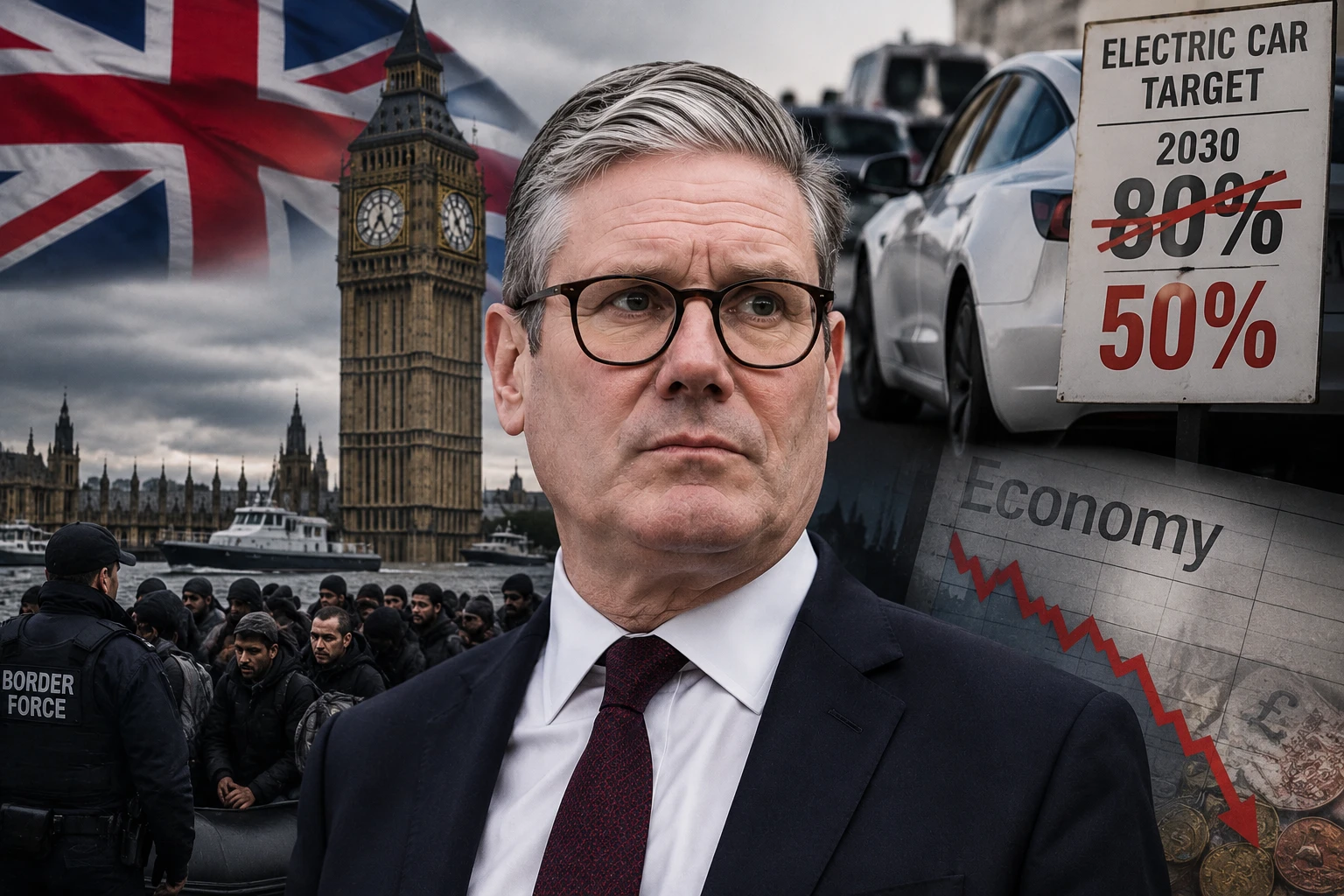
Today, he is retreating from electric vehicle targets that until recently formed part of one of his government’s most ambitious projects: reducing emissions and steering the economy towards a greener future.
But climate policy is not what is keeping anxious voters awake at night.
The economy is.
Even before the row over defence spending that culminated in the resignation of Defence Secretary John Healey had subsided, immigration returned to dominate public debate. Calls for tighter borders, faster deportations of failed asylum seekers and greater resistance to new arrivals once again moved to the centre of British politics.
On the surface, these appear to be unrelated issues.
Yet what connects them may matter more than their individual details.
The prime minister who entered office promising to lead Britain into the future increasingly finds himself pulled back towards the demands of the present.
Security.
Borders.
The cost of living.
And the politics of survival.
Perhaps this is not merely Starmer’s crisis.
Perhaps it is a sign that Britain has entered an age of great retreats.
When Priorities Collide

It is tempting to interpret these reversals as evidence of political weakness or governmental drift.
But the problem may run deeper than that.
Western democracies increasingly promise voters a set of goals that have become difficult to achieve simultaneously.
Britain wants a stronger military in a more dangerous world, but it does not want higher taxes.
It wants to accelerate the green transition, but it does not want consumers or businesses to shoulder additional costs. The average electric vehicle still costs around 30 to 40 per cent more than its conventional equivalent — a gap difficult to ignore for voters scrutinising every pound leaving their pockets.
It wants tougher borders, but without undermining an economy that depends heavily, in many sectors, on migrant labour. Within the NHS alone, foreign nationals account for around 21 per cent of the workforce, making any broad tightening of immigration policy far more complicated than political slogans often suggest.
It wants to preserve the welfare state without reducing spending or compromising public services, even as the NHS alone faces funding pressures estimated at around £3bn.
Each of these ambitions appears reasonable in isolation.
Pursuing all of them at once has become increasingly difficult.
That is why Starmer’s recent manoeuvres look less like a series of tactical retreats and more like symptoms of a broader dilemma.
When preserving every priority becomes impossible, governing turns into an exercise in painful trade-offs between competing demands.
The programmes crafted in the optimism of opposition are often reshaped by the harsher realities of power.
The First Certainty to Fall

Perhaps no example illustrates this better than electric vehicles.
Until recently, the green transition was presented as a historical necessity — part of an irreversible march towards a more sustainable economy.
Yet Starmer’s decision to reduce the target for electric vehicles from 80 per cent of new car sales by 2030 to 50 per cent signals that even the most ambitious commitments have become negotiable.
Slowing demand, high prices and growing concern about the costs imposed on consumers and manufacturers have transformed supposedly fixed destinations into political choices.
Companies such as Ford and Stellantis have warned that accelerating deadlines too aggressively could damage the industry and threaten jobs.
Not because climate change has disappeared.
Not because the case for net zero has lost its legitimacy.
But because voters facing immediate economic pressures want answers to today’s problems before embracing sacrifices for generations yet to come.
The question is no longer simply what should be done in the long term.
It is what can be afforded now.
In an age of economic anxiety, even the future becomes negotiable.
The Age of Great Retreats

Starmer may succeed in stabilising his government through these revisions.
His critics may cite each step backwards as evidence of weakness, using every concession to chip away at what remains of his political authority.
But the real story may lie elsewhere.
Britain is not merely retreating from individual policies.
It is reordering its priorities.
Each time politics attempts to focus on the grand questions of the future, the demands of the present force their way back onto the agenda: security, the economy, immigration and the cost of living.
Perhaps this is the defining paradox of Keir Starmer’s premiership so far.
The man who arrived promising to manage the future increasingly finds himself managing retreat from it.
Not necessarily because he lacks ambition.
But because the age of big aspirations appears to be colliding with an age of great retreats.
Read more:
ShortURL ⬇