

Report: Britons are paying more in tax. Why don’t public services feel better?
Report: Britons are paying more in tax. Why don’t public services feel better?
Britons are paying more in tax than they did a few years ago. The government, in turn, is spending more.
Yet for many people, everyday experience does not feel as though it reflects that extra money.
The NHS waiting list in England still contains millions of cases. Local councils continue to warn of severe financial pressures. Council tax bills have risen across much of the country, while many of the services residents see around them remain stretched.
It creates an obvious question: if the state is taking more money, where is it going — and why do public services not seem to be improving at the same rate?
The answer is not simply that the money has disappeared, or that government spending has been cut.
Britain has become a country that taxes more and spends more, while also carrying much larger and more expensive obligations.
Britain’s tax burden is heading towards a historic high 
The scale of the shift can be seen in forecasts from the Office for Budget Responsibility.
In 2019-20, taxes amounted to around 32.9 per cent of GDP. The OBR expects that figure to reach 38.3 per cent by 2030-31, a historically high level for the UK.
The increase does not come from a single tax.
Income tax, National Insurance, corporation tax, taxes on capital and other revenues are together taking a larger share of the economy.
Frozen income tax thresholds also mean that as wages rise, more people can be pulled into higher tax bands even when the headline tax rates themselves do not change.
It is therefore understandable that households feel they are handing a larger share of their income to the state.
But tax is only half of the story.
The government is spending more too
If taxes are rising while services remain under pressure, it might be tempting to conclude that the government simply is not spending the additional money.
The figures tell a more complicated story.
The OBR expects public sector receipts to reach around £1.235 trillion in 2025-26, equivalent to roughly £43,000 per household. Public spending, meanwhile, is expected to be about £1.368 trillion, or close to £48,000 per household.
In other words, the state is not merely spending the money it raises. It is still spending more than it receives and borrowing to cover the difference.
Public spending as a share of the economy is also higher than it was before the pandemic.
So the more useful question is not: why isn’t the government spending the extra tax revenue?
It is: what has become so expensive?
Billions that never become a hospital bed or a classroom
One major change has taken place largely out of public view: the cost of servicing government debt.
The OBR expects debt interest spending to be around £110 billion in 2025-26, rising to approximately £137 billion by 2030-31.
Debt interest spending is currently around twice its average share of the economy during the decade before the pandemic.
This is real public spending, but it does not produce another doctor, teacher or repaired road.
The government accumulated substantial debts over many years, and when interest rates or inflation rise, servicing parts of that debt becomes more expensive.
This explains one part of the apparent contradiction: higher government spending does not necessarily mean more money reaching the public as visibly better services.
The NHS gets more money — but demand keeps rising
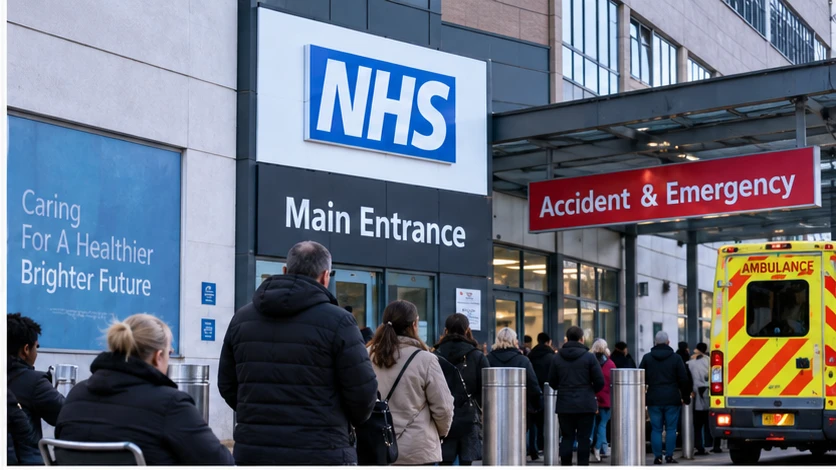
Healthcare shows why a larger budget does not automatically translate into a noticeably better experience.
The Department of Health and Social Care is now the biggest public service spending department. Its planned day-to-day budget for 2025-26 was around £202 billion, including approximately £193 billion for the NHS in England.
Yet the latest figures from NHS England showed the waiting list at around 7.3 million cases in July.
That does not mean additional NHS spending has achieved nothing.
The same month saw record activity in some areas. More than 308,000 people were seen following an urgent suspected cancer referral, while all three main cancer waiting-time measures improved.
The difficulty is that the health service is trying to increase what it delivers while dealing with enormous and growing demand.
A service can therefore treat more patients and become more productive in some areas while still maintaining a waiting list large enough for many patients to feel that little has improved.
Britain’s population is changing — and so are its needs
There is another pressure that is less visible in debates about tax.
As the population ages, spending pressures increase across healthcare, social care and the State Pension.
More people are also living with chronic conditions that require longer-term and more complex health and care services.
At the same time, some benefits and the State Pension rise in line with prices or earnings.
This means that part of additional public spending is not necessarily buying a better service for each individual. It is meeting greater needs, supporting more expensive provision and maintaining existing commitments.
Sometimes the government has to spend more simply to prevent a service from getting worse.
Council tax exposes the problem even more clearly
The contradiction can feel particularly sharp at local level.
A household may receive a larger council tax bill without seeing cleaner streets, better roads, longer library opening hours or noticeably improved neighbourhood services.
One reason is that an increasing share of council resources is being absorbed by expensive statutory services.
OBR figures show that housing and social care for children and adults together now account for around 30 per cent of English local authorities’ service spending, compared with about 20 per cent in 2015-16.
Councils also face rising bills for temporary accommodation for homeless families, transport for children with special educational needs, staff costs and care provision.
These services can be essential for the people who depend on them, but much of that spending is largely invisible to most council taxpayers.
Residents can therefore pay more while simultaneously seeing pressure on the services they encounter most often, from parks and libraries to street cleaning and road maintenance.
Today’s spending is also repairing yesterday’s damage
Recent increases in spending follow a decade in which many services faced substantial cuts.
The Institute for Fiscal Studies has found that although funding for English councils has increased in real terms since 2019-20, funding per resident has remained well below its 2010-11 level.
That distinction matters.
The government is not starting with a fully functioning network of public services and simply adding new money on top.
In some areas, additional spending is being used to deal with backlogs, ageing infrastructure, capacity shortages and pressures accumulated over years.
Billions can therefore be spent before residents see anything that feels like a new improvement.
Inflation eats into the extra money
There is also a major difference between a budget becoming larger on paper and what that budget can actually buy.
Higher wages, energy bills, medicines, food, construction costs and contracts all make public services more expensive to provide.
Official public finance data show that higher government spending on goods and services has partly reflected rising pay and operating costs.
The problem can be particularly acute for councils, where the cost of social care, temporary accommodation or special educational needs transport can rise much faster than general inflation.
An extra £1 billion today therefore does not necessarily buy the same amount of public service that £1 billion would have bought five years ago.
Taxes do not go into a single pot marked ‘public services’
There is another misconception worth addressing.
An additional pound paid in income tax does not travel directly to a hospital or school.
Most government revenue enters the wider public finances, from which the state pays for public services, benefits, pensions, investment, debt interest and a long list of other commitments.
In 2025-26, the OBR expects the government to spend around £133 billion more than it receives.
So the higher tax burden has not created a vast surplus that ministers have simply chosen not to spend on services.
The state is still borrowing despite historically high taxation.
Are Britons paying more for worse services?
There is no single answer that applies to every public service.
Some performance measures are improving. Some services are receiving substantially more funding. Others remain weaker than they were years ago.
But the broader picture helps explain the contradiction many households experience.
Taxes have risen, and spending has risen too. But so have the cost of government and the demands placed upon it.
More money is being absorbed by debt interest, healthcare, social care, pensions and increasingly expensive statutory services. Inflation has eroded some of the purchasing power of departmental budgets, while parts of the public sector are still dealing with problems accumulated over many years.
That leaves Britain facing a harder question than the familiar argument over whether taxes should rise or public spending should increase.
If the state is already taking a historically large share of national income in tax, while also spending a high share of it, the challenge is increasingly about how effectively each additional pound can be turned into a public service that people can actually see and feel improving.
Read more:
ShortURL ⬇