

Report: The Economy Is Improving, but the Treasury Is Falling Behind – How Should We Read Burnham’s Economic Dilemma?
Report: The Economy Is Improving, but the Treasury Is Falling Behind – How Should We Read Burnham’s Economic Dilemma?
A run of economic data released on Friday 21 August presented what, at first glance, looks like a contradictory picture of the British economy.
Businesses, particularly in the services sector, are reporting stronger-than-expected activity. Consumer confidence has risen to its highest level in two years. Yet retail sales fell in July, while the public finances unexpectedly slipped into deficit despite stronger tax receipts.
The figures are not necessarily in conflict.
Some measure what happened in July, while others capture conditions facing businesses and consumers in August. Nor does stronger economic activity automatically feed through, at the same pace, into government finances or household spending.
With Chancellor John Healey’s first Budget approaching in the autumn, Friday’s data offers one of the clearest pictures yet of the economy inherited by Andy Burnham’s government: growth is holding up better than many expected only weeks ago, but it remains accompanied by pressure on public spending, prices and household finances.
Services Sector Surprises on the Upside
The strongest positive signal came from S&P Global’s preliminary purchasing managers’ index.
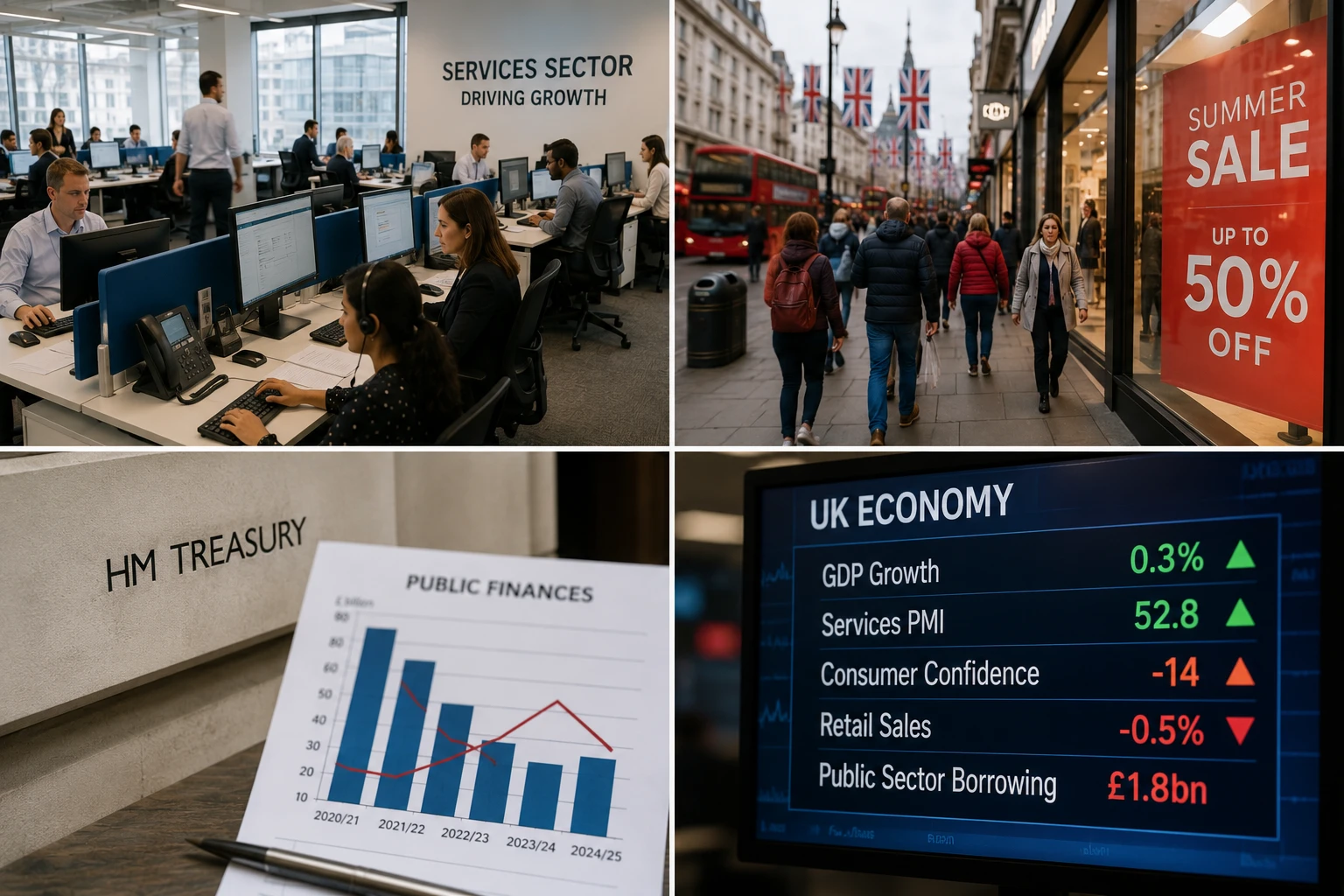
The services activity index rose from 52.1 in July to 52.8 in August, its highest level in six months, despite a Reuters poll of economists pointing to a fall to 51.8.
A reading above 50 indicates that a majority of firms surveyed are reporting an expansion in activity compared with the previous month, while a reading below 50 signals contraction.
The composite index, combining services and manufacturing, rose from 52.2 to 52.5, its highest in four months. Manufacturing, meanwhile, slowed slightly, with its index slipping from 51.9 in July to 51.5 in August.
Chris Williamson, chief business economist at S&P Global Market Intelligence, said growth had been supported by sunny weather and investment in technology, while the boost to manufacturing from earlier stock-building was beginning to fade.
According to S&P Global, the survey is consistent with economic growth of around 0.3% in the third quarter, close to the rate recorded in the second.
But the survey was not uniformly positive.
Employment in services continued to fall, although at the slowest pace since last October. Input costs and output prices also picked up again as energy costs rose and disruptions linked to the war in the Middle East added pressure.
At the same time, expectations among services firms for the year ahead reached their highest level in seven months.
Consumers Are Less Pessimistic – but Not Yet Optimistic

A second positive signal came from GfK’s consumer confidence index, which rose from minus 17 in July to minus 14 in August, its strongest reading since August 2024.
The number still matters in context.
A two-year high does not mean consumers have become broadly optimistic. The index remains below zero, meaning negative sentiment still outweighs positive sentiment.
But the direction has clearly improved.
The index stood at minus 25 in April and has since risen gradually, with households reporting better assessments of their own finances, the wider economy and their willingness to make major purchases.
That improvement has come despite continuing pressure from the cost of living and from energy and food prices.
The next question is whether greater confidence will translate into stronger spending over the coming months.
If Confidence Is Improving, Why Did Retail Sales Fall?
This is where one of Friday’s more interesting figures comes in.
Data from the Office for National Statistics showed that retail sales volumes fell by 0.5% in July compared with June, after the previous month had benefited from hot weather and promotional activity linked to the World Cup.
On an annual basis, sales rose by 1.6%, below economists’ expectations.
Non-food stores were the weakest area, particularly clothing and footwear retailers, after a number of businesses brought forward their summer sales into June rather than July.
But weaker retail sales do not necessarily mean all consumer spending fell.
Retail data mainly captures spending on goods in shops and online. It does not include large parts of household spending on services such as restaurants, pubs, travel and entertainment.
That means spending can shift away from shops and into services without appearing in the retail sales figures.
During the World Cup, for example, pubs and venues showing matches benefited from stronger spending, but those transactions do not appear in the retail data itself.
Martin Beck, chief economic adviser to the EY ITEM Club, therefore argued that July’s fall may simply represent a pause after a strong previous month rather than the beginning of a renewed weakening in consumption.
Then Came the Surprise From the Public Finances

The public finance figures offered the chancellor rather less comfort.
Public sector net borrowing came in at £1.8bn in July, a month in which the Treasury would usually expect to benefit from strong self-assessment income tax receipts.
Economists polled by Reuters had expected the public finances to be broadly balanced, while the Office for Budget Responsibility had forecast a surplus of around £500m.
The deficit came despite strong receipts from self-assessed taxes, with the ONS saying that higher spending outpaced revenue growth.
Central government spending on social benefits rose by around £2bn compared with July last year, while expenditure on goods and services, including staff costs, increased by about £1.2bn.
Total borrowing over the first four months of the financial year reached £56.7bn.
That was around £6bn lower than in the same period last year, but £2.3bn above the path forecast by the OBR.
This is what makes the fiscal picture more complicated than simply saying borrowing is rising.
The position is better than it was a year ago.
But it is worse than the government had planned for.
Why Doesn’t Stronger Growth Immediately Improve the Treasury’s Position?

Part of the answer is that the indicators measure different things, at different times.
The borrowing and retail sales figures released on Friday mainly relate to July.
The confidence data and business surveys, by contrast, offer a reading of conditions in August.
The PMI surveys also measure whether business activity is expanding or contracting. They do not measure how much tax the government is collecting from that activity.
Public finances depend on much more than headline growth.
They are also shaped by spending on benefits, wages and public services, debt-interest costs and inflation.
That means the economy can grow while the fiscal deficit remains high, particularly if government spending is rising as quickly as, or faster than, revenues.
June had offered almost the reverse picture, when borrowing came in slightly below the OBR’s forecast, partly because inflation-linked debt-interest costs were lower.
That too illustrates how volatile monthly public finance figures can be.
A Harder Test Ahead of the Budget
For Healey, the difficulty is that stronger growth should help government revenues over the medium term, but it does not remove the spending and borrowing pressures already in place.
After the figures were released, the chancellor said “fiscal discipline” remained the foundation of economic stability, reiterating the government’s commitment to its fiscal rules and to maintaining room to absorb global shocks.
At the same time, ministers face higher borrowing costs in bond markets and pressure to spend more on areas including defence, housing and public services.
That will make the coming Budget a test of how Burnham’s government intends to reconcile its growth agenda with the need to contain debt and the deficit.
The equation becomes harder still if energy costs continue to push up inflation.
The PMI data showed business costs rising again in August, prompting S&P Global to suggest that the Bank of England may remain cautious about changing interest rates until the direction of both growth and prices becomes clearer.
Four Numbers, Four Different Messages
Friday’s data does not offer a single verdict on the state of the economy.
A services PMI reading of 52.8 says that the sector accounting for the largest share of economic activity is expanding faster than expected.
A consumer confidence reading of minus 14 says households are less pessimistic than they have been for two years, but are not yet broadly optimistic.
A 0.5% fall in retail sales says that this improvement in mood did not translate directly into greater purchases of goods in July.
And a £1.8bn deficit says that stronger parts of the economy have not yet improved the public finances as much as the government needs.
Taken together, the figures do not describe an economy in recession.
Nor do they describe one that has fully escaped its problems.
They point instead to private-sector activity beginning to gain some strength, and consumers becoming less gloomy, while the Treasury remains under pressure and costs remain elevated.
The question over the coming months may therefore be not simply whether the economy can keep growing, but whether that growth becomes strong and durable enough to show up in household incomes, jobs and, eventually, the government’s own accounts.
Read more:
ShortURL ⬇