

Can Reform Still Call Itself Anti-Elite When Two Billionaires Fund Its Path to Power?

Can Reform Still Call Itself Anti-Elite When Two Billionaires Fund Its Path to Power?
Reform has spent years presenting itself as the insurgent in British politics: a party challenging Westminster, established institutions and a political class it says has lost touch with ordinary voters.
Now it faces an awkward question. What happens to an anti-establishment party when its route to power is increasingly financed by some of the wealthiest people in the country?
The question has become harder to avoid after Ben Delo and Christopher Harborne each donated £36 million to Reform. The £72 million received from just two individuals gives the party something it has never had before: the financial capacity to turn electoral momentum into a permanent national political machine.
For Nigel Farage, this is potentially transformative. For Reform’s opponents, however, it exposes a contradiction at the heart of the party’s populist appeal.
Reform may speak the language of an uprising against the elite. Increasingly, it has the finances of an establishment party — except that much of the money is concentrated in remarkably few hands.
From insurgency to political machine

The importance of the £72 million is not simply its size. Money can change what kind of political organisation Reform is.
The party can recruit researchers and policy specialists, employ campaign organisers, strengthen its data operation and build permanent infrastructure across constituencies rather than assembling much of its electoral operation shortly before an election.
Farage has already spoken about recruiting hundreds of staff as the party prepares for the next general election.
Zia Yusuf, Reform’s home affairs spokesman and former chairman, provided a glimpse of this ambition in a new Times interview.
His argument is essentially that Reform is becoming stronger and more professional as the pressure on it increases. He invoked Nassim Nicholas Taleb’s idea of the “antifragile”: something that does not merely survive shocks but becomes stronger because of them.
There is some substance to that claim. Money removes one of the structural disadvantages faced by insurgent parties.
Winning votes and building a government-in-waiting are very different tasks. The latter requires policy expertise, organisation, candidates, communications staff and people capable of navigating the machinery of government.
Reform can now afford many of them.
The problem with being the “people’s party”
Yet the same money that could professionalise Reform also creates a political vulnerability.
Two people have provided £72 million.
That concentration matters because Reform’s political identity is built partly on the argument that Britain is controlled by an establishment that is detached from ordinary people.
Its opponents can now turn that argument around.
If political power is too concentrated in Westminster, they can ask, why should financial power over political parties be concentrated among a handful of extremely wealthy donors?
This is not an argument that the donations are unlawful. Large political donations are permitted under British law when they come from eligible donors, and Reform insists its donors receive no political favours in return.
The more interesting question is political rather than legal.
An anti-elite party does not automatically cease to be anti-elite because wealthy people support it. Populist movements have frequently attracted rich backers. But the greater the dependence on a small number of donors becomes, the harder it is to maintain a simple distinction between an insurgent “people” and a powerful “elite”.
The numbers make that vulnerability difficult to dismiss.
Analysis based on Electoral Commission data has shown how unusually dependent Reform has become on large donations. Delo and Harborne alone accounted for a substantial share of its recorded donation income over the previous year, while the average size of Reform’s declared donations was far higher than those received by Labour or the Conservatives.
That does not prove donor influence. It does demonstrate donor concentration.
Those are not the same thing, but politically the distinction may become increasingly difficult for Reform to explain.
Can money buy the infrastructure of power?
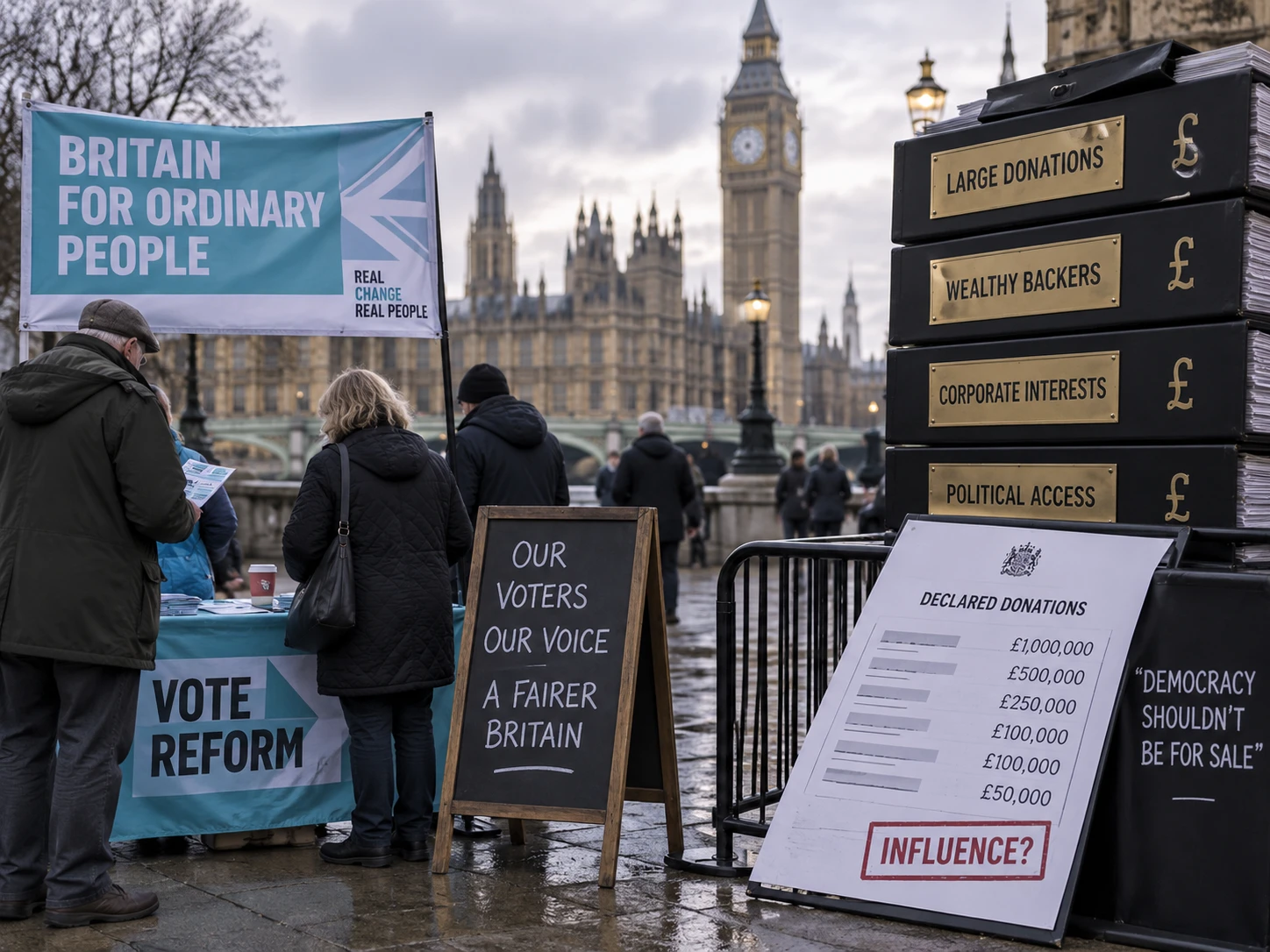
There is another reason the donations matter.
British elections have spending limits. A billionaire cannot simply give a party unlimited freedom to spend unlimited amounts during an election campaign.
But political money matters long before the formal campaign begins.
It can finance staff, research, organisation and the slow construction of a political institution capable of contesting hundreds of constituencies.
This is where Reform’s new wealth could be most consequential.
The party has already demonstrated that there is an electorate for its message. Money can now help it solve a different problem: turning support for Farage into an organisation capable of surviving beyond Farage.
That is precisely why the debate over a cap on political donations has returned.
Critics of the current system argue that no individual should be able to inject tens of millions of pounds into a political party. Proposals for an annual cap — including figures around £100,000 — have been discussed as a way of reducing the ability of a small number of wealthy individuals to dominate party financing.
Such a limit would hit Reform particularly hard. Previous analysis of donation data suggested that a £100,000 ceiling would have removed a very large proportion of the party’s recorded donation income over a recent 12-month period.
Reform has an obvious response: established parties already possess mature fundraising networks, institutional relationships and decades of accumulated political infrastructure. Imposing a cap just as a challenger acquires the resources to compete could protect the very political establishment that Reform exists to challenge.
That argument deserves to be taken seriously.
But so does the argument on the other side: democracy becomes uncomfortable when the financial difference between a political movement capable of building national infrastructure and one that cannot may depend on the decisions of two billionaires.
Reform’s new contradiction
This leaves Reform with a problem that success itself has created.
When it was primarily an insurgent movement, attacking the establishment was straightforward. The party had fewer MPs, less money and a much thinner organisation than Labour or the Conservatives.
That asymmetry helped its argument that it stood outside the political system.
The £72 million begins to change that.
Reform can now build the researchers, campaign teams and political infrastructure required of a serious contender for government. If it uses the money effectively, that could prove far more important than the headline value of the donations themselves.
But every step towards becoming an institution also makes it harder to campaign simply as an outsider fighting institutions.
And every multimillion-pound donation makes the language of ordinary people versus powerful elites more complicated.
That does not mean Reform’s populist appeal will collapse. Voters who support its positions on immigration, taxation or the political establishment are unlikely to abandon those views merely because wealthy donors also support the party.
The deeper question is whether Reform can complete the transition from protest movement to potential party of government without changing the political identity that made that transition possible.
For years, Farage’s strongest argument was that Reform stood outside Britain’s political establishment.
With £72 million from two billionaires helping to finance its path towards Downing Street, the more interesting question may soon be: where exactly does the establishment end?
Read more:
ShortURL ⬇