

Analysis: Britain is expanding its military role against Russia. Can it afford the deterrence?
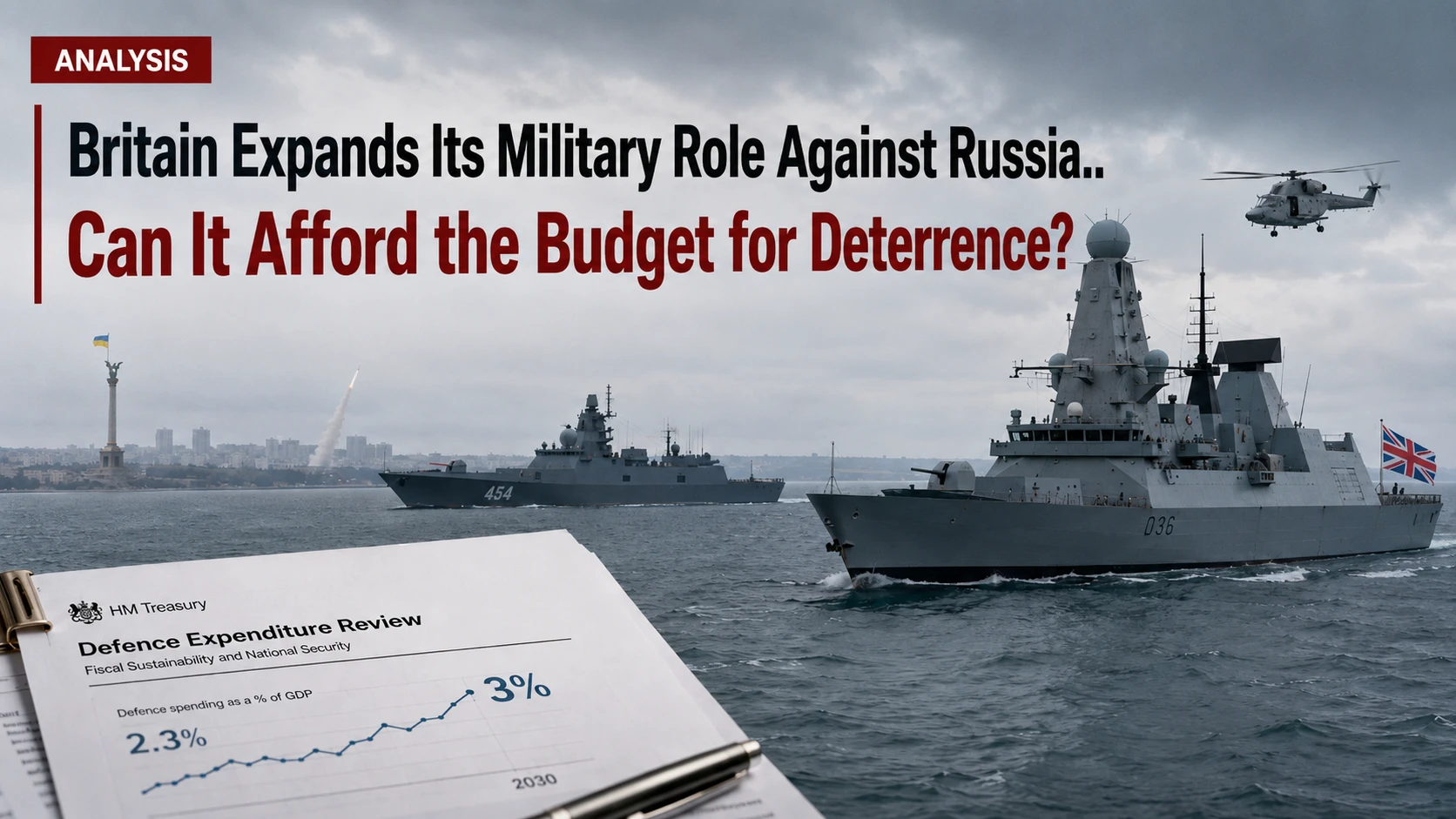
Analysis: Britain is expanding its military role against Russia. Can it afford the deterrence?
Within the space of a few days, tensions between Britain and Russia have risen sharply.
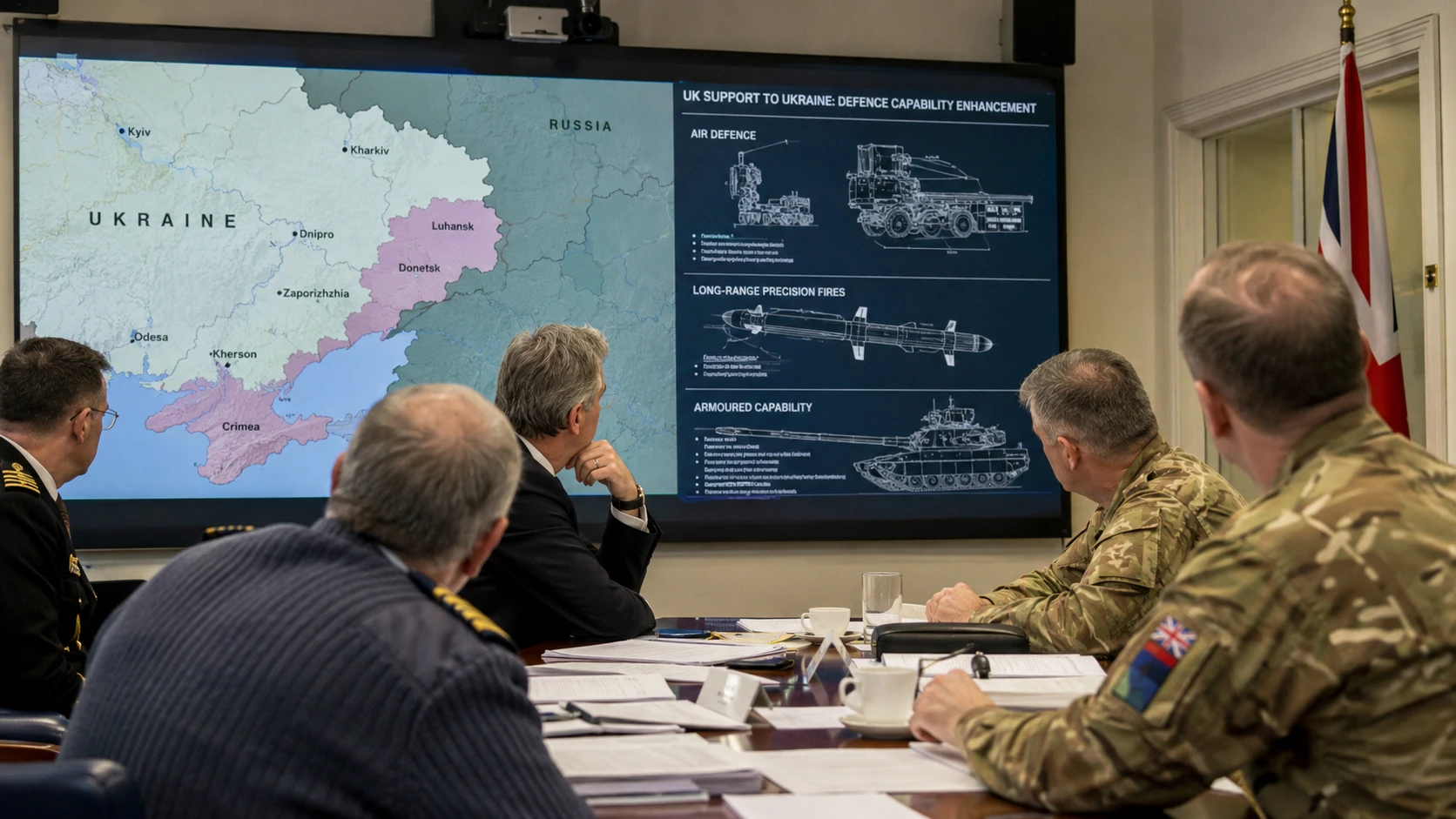
Prime Minister Andy Burnham chose Kyiv for his first overseas visit since entering Downing Street, where he announced that MBDA would be allowed to share classified British information on components used in long-range SCALP missiles, helping establish missile assembly lines in Ukraine. Moscow, in turn, escalated its threats, warning that British military facilities and equipment inside and outside Ukraine could become targets.
At the same time, the Royal Navy completed a 72-hour operation monitoring Russian warships and sanctioned vessels passing through the North Sea and English Channel. The Navy said call-outs to monitor Russian activity had risen by around 25 per cent in the first eight months of this year compared with the same period in 2025.
At Arab in UK, we have already examined the direct Russian threat to Britain and the scenarios that could follow any escalation between Moscow and London.
But there is another question on the British side of the equation.
Taken together, these moves suggest a country that wants to remain at the forefront of Europe’s confrontation with Russia, while increasing both its support for Ukraine and its capacity to deter Moscow.
Yet in the same week, a very different signal came from the Treasury.
October’s Budget is now expected to contain no timetable for raising defence spending to 3 per cent of GDP, even though Chancellor John Healey had previously been among the strongest advocates of reaching that level more quickly while serving as defence secretary, calling for the target to be met by 2030.
Healey even resigned as defence secretary amid a dispute over what he regarded as the government’s failure to provide the spending needed to achieve that goal. After moving to the Treasury, however, he has become more cautious about the very timetable he once wanted accelerated.
The contrast captures part of Britain’s dilemma: what appears to be an urgent military necessity from inside the Ministry of Defence becomes, from the Treasury, a commitment worth billions of pounds for which funding must be found.
Is Britain expanding the military role it has chosen for itself faster than its ability to pay for it?
The political will is clear. Deterrence requires more than will
There is little ambiguity about Britain’s political intent towards Russia.
London is arming Kyiv, helping develop its long-range capabilities, monitoring Russian naval movements close to British waters and seeking to weaken Moscow’s shadow fleet. Britain’s Defence Investment Plan speaks explicitly of moving towards “warfighting readiness”, rebuilding ammunition stocks and expanding the use of drones, autonomous systems and long-range weapons.
But deterrence does not depend only on convincing an adversary that a country is willing to use force. It also requires convincing them that the country possesses that force, can replace its losses, rearm and sustain a confrontation if it lasts.
Sustainable deterrence requires stockpiles, spare parts, launch platforms, air defences, trained personnel, protected bases and an industrial base capable of producing replacements. The war in Ukraine has demonstrated how rapidly a major conflict can consume ammunition and equipment compared with the limited operations for which many Western militaries had become accustomed to preparing.
Money, therefore, is part of the credibility of deterrence, not simply a figure debated by the Chancellor.
The problem is bigger than the 3 per cent target
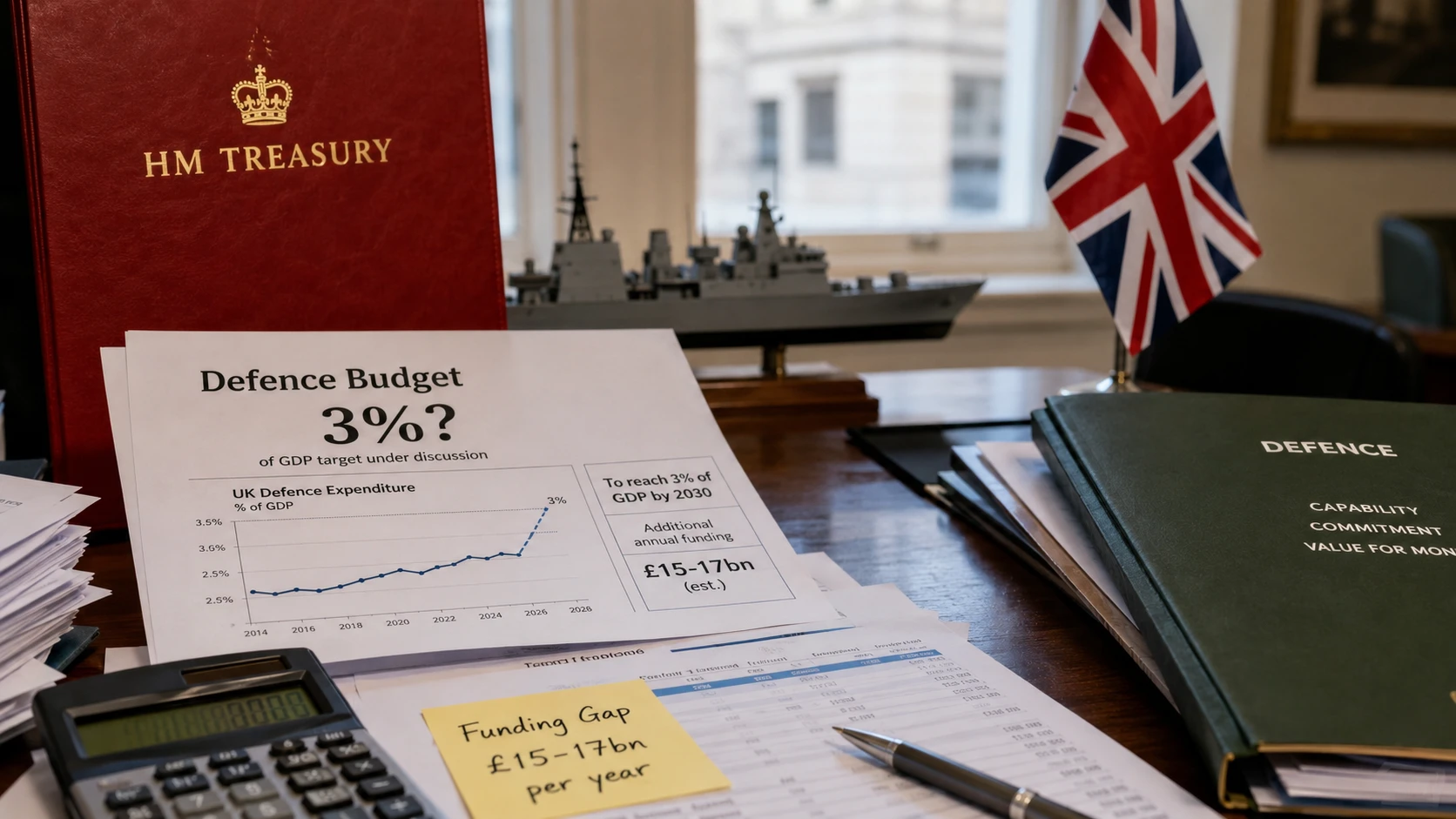
It would nevertheless be a mistake to reduce British military strength to a single question: whether the government reaches defence spending of 3 per cent of GDP.
Three per cent is not a magic figure that makes an army stronger the moment it is reached.
The government already has a substantial programme to rebuild military capacity. Its Defence Investment Plan includes £298bn of investment over four years, while core defence spending under NATO’s definition is expected to reach 2.7 per cent of GDP from 2027-28, with a commitment to reach 3.5 per cent by 2035.
This is not, in other words, a government disarming Britain.
The difficulty is that the state is asking its armed forces to prepare for a more dangerous security environment and wants Britain to assume a larger European role, while postponing decisions about the financial path towards the level of capability it says that environment requires.
Even the existing plan contains a bill that has yet to be fully settled. In June, the government announced an additional £15bn for the Defence Investment Plan through to 2029-30, but its own documents show that £4.7bn still needs to be funded through the 2026 Budget.
The gap between ambition and the speed at which resources are being provided therefore exists even before the larger argument over 3 per cent begins.
A harder line on Russia is not only a foreign-policy choice
Money, however, is not the only political dimension of this confrontation.
The Russian threat to Britain and Europe is real, but the present conflict did not emerge from a strategic vacuum. Russia made the decision to launch its full-scale invasion of Ukraine in February 2022 after years of deterioration in the European security order, NATO’s eastward enlargement and the alliance’s declaration at its 2008 Bucharest summit that Ukraine and Georgia “will become members of NATO”, despite repeated Russian objections and Moscow’s insistence that the alliance’s movement towards its borders threatened its security.
Russian perceptions of Western intentions may have been exaggerated, and they have been used to justify policies that go far beyond defensive security concerns. But those concerns were openly expressed and well known in Western capitals for years before the war.
It is therefore possible to hold Moscow responsible for the decision to invade without reducing the entire road to war to the responsibility of one side. Equally, the degree of escalation Britain chooses today can be understood as a political choice rather than an automatic response for which no alternative exists.
That is where domestic politics enters the equation.
In a country facing weak economic performance, strained public services and declining confidence in governments’ ability to improve everyday life, national security can provide a different source of political legitimacy. If it is difficult to convince voters that they are becoming more prosperous, a government can still present itself as the authority capable of protecting them in a more dangerous world.
British political rhetoric itself connects the two. In a speech in Kyiv, former prime minister Keir Starmer linked Russia’s actions directly to the security of British people and to the cost of living.
External crises have also affected public priorities. In March, the proportion of Britons who regarded defence and foreign affairs as among the most important issues facing the country doubled from 15 to 31 per cent in a single month. By June, 47 per cent said they wanted defence spending increased, up ten percentage points in a month.
None of this means the government needs to invent a Russian threat. The threat exists.
But putting security, danger and military readiness at the centre of public debate changes some of the criteria by which a government is judged. Growth, taxation and public services are joined by leadership, resolve and the ability to protect the country.
Burnham chose his tone
Andy Burnham’s first steps in foreign policy matter in this context.
His visit to Kyiv was not simply a signal of continuity in Britain’s support for Ukraine. It came with a significant military announcement designed to expand Ukraine’s missile capabilities, while Burnham chose language emphasising resolve rather than any attempt to lower the temperature.
The government presented the visit under the headline “Britain is 100% behind you”. Burnham compared Ukraine’s resistance to Russia with Britain’s role in defending European freedom during the Second World War. He later condemned what he called Russia’s “outrageous threats” against Britain, insisting that London would not retreat from its support for Kyiv.
Burnham has denied deliberately escalating the confrontation and presented his stance as a continuation of established British policy.
But a new government had room to establish its own tone, combining continued military assistance to Kyiv with greater emphasis on a political track or on managing escalation. Instead, its opening message stressed deterrence and resolve.
That does not prove the government is seeking escalation for domestic political gain. It does, however, show that the degree of confrontation is not mechanically determined by the Russian threat alone. The level of involvement, the weapons supplied, the language used and the diplomatic channels kept open are all political choices.
When threat becomes a source of legitimacy
External confrontation does more than provide a justification for military spending. It can also help governments construct a broader story about the purpose and authority of the state.
This is not a uniquely British phenomenon. Political science has long examined the “rally around the flag” effect, in which foreign crises can temporarily encourage sections of the public to rally behind national leadership.
That does not mean governments facing domestic difficulties necessarily manufacture foreign crises.
In Britain’s case, a more precise argument is that the Russian threat is performing two functions at once: it is a genuine security challenge that must be addressed, but it also provides a political framework through which governments can speak about leadership, unity and national preparedness.
That may create another consequence. The more toughness towards Moscow becomes associated with strong leadership, the greater the domestic political cost of de-escalation may become, even if diplomatic circumstances later make it possible.
A government that has built part of its political narrative around the idea that Russia requires ever greater resolve may have to explain any later shift towards less confrontational language.
Domestic politics can, in that sense, begin to narrow the room for manoeuvre in foreign policy rather than expand it.
Even the war that does not happen has a price
The cost of confrontation is not confined to an actual war.
The recent naval operation, although no shots were fired, required HMS Duncan, HMS St Albans, HMS Severn and a Merlin helicopter, while HMS Mersey tracked the Russian support vessel Akademik Pashin.
British ships and helicopters had already spent 21 days in July monitoring Russian activity in UK waters and the North Atlantic.
This is what deterrence looks like on most days. A ship shadowing a Russian vessel still requires crew, maintenance, fuel and training even when a war never begins.
As such missions become more frequent, “readiness” ceases to be a political slogan and becomes a capability that must be funded and sustained.
The public wants security — but not an open-ended bill
Britons have become more willing to support higher defence spending, but that support weakens when the real trade-offs become visible.
In an Ipsos poll conducted in May, 45 per cent opposed increasing military spending if it meant cuts to public services, while 50 per cent opposed funding it through higher personal taxes.
Support was considerably stronger when military investment brought civilian benefits: 73 per cent backed higher spending if it created jobs and apprenticeships, while 61 per cent supported investment that also strengthened vital civilian infrastructure.
Threat can therefore increase public demand for security, but it does not abolish economics.
A pound spent on defence comes from the same public finances that pay for hospitals, schools, transport and housing. The government consequently finds itself caught between two pressures: an external threat that makes military spending easier to justify, and domestic economic strain that makes the bill harder to pay.
Between the legitimacy of security and the cost of security
So far, the Burnham government has chosen to emphasise resolve towards Moscow and to expand Britain’s role in supporting Ukraine.
That does not mean Russia is not a threat, nor that de-escalation is necessarily the correct policy. It means that confrontation with Moscow is not simply an automatic response to an external danger. It is also a political choice with domestic functions and domestic costs.
That creates the circle the government now faces. Domestic difficulties make national security an attractive arena in which to project leadership and political agency. The Russian threat makes a larger military role easier to justify. But that larger role requires billions of pounds in additional resources, pushing the pressure back on to the Budget, public services and taxation.
Security can provide a government with a source of legitimacy. It cannot provide the money needed to finance it.
The credibility of British policy will therefore not be measured by the number of hard-line speeches delivered or the severity of threats exchanged. It will be measured by Britain’s ability to finance the force it says it requires, maintain public support once the bill becomes visible, and preserve enough political space for de-escalation if circumstances allow it, rather than allowing toughness to become an end in itself.
Sustainable deterrence requires something harder than rhetoric: resources that can be maintained, objectives that can be paid for, and a policy that knows when escalation is necessary — and when the ability to reduce it becomes part of security itself.
Read more:
- The Russian Threat to Britain: Where Are the Military Bases Located, and How High Is the Risk of Being Targeted?
- Analysis: Fewer Jobs for More Security? The Hidden Cost of Britain Rearmament Plan
- Analysis: Is Washington Choosing Britain Chancellor? Why the Trump Administration Is Weighing In on the Next UK Government
ShortURL ⬇