

Analysis: The Battle Over Henry Novak Was Never Just About Henry Novak
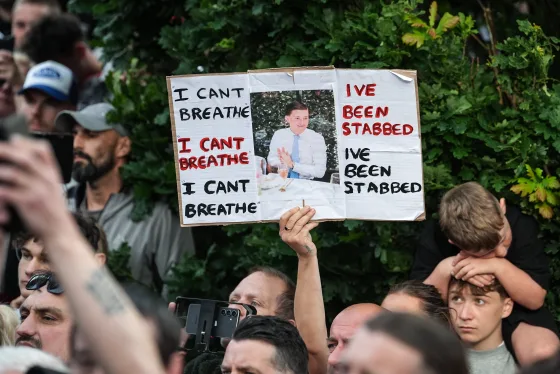
Analysis: The Battle Over Henry Novak Was Never Just About Henry Novak
Britons did not divide over what should happen after the death of Henry Novak.
They had divided long before that — over what the incident meant in the first place.
Within hours of details emerging about the case, the debate had moved far beyond the actions of the police officers who restrained a young man as he lay critically injured after a stabbing. What followed was a much broader confrontation, one that quickly drew in politicians, commentators, activists and campaigners, each interpreting the incident through their own political lens.
Some saw the case as further evidence of deep-rooted problems within British policing. Others saw precisely the opposite, arguing that it exposed the consequences of diversity policies and race-awareness training within public institutions — particularly after the perpetrator, Vickrum Digwa, falsely claimed he had been the victim of a racist attack by the white teenager, a claim that significantly shaped the initial police response at the scene.
That is what makes the Henry Novak case significant.
What it reveals is not simply a dispute about policing, racism or party politics. It points to something deeper: the growing difficulty of maintaining a shared understanding of public events in an increasingly polarised society.
From Disagreement Over Solutions to Disagreement Over Reality

In many public controversies, political disagreement traditionally centred on how a problem should be addressed.
Increasingly, however, the disagreement begins much earlier.
In cases such as this one, people are often divided not over solutions but over the nature of the problem itself.
Before all the facts have emerged, incidents enter the political arena and become the subject of competing narratives about what happened, why it happened, and what it ultimately means.
When a controversy involves policing, some interpret it as evidence of institutional bias. When it concerns ethnic minorities, others see proof of reverse discrimination. If protests or unrest follow, one side speaks of grievances while another focuses on law and order.
The competing narratives become almost as important as the event itself.
In some cases, they become more important.
When a Tragedy Becomes a Political Weapon

Part of what gave the Henry Novak case such momentum was not simply the incident itself, but the political environment into which it emerged.
The controversy unfolded at a time when Reform UK continues to gain support through a political message built around scepticism towards traditional institutions — from mainstream political parties to the police and the media — while linking those concerns to wider debates about immigration, national identity and multiculturalism.
Against that backdrop, it was perhaps inevitable that the case would become part of a larger political argument.
For Nigel Farage and many of his supporters, the incident became further evidence of what they see as institutions increasingly influenced by identity politics and cultural considerations rather than consistent standards of justice and accountability.
The debate quickly expanded beyond policing and into broader questions about immigration, cultural diversity and British identity — issues that have formed the core of Reform UK’s political appeal in recent years.
Critics of Farage, however, saw something different.
They argued that the case was being used to inflame racial tensions, deepen social divisions and transform an individual tragedy into a political platform.
At that point, the discussion moved far beyond the original incident.
Notably, Henry’s own family issued a dignified plea against such exploitation. They described the police treatment of their son as “inhumane and degrading”, while stressing that they held only the killer responsible and explicitly stated that they did not want his death to be used to create further division, hatred or tension — underlining that “this is not a case about racism. This is a case about murder.”
The central question was no longer whether mistakes had been made by the police.
It became a struggle over which narrative would prevail politically.
Would the case be seen as evidence of the need for further institutional reform? Or would it be remembered as proof that diversity and identity-based policies have failed?
In that sense, the debate ceased to be solely about what happened to Henry Novak.
It became a debate about what different groups wanted to say about Britain through Henry Novak.
A Crisis of Trust

The phenomenon extends well beyond a single case.
An increasing number of Britons no longer view public institutions in the same way they once did.
The police, the media and the political establishment have all become subjects of political dispute rather than broadly accepted arbiters of public life.
As a result, arguments no longer revolve solely around the findings of investigations.
They increasingly revolve around who has the authority to interpret those findings.
For many people, the police are no longer seen simply as a law enforcement institution.
They have become symbols within larger debates about race, identity, authority and justice.
More Than a Criminal Case
That is why the Henry Novak case does not appear merely as a criminal investigation that captured public attention.
It represents a broader pattern that has become increasingly visible in Britain over recent years.
Major incidents are rapidly transformed into political and cultural battlegrounds whose significance extends far beyond their immediate facts.
Perhaps the most striking feature of this process is that many controversies no longer become political after an event occurs.
They arrive in public debate already burdened with pre-existing political and cultural conflicts.
Each side finds within them confirmation of fears it already held, or evidence supporting arguments it was already making about the direction of the country.
The most important question, therefore, may not be whether the Henry Novak case leads to changes in British policing.
The larger question concerns what the case reveals about the nature of public debate in Britain itself.
When criminal incidents are so quickly transformed into symbolic political struggles, public arguments become less about the event and more about what the event represents within divisions that already existed.
Perhaps that is why some of Britain’s most contentious public debates no longer revolve around responsibility alone.
They revolve around the meaning of what happened in the first place.
Read more:
ShortURL ⬇