

Analysis: From the “Hand of God” to the Falklands Banner: Why England–Argentina Matches Never Stay on the Pitch
Analysis: From the "Hand of God" to the Falklands Banner: Why England–Argentina Matches Never Stay on the Pitch
When England and Argentina meet, the story never begins with the referee’s whistle.
Something always enters the stadium before the players do: an old war in the South Atlantic, Diego Maradona’s infamous handball, a British memory shaped by what it sees as footballing deception, and an Argentine memory that has long treated football as a symbolic answer to military defeat and an unresolved sovereignty dispute.
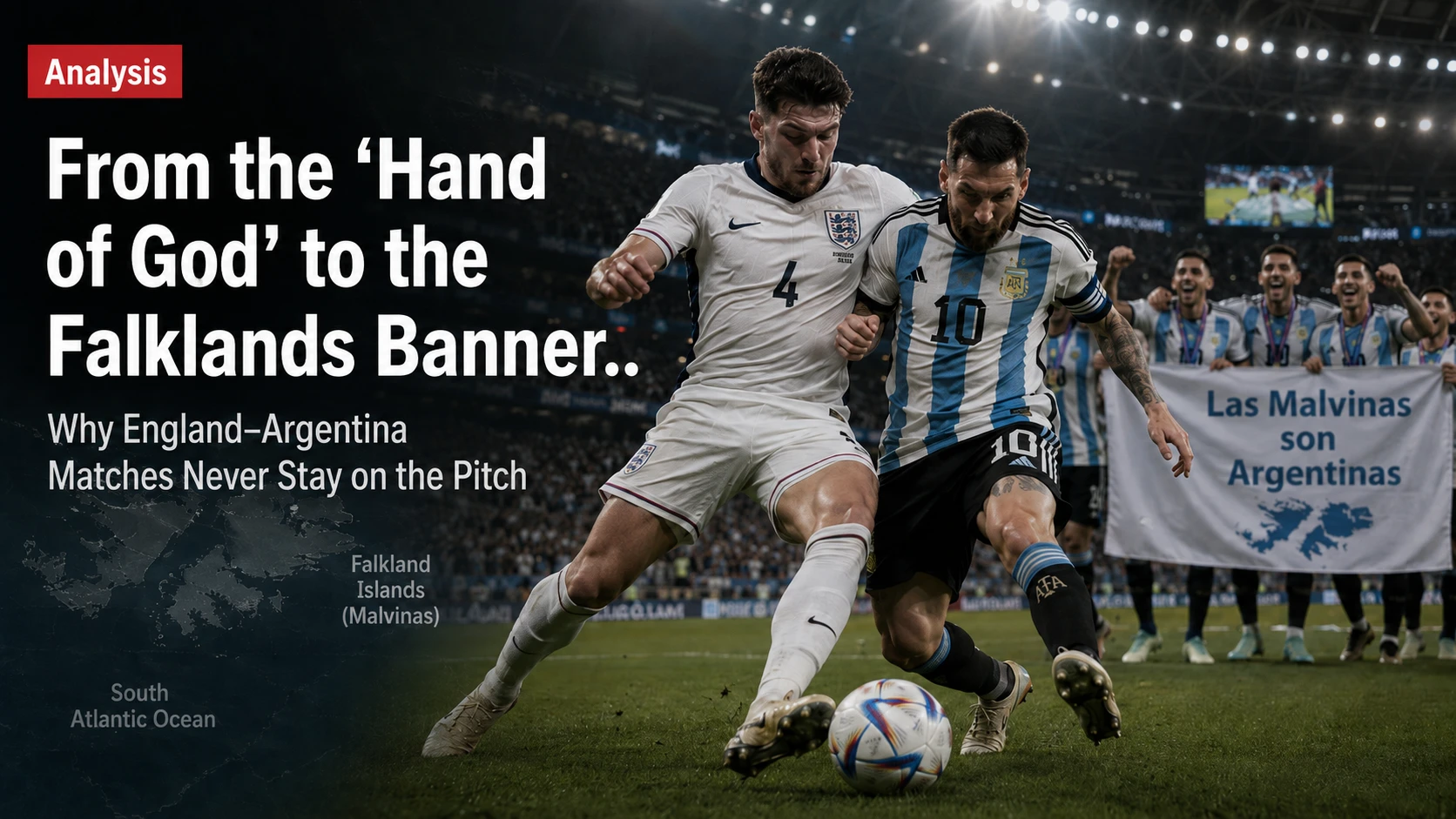
That is why the banner displayed by several Argentina players after defeating England in the 2026 World Cup semi-final was never going to be dismissed as a fleeting celebration.
It carried a simple message that reopened a decades-old argument.
“Las Malvinas son Argentinas.”
For Argentina, the islands are the Malvinas: an unfinished national cause and a symbol of dignity yet to be restored.
For Britain, they are the Falkland Islands: a British Overseas Territory whose people have repeatedly chosen to remain under British sovereignty.
England’s defeat therefore became more than a football result.
The question quickly shifted from why England had missed another World Cup final to why the Falklands return to the centre of attention almost every time England and Argentina meet on football’s biggest stage.
A Banner Bigger Than the Victory
After Argentina’s 2–1 victory in Atlanta, several players held up a banner declaring that “The Malvinas are Argentine.”
In Argentina, the gesture appeared entirely consistent with a long-standing national position.
In Britain, it was interpreted as a political statement reopening an old wound.
Downing Street’s response revealed as much.
“The World Cup may not be coming home,” a spokesman for the Prime Minister said, “but the Falkland Islands certainly are.”
He added that Britain’s position remained unchanged, that the principle of self-determination rested with the islanders themselves and that London’s commitment to the Falklands would remain unwavering.
The political response did not stop there.
Business Secretary Peter Kyle described the banner as “a blatant breach” of football’s long-standing principle that political messaging should remain outside the game, while FIFA confirmed that its independent disciplinary committee would review reports from the match before deciding whether any action was warranted.
That is the heart of the controversy.
Football wants to present itself as politically neutral.
History rarely allows it to remain so.
1982: The War That Never Left

The roots of the rivalry stretch back to the Falklands War of 1982, when Britain dispatched a naval task force after Argentina seized control of the islands.
Britain won the conflict.
The argument, however, never disappeared.
For Britain, the war reinforced a narrative centred on sovereignty and the islanders’ right to determine their own future.
For Argentina, the Malvinas remained a national wound: islands geographically close, politically distant and permanently embedded in public life as unfinished business.
Even the Falkland Islands Government responded to the 2026 banner in those terms.
Officials said they were “disappointed, though not surprised,” arguing that Argentina’s players had tarnished a football match in which the islands themselves played no part.
They also reminded observers that islanders were victims of the 1982 invasion, an experience that left lasting trauma across the community.
The banner therefore represented more than words printed on fabric.
It was a choice between competing historical narratives.
Falklands or Malvinas?
Self-determination or disputed sovereignty?
1986: The “Hand of God” Was Never Just Football
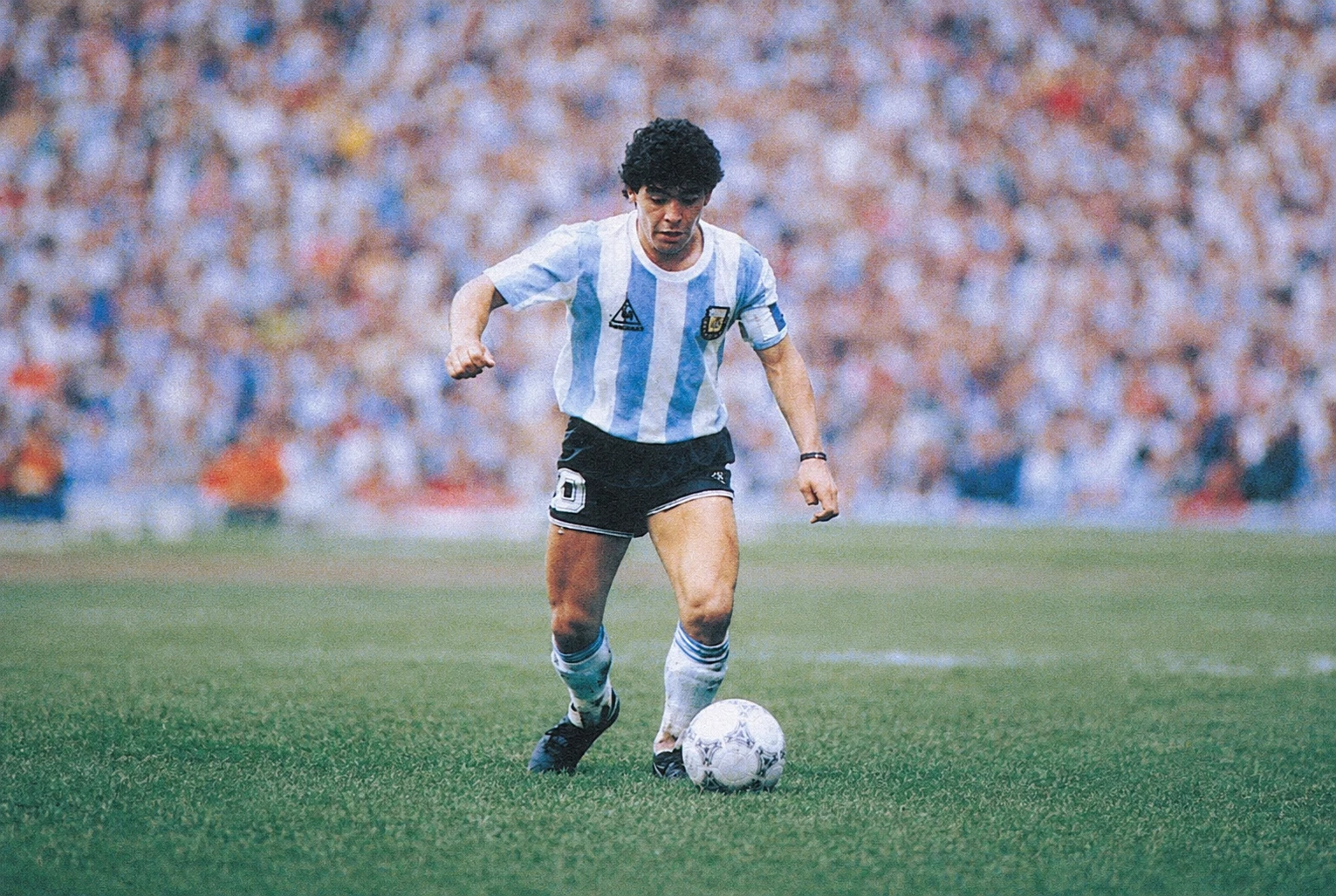
Four years after the war, England and Argentina met again in the quarter-finals of the 1986 World Cup in Mexico.
Maradona scored two of football’s most famous goals.
The first with his hand—later immortalised as the “Hand of God.”
The second after weaving past half the England team in what became known as the “Goal of the Century.”
Maradona’s explanation entered football folklore.
“A little with the head of Maradona, and a little with the hand of God.”
But the moment never remained simply a sporting anecdote.
For England, it felt like theft layered upon an already painful political memory.
For many Argentines, it became symbolic revenge for a military defeat still fresh in the national consciousness.
The match therefore became something larger than another 2–1 result.
It became the defining chapter in the football relationship between the two nations: deception, brilliance, symbolic revenge and an open historical wound.
From Beckham to Messi: A Rivalry That Never Stops Accumulating History
The rivalry acquired another chapter in 1998 when David Beckham was sent off against Argentina before England lost on penalties.
The Falklands were no longer at the forefront of public discussion.
The memory, however, remained.
England had once again fallen to the same opponent under circumstances that left both personal and national scars.
Four years later Beckham converted the winning penalty against Argentina in the 2002 World Cup.
England celebrated it not simply as three group-stage points, but as a measure of sporting redemption after 1998.
As the symbolic weight of the rivalry passed from Maradona to Lionel Messi, the faces changed but the burden did not.
England versus Argentina has never been played entirely in the present.
Each generation inherits the unfinished stories of the last.
And now 2026.
When the Malvinas Returned
The 2026 semi-final was not remembered simply because England surrendered a late lead.
It was remembered because the defeat left the stadium accompanied by a political banner that many British newspapers described as a fresh insult after the final whistle.
It was both a political statement and a defensive one.
Argentina may have won on the pitch.
That did not alter Britain’s position on sovereignty.
For Argentina, meanwhile, moments of footballing triumph provide opportunities to keep the Malvinas alive in international consciousness.
Sport does not replace politics.
It becomes another language through which politics is expressed—through a flag, a banner, a chant or an unforgettable goal.
Why It Never Stays on the Pitch
Because football, in fixtures like these, is never just football.
It is one of the most accessible ways nations retell history.
States do not communicate solely through diplomatic statements.
Sometimes they speak through a player’s celebration.
A banner.
A newspaper headline.
Or a goal remembered for generations.
That is why England–Argentina matches never truly end with the scoreline.
Argentina won 2–1 in 1986.
Yet the “Hand of God” remains more famous than the country’s route to lifting the World Cup.
Argentina won 2–1 again in 2026.
Yet Britain’s conversation moved almost immediately from another missed final to the Falkland Islands.
That is the nature of sporting rivalries shaped by history rather than sport alone.
The pitch appears neutral: grass, white lines, a referee, a ball and two teams.
National memory is anything but neutral.
Whenever England and Argentina walk onto the field, something else walks out with them.
An old war.
A goal scored by hand.
Remote islands in the South Atlantic.
And two nations that continue to use football to say things far larger than football itself.
Read more:
ShortURL ⬇