

A Big War, A Small Result – How Britain Read Trump’s Deal with Iran
A Big War, A Small Result – How Britain Read Trump's Deal with Iran
If Iran was negotiating before the war, what exactly did the war achieve?
That question lies beneath much of Britain’s reaction to the memorandum of understanding reached between Washington and Tehran.
The agreement has proved controversial not simply because it appears to abandon several of the ambitious objectives floated at the outset of the conflict — dismantling Iran’s missile programme, toppling the regime in Tehran or breaking its network of regional allies — but because it arrived after a long and costly war, despite diplomatic channels having remained open before the fighting began.
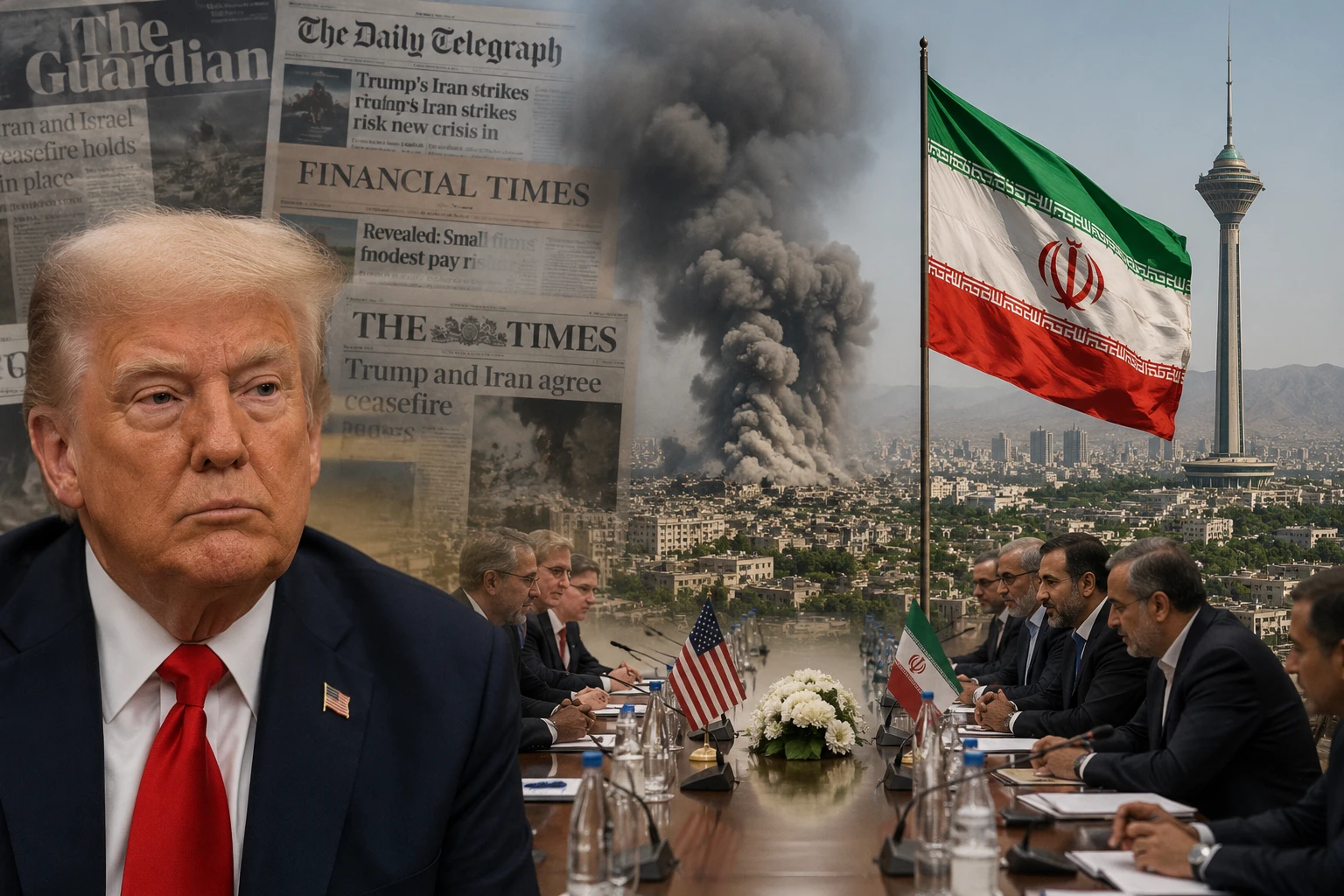
For much of the British press, this was not an unmistakable American victory.
On the left, the Daily Mirror focused on the financial cost of the agreement, highlighting reports that it could require a $300 billion (£223 billion) reconstruction package for Iran after the war. The newspaper presented the proposal as a striking concession by Washington rather than the outcome of a clear military victory. The Guardian similarly argued that the memorandum granted Tehran significant political and financial concessions.
On the right, The Daily Telegraph asked an even blunter question: “Thirteen thousand air strikes for what?” David Blair, the newspaper’s chief foreign affairs commentator, argued that Trump’s war had ended not with the collapse of the Iranian regime, but with a limited agreement involving the very leadership he had once pledged to remove.
The Financial Times approached the issue from the perspective of cost. Was the agreement worth four months of war, billions of dollars, depleted American weapons stockpiles and growing friction with allies?
Meanwhile, The Times suggested that the deal could provoke a political confrontation within Trump’s own Republican coalition.
When newspapers spanning the left, the liberal centre, the conservative right and the financial press converge around this degree of scepticism, the question becomes larger than Donald Trump himself.
Did the United States genuinely emerge victorious?
Or did Iran survive sufficiently intact to claim that it had not been defeated?

Victory or Survival?
From the perspective of much of the British press, America does not appear to have secured a decisive strategic victory.
Victory would have required something more substantial: the genuine dismantling of Iran’s military capabilities, a fundamental shift in its regional behaviour, binding limits on its missile programme or a definitive resolution of the nuclear dispute.
None of that happened.
Nor does Iran appear victorious in any conventional military sense.
It suffered significant damage and substantial losses.
Yet politically it emerged without being broken.
In the Middle East, that alone can become a powerful strategic asset.
Tehran can argue that it withstood a joint American-Israeli campaign without surrendering or abandoning its principal sources of leverage.
Washington, by contrast, must explain why a major war was necessary to reach an outcome that does not appear dramatically different from one that might have been negotiated beforehand.
In that sense, the phrase “a big war, a small result” becomes more than a newspaper headline.
It becomes a political verdict.
The Israeli Assumption

The war cannot be understood without considering Israel’s role.
Benjamin Netanyahu’s government entered the confrontation convinced that the Iranian regime was more fragile than it appeared.
The strategy presented to the Trump administration rested on a relatively simple assumption: that concentrated strikes against Iran’s leadership and military infrastructure — a classic “decapitation strategy” — would either trigger internal collapse or force Tehran into concessions that diplomacy alone could never secure.
Implicit in that assumption was the belief that attacking command centres and instruments of repression would encourage public unrest and elite fragmentation.
But this overlooked something well understood by many students of Middle Eastern political psychology.
External military attacks are rarely interpreted as opportunities for liberation.
They are far more often perceived as foreign intervention.
Societies with long memories of colonialism, sanctions and outside interference tend not to respond to bombardment by turning against their governments, even when they are deeply dissatisfied with them.
They frequently do the opposite.
National solidarity begins to outweigh domestic grievance.
This was one of the central miscalculations made by both Washington and Tel Aviv.
Military power was treated as though it could reshape politics by itself, overlooking the fact that military force often collides with historical memory in ways its planners fail to anticipate.
Rather than becoming the beginning of regime collapse, the strikes became a catalyst for political consolidation.
That, in turn, makes the outcome appear remarkably modest when measured against the scale of the war that produced it.
If the conflict ultimately delivered little more than a ceasefire, renewed negotiations and conditional sanctions relief, what exactly could not have been achieved without fighting?
That is the question that explains why much of the British press viewed the agreement with considerably less enthusiasm than the White House.
Trump can present the deal as a success because it ended the war.
His critics judge it against the war that came before it, the promises that accompanied it and the objectives that remained unrealised.
Who Won?

If survival is the measure of success, Iran emerged in a stronger position than its adversaries intended.
The regime survived. It did not surrender. It retained much of its leverage.
It was not compelled to accept the kind of unconditional surrender discussed during the opening stages of the conflict.
If ending the war is the measure of success, Trump secured something he can sell politically at home: hostilities brought to an end, shipping routes kept open and markets stabilised.
But the difference is significant.
Iran needed to survive.
The United States needed to demonstrate a clear victory capable of justifying the war itself.
That distinction leaves Washington in a less comfortable position.
Great powers are judged not simply by their ability to wage war, but by their ability to produce convincing political outcomes once the fighting ends.
If much of the British press remains unconvinced by the outcome, and if Iran can plausibly claim it emerged unbroken, then the question of victory remains unresolved.
There may be no outright winner.
But there is one side against whom the principal objectives of its opponents were not achieved.
That side is Iran.
Britain’s Deeper Concern
What worries Britain is not simply Iran’s future.
It is America’s.
If Washington can enter a major war on the basis of optimistic American and Israeli assumptions, only to discover that the regime survives, negotiations prove unavoidable and the costs outweigh the gains, what does that imply for its allies?
What happens if the same logic is applied elsewhere?
Against Russia?
Or China?
This is not fundamentally an argument against the United States.
It is an expression of anxiety about a partner that remains indispensable, yet may draw others into strategic calculations they cannot fully control.
That, ultimately, is Britain’s deeper question after the memorandum of understanding.
Not simply whether America or Iran won.
But whether American power still knows how to choose its wars — and, just as importantly, how to leave them with outcomes commensurate with their cost.
In this case, the answer appears rather less convincing than Washington had hoped.
The war was large.
The result was considerably smaller.
Read more:
ShortURL ⬇