

After Recognising Palestine, Can Britain Protect the State It Recognised?
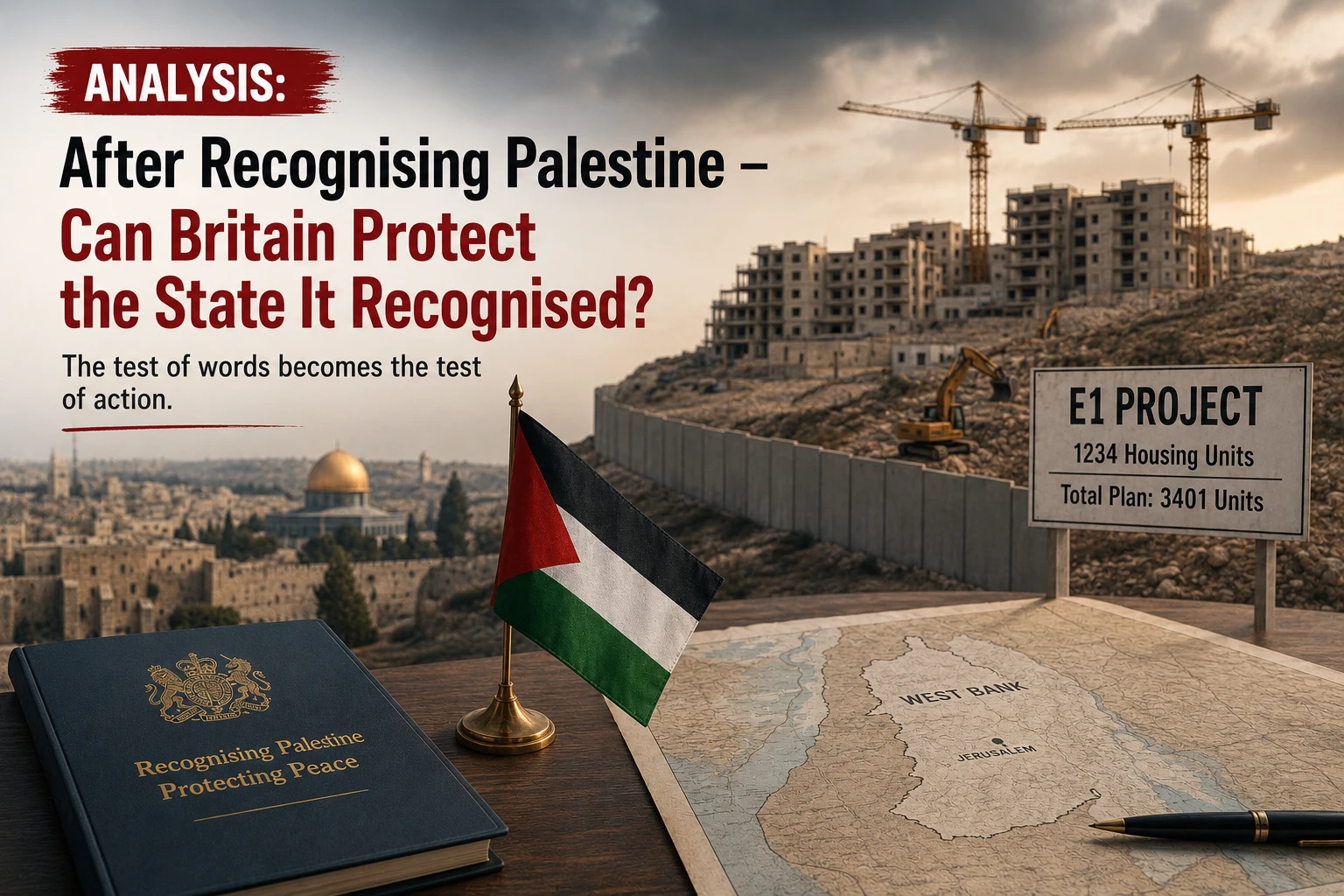
After Recognising Palestine, Can Britain Protect the State It Recognised?
When Britain formally recognised the state of Palestine in September 2025, it did not present the decision simply as a belated diplomatic correction.
It tied recognition to a specific political objective: preserving the possibility of a viable Palestinian state and keeping the two-state solution alive.
At the time, the British government said explicitly that recognition “will not be enough on its own to change the situation on the ground”, and that its value lay in a broader effort to prevent the political horizon itself from disappearing.
Less than a year later, Israel’s E1 settlement project is testing that logic in a much more difficult way.
On 18 August, the Israeli government opened the bidding process for 1,234 housing units in the E1 area east of occupied Jerusalem, part of a wider plan involving 3,401 units.
From the British and wider international perspective, the problem is not simply the number of homes.
It is where the project sits, and what it could do to the geography on which a future Palestinian state is supposed to exist.
That is why Britain’s response went beyond the familiar language of diplomatic concern.
London summoned Israel’s chargé d’affaires and called on the Israeli government to withdraw the tender and halt the project. Foreign Secretary Ed Miliband also said Britain would announce a package of measures in the coming weeks targeting, among other things, those involved in illegal settlement expansion.
The argument has therefore moved beyond whether Britain should recognise Palestine.
The harder question now is this: what does Britain do when the state it has recognised gains greater diplomatic legitimacy while becoming less geographically viable?
Recognition Expands as the Geography Shrinks

When London recognised Palestine on 21 September 2025, it said the move was intended to “protect the viability of the two-state solution” and that the Palestinian state it sought should be “viable and sovereign”.
That language made recognition a means rather than an end in itself.
A state is not simply a flag, an embassy and international recognition.
It also requires territory over which political, economic and administrative authority can actually be exercised.
That is what makes the Palestinian case so stark.
Palestine can win political victories abroad while losing the physical basis of statehood at home.
The two processes do not necessarily move in the same direction.
International recognition can expand at precisely the moment the geography of the state is shrinking.
Why E1 Is Different From Another Settlement Project
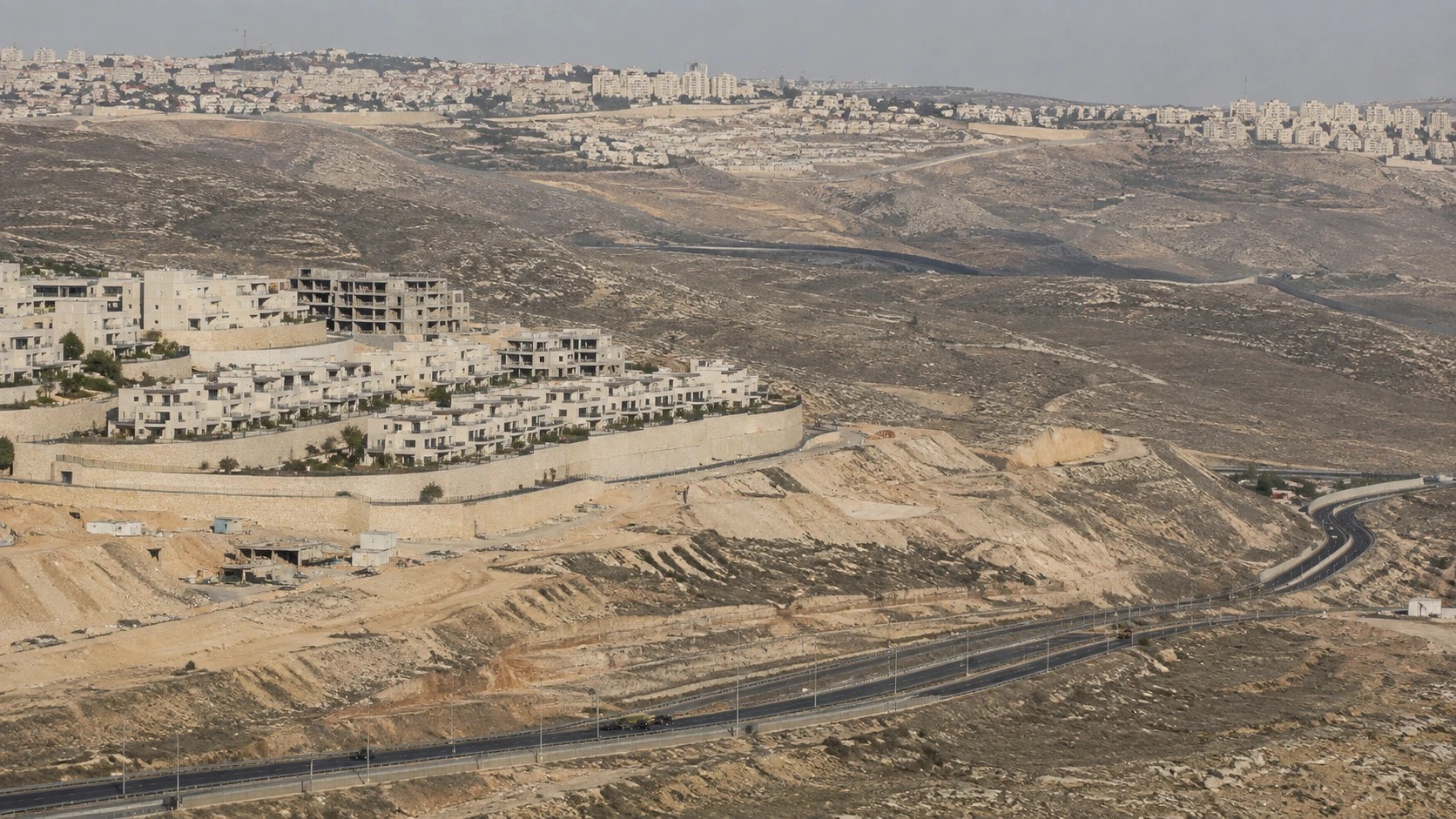
Settlement expansion is nothing new in the occupied West Bank.
But the significance of E1 lies not only in the additional 1,234 housing units, or even in the wider 3,401-unit plan.
The project sits east of Jerusalem, between the city and the settlement of Ma’ale Adumim, in an area that is particularly sensitive to the future territorial contiguity of a Palestinian state.
That is why Britain has not limited its criticism to the illegality of settlements.
In a joint statement issued on 20 August, Britain, France, Germany, Italy, the Netherlands, Canada and Norway said implementation of the project would drive a “wedge” through the West Bank and undermine the territorial continuity of Palestinian land.
Britain and its partners had used even more explicit language in May, warning that development in the area would effectively split the West Bank in two.
That is what makes E1 politically distinctive.
The issue is no longer simply the construction of homes on land Britain considers occupied.
It is the reshaping of the territory in a way that threatens the very model on which the two-state solution depends: a Palestinian state whose component parts remain geographically and politically connected enough to govern.
If Palestinian areas are gradually reduced to isolated enclaves surrounded by settlements, roads and Israeli-controlled infrastructure, the issue becomes much larger than the number of housing units being built.
It becomes a question of whether the geography required for a two-state solution will still exist at all.
From Condemnation to Pressure
The other important development is that British policy towards settlements has begun to move beyond diplomatic statements.
In June, the government tightened its guidance to British businesses, explicitly advising them against engaging in economic or financial activity in illegal Israeli settlements, whether through investment, procurement, services or other forms of commercial involvement.
That same month, Britain joined partners in imposing sanctions on individuals and entities it said were financing or facilitating settler violence in the West Bank.
Then, in August, the Charity Commission opened investigations into eight charities over concerns that charitable funds may have been used in illegal settlements. The opening of an investigation does not in itself establish wrongdoing, but it shows that the settlement issue is increasingly being treated as a regulatory matter as well as a diplomatic one.
With the launch of the E1 tender, Britain and its partners also explicitly warned companies against bidding for the contracts, highlighting potential legal and reputational risks arising from involvement in the project.
Taken separately, these measures are limited.
Taken together, they suggest a shift.
Pressure is beginning to move towards companies, financing, individuals and organisations linked to settlement activity – the networks that help turn a political project into a physical and economic reality.
The question Miliband’s forthcoming package will answer is how far the government is prepared to take that approach.
The Limits of What Britain Can Do
It is easy, however, to demand more of recognition than it can deliver.
There is no principle under which a state that recognises another state becomes responsible for guaranteeing its borders or defending it.
Nor does Britain, acting alone, have the power to force the Israeli government to stop construction in the West Bank.
British leverage over Israel has obvious limits, and sanctions or corporate warnings should not be treated as though they can, by themselves, alter the balance of power on the ground.
But limited power is not the same as having no choices.
There is a substantial difference between recognising Palestine and then merely repeating a legal position on settlements, and using diplomatic, economic and regulatory tools to make settlement expansion more costly.
British policy should therefore not be judged against an unrealistic standard, such as whether London can single-handedly stop E1.
The more useful question is whether Britain is prepared to use the leverage it does possess when the very policy rationale behind recognition is being undermined.
That is why Miliband’s promised measures matter.
Their scale, their targets and whether they remain confined to settlers and directly linked entities – or extend into wider circles – will reveal how far London is prepared to move from diplomatic objection towards attempting to change calculations on the ground.
Israel and the Test of Separating the State From the Settlements
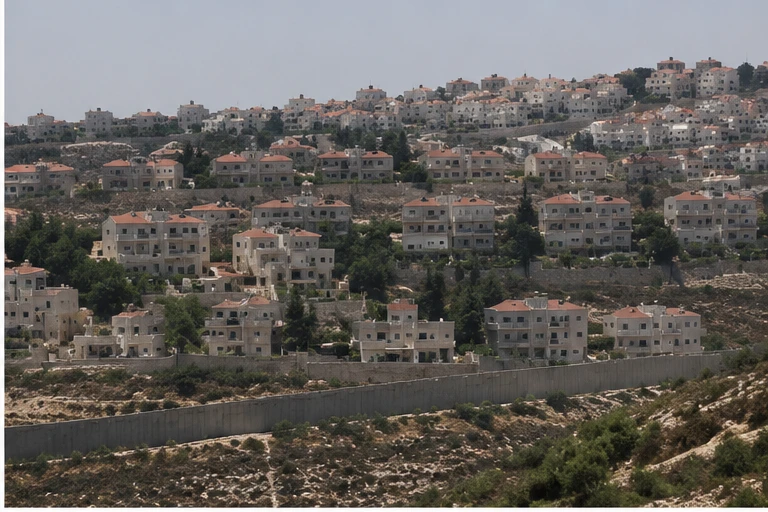
British governments have traditionally maintained a clear distinction between Israel within its pre-1967 borders and settlements built in the occupied territories.
That distinction allows London to maintain political and commercial relations with Israel while regarding the settlements as illegal and opposing their expansion.
E1 places that separation under growing pressure.
When Britain says that a particular settlement project does not merely breach international law but threatens the political solution on which its entire approach to the conflict is based, it becomes harder to treat that project as a peripheral issue detached from the broader bilateral relationship.
That does not mean Britain must move towards a wholesale confrontation with Israel.
But it could mean that continued settlement expansion carries a more visible political cost within the relationship itself.
That is the more significant test in the weeks ahead.
Will opposition to E1 remain a self-contained issue, addressed with limited tools?
Or will London begin to attach a clearer political and economic price to policies it says are making Palestinian statehood less viable?
From Symbolic Recognition to a Policy That Carries a Cost
The strength of Britain’s recognition of Palestine lay in its political message.
London was no longer treating Palestinian statehood as something that could be postponed indefinitely until the end of an undefined peace process.
It recognised that statehood as a political right in the present.
E1 exposes the limit of what recognition can achieve on its own.
Recognition can alter Palestine’s diplomatic status.
It cannot stop bulldozers.
It cannot reconnect territory once new facts on the ground have severed it.
That is where the harder phase begins.
Britain no longer needs to repeat that it supports a viable Palestinian state. It settled that politically when it recognised Palestine.
The question now is how much cost it is prepared to impose on policies that, by its own assessment, make that state less viable.
That is why E1 matters beyond the familiar argument over whether Britain still supports a two-state solution.
The official answer to that question is already known.
What the project tests is something far more practical:
Will recognition of Palestine remain a diplomatic position, or become a policy aimed at protecting the material conditions required for the state Britain has recognised to exist?
A Palestinian state needs more than flags and embassies in European capitals.
It needs land on which it can actually stand.
And if British recognition was presented as a way of preserving that possibility, its political value will begin to be measured precisely at the point when defending it becomes costly.
Read more:
ShortURL ⬇