

Analysis: The Killing of Ann Widdecombe: When a Criminal Investigation Becomes Political Anxiety
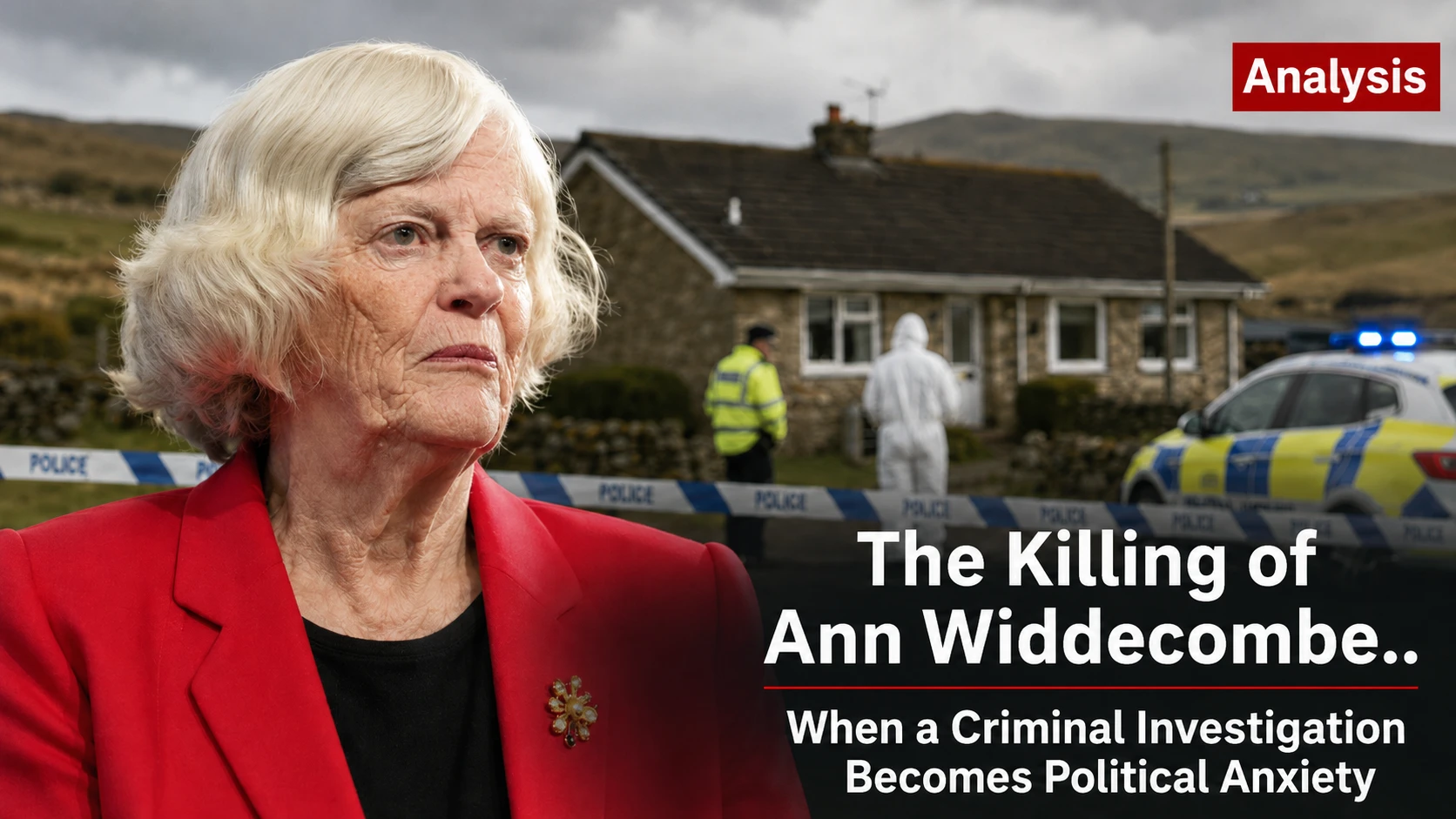
Analysis: The Killing of Ann Widdecombe: When a Criminal Investigation Becomes Political Anxiety
Before any political interpretation, one fact must remain clear.
The killing of Ann Widdecombe is an active criminal investigation.
Police have arrested a 26-year-old man on suspicion of murder after the former Conservative minister was found dead with fatal injuries at her home in rural Dartmoor. Investigators have also stressed, according to British media reports, that they are not currently treating the case as terrorism or as politically motivated.
That distinction matters.
Because the victim was not an anonymous member of the public. Widdecombe was a former Cabinet minister, a veteran parliamentarian, a familiar media personality, a Reform UK spokesperson and a political figure who spent decades at the centre of Britain’s debates over religion, Brexit, immigration and conservative values.
For that reason, the public rarely experiences such a crime as merely criminal.
Even when police say there is no evidence of a political motive, the killing of a well-known political figure immediately raises broader anxieties: about the safety of politicians, the fragility of public life and the way violence is interpreted once it touches those in public office.
A Crime Before It Becomes a Symbol
The facts currently available remain limited.
Widdecombe, 78, was found at her home after concerns were raised for her welfare, prompting a murder investigation. Some reports have suggested the incident may have begun as a burglary or break-in before escalating into homicide, but detectives have not yet established either the motive or the full sequence of events.
For that reason, the case should not be turned into a fully formed political narrative before the investigation reaches its conclusions.
Doing so carries a double risk.
It may undermine the investigation itself while simultaneously encouraging political narratives unsupported by evidence.
Yet resisting politicisation does not require ignoring context.
When the victim is a public figure, society does not process the death as it would an ordinary criminal case. Public memory, political identity and symbolic significance inevitably shape the response. Political parties, opponents, supporters and newspapers all begin searching for meaning beyond the police statement.
A Victim Who Was Never Just a Politician

Ann Widdecombe was one of the most recognisable—and often controversial—conservative voices in modern British politics.
She served as a Conservative MP for decades, held ministerial office and later moved beyond mainstream Conservatism into the worlds of Brexit politics and Reform UK. She became known for her outspoken social conservatism and a style that rarely sought compromise or carefully balanced language.
At the same time, she became a public figure who extended well beyond Westminster, particularly after appearing on television programmes such as Strictly Come Dancing, where she reached audiences with little interest in parliamentary politics.
That dual identity helps explain the scale of the reaction.
Widdecombe was not simply a former politician.
She had become part of Britain’s wider political and cultural memory: someone with whom many disagreed, yet whose public presence had become sufficiently familiar that her sudden death resonated far beyond her political supporters.
That creates an obvious challenge.
Her death should become neither an opportunity to sanitise a divisive political legacy nor an occasion to settle old political arguments.
The more important task is understanding why her killing, despite its apparently criminal character, has become a matter of public concern.
The Memory of Violence Against Politicians

No violent attack involving a British politician now exists outside the shadow of recent history.
The murders of Jo Cox in 2016 and David Amess in 2021 fundamentally changed the way Britain thinks about the security of its elected representatives. Since then, any serious violence affecting a political figure immediately revives a broader question.
Has British politics itself become more dangerous?
Has increasingly hostile political rhetoric begun spilling into physical violence?
That does not mean Widdecombe’s death belongs in the same category.
Investigators have made no such suggestion.
Public memory, however, does not operate like a police investigation.
It recalls fears before evidence is complete and reopens debates about the security of politicians—particularly in a country that has witnessed several shocking attacks on public figures within less than a decade.
Reform UK, Farage and the Politics of Narrative
Widdecombe’s association with Reform UK inevitably makes the case more politically sensitive.
The party is already navigating a period of electoral momentum, financial scrutiny and intense media attention surrounding Nigel Farage. Under such circumstances, the murder of someone closely associated with the party could quickly become part of a broader political narrative: that Reform figures are under threat, that politics itself has become more dangerous or that an increasingly hostile political climate bears responsibility.
Such narratives may find a willing audience in an era marked by deep political polarisation.
Their danger lies in outrunning the evidence.
If investigators conclude that the motive was not political, politicians and the media have a responsibility to preserve the distinction between legitimate grief and political exploitation.
Not because politics should remain silent in the face of violence.
But because rushing to assign political meaning risks turning the victim into an instrument of a conflict that may have had nothing to do with the crime itself.
Nor is this a challenge unique to Reform UK.
Every political party, in similar circumstances, risks interpreting tragedy through its own political lens.
The crime, however, belongs first to the victim, the family and the investigation.
Between Truth and Political Narrative

Political disagreement is inevitable.
The greater danger is allowing violent events to become an easy source of political theatre or allowing a victim’s political identity to become a shortcut to deeper polarisation.
In either case, the essential distance between establishing facts and exploiting them begins to disappear.
The killing of Ann Widdecombe is undoubtedly shocking.
It is also a test of how Britain responds when violence reaches public life.
Can the country wait for the investigation?
Can it respect grief before drawing political conclusions?
Can it separate evidence from symbolism?
Can it acknowledge public anxiety without turning anxiety into accusation?
The legal conclusion may ultimately be that this was an ordinary criminal homicide unrelated to politics.
The public response, however, is unlikely ever to be purely criminal.
That is the paradox of public figures.
Even when they die outside politics, politics rarely dies around them.
Read more:
ShortURL ⬇