

Analysis: “A Messiah Without a Mandate”: How Burnham’s First Test Began Before He Entered Downing Street
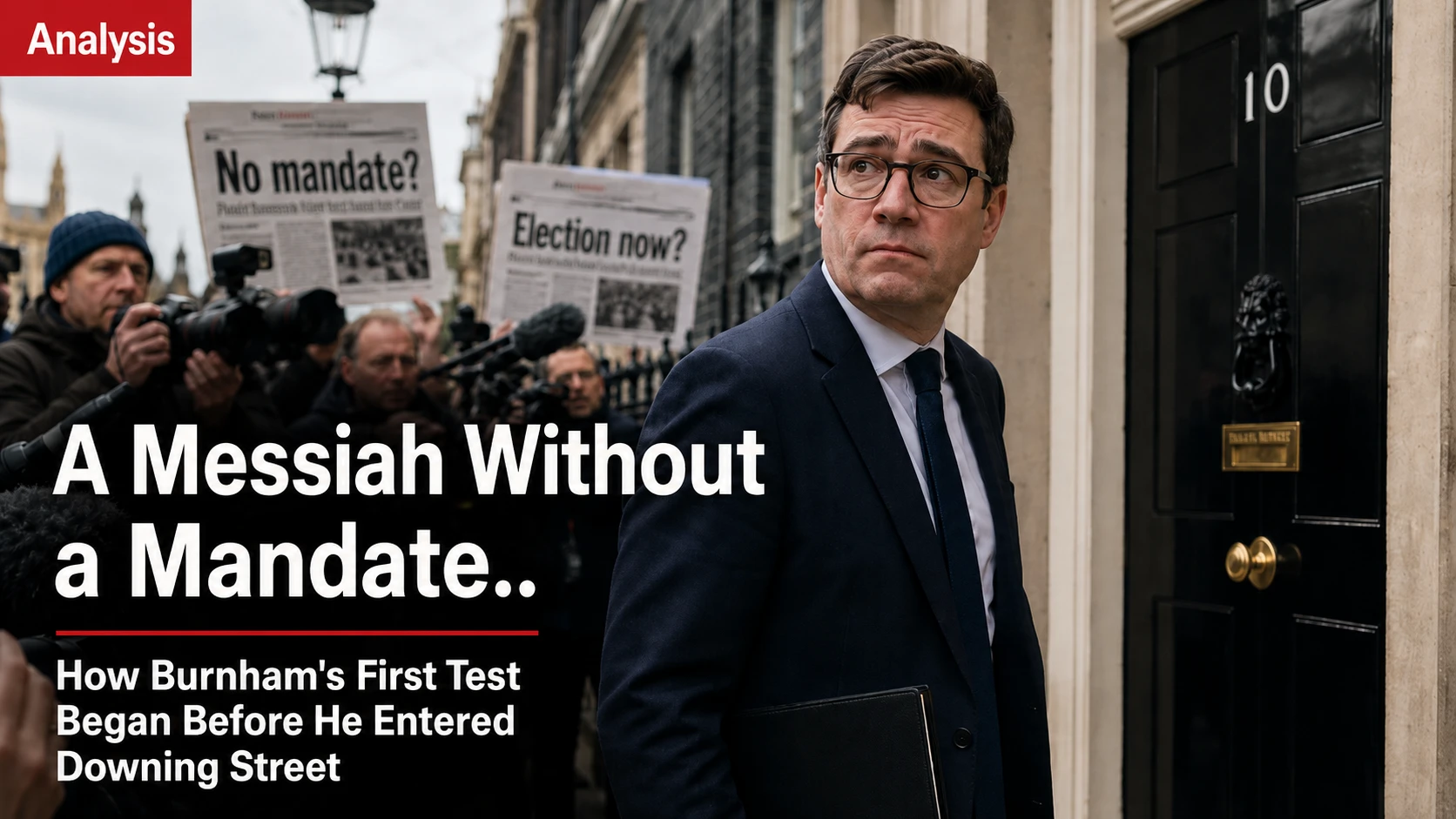
"A Messiah Without a Mandate": How Andy Burnham's First Test Began Before Entering Downing Street
Before Andy Burnham has even formally walked through the door of Number 10, the political battle over his premiership has already begun.
The argument is not primarily about what he intends to do in office.
It is about whether he has the political authority to do it at all.
That is the real significance behind the Mail on Sunday’s striking headline: “Messiah without a mandate.”
The attack is not simply directed at Burnham’s popularity or his public image.
It seeks to frame every major decision he makes before he has the opportunity to define himself.
You may be the constitutional Prime Minister.
But who, politically, gave you the authority to govern?
Only weeks ago, that question remained hypothetical.
What if Burnham became Prime Minister without a general election?
Today, on 19 July 2026, following his election as Labour leader and one day before formally taking office, the question has become something else entirely.
A headline.
A political campaign.
A ready-made line of attack.
The right has launched its offensive before Burnham has even crossed the threshold of Downing Street.
The Campaign Began Before Day One
Conservative-leaning newspapers wasted little time.
The Mail on Sunday did not simply demand a general election. It personalised the attack.
“Flutter those eyelashes all you like, Andy… we want an election now.”
The message was unmistakable. Charisma is not a mandate. Popularity is not legitimacy.
Elsewhere, the Sunday Telegraph chose a different battlefield. It portrayed Burnham’s decision to scrap the national digital identity card programme as an early break with Keir Starmer’s legacy while questioning the wisdom of abandoning a project reportedly worth £1.8 billion, arguing that the money would be better spent addressing the cost-of-living crisis.
The Sunday Times focused on Thames Water.The prospect of placing Britain’s largest water company into a special administration regime is about more than rescuing a failing utility.
It is an early test of Burnham’s belief in greater public control over essential services—and of how far he is prepared to challenge the privatisation model.
Meanwhile, the Sunday Express turned its attention to the cost of government itself, highlighting Labour’s growing team of advisers.
Before Burnham has taken office, his opponents have already assembled a political narrative.
A Prime Minister without a direct mandate.
A leader abandoning expensive projects.
A government preparing greater state intervention.
An administration that risks becoming costly before it has even begun.
This is not routine scrutiny of a new Prime Minister. It is an attempt to define him before he can define himself.
Mandate as a Political Weapon
Constitutionally, the matter is straightforward. Britain does not elect its Prime Minister directly.Voters elect Parliament. The monarch invites whoever can command a majority in the House of Commons to form a government.
If the governing party changes its leader while retaining that majority, the new leader is fully entitled to become Prime Minister.
Politics, however, operates by more than constitutional procedure. Opponents understand that the word mandate carries greater emotional force than legal explanation. It speaks directly to voters.
“Nobody elected you for this.”
That is precisely the argument Nigel Farage and Reform UK are making. Farage insists Burnham has “no mandate whatsoever” to govern.
Conservative figures have adopted a similar line. Robert Jenrick has argued that “no one voted” for Burnham’s proposed tax increases, insisting he should either abandon them or seek fresh public approval through a general election.
Kemi Badenoch has approached the issue from a different angle. Her argument is less about how Burnham arrived in office than about what he should be permitted to do once there.
She maintains he should not use Labour’s parliamentary majority to implement policies that were never explicitly endorsed by voters, while mocking suggestions that his arrival somehow resolves Britain’s security challenges.
The result is that every future decision risks being judged through the same political lens.
Do you have a mandate for this?
His First Decisions Make the Question Harder to Escape
The challenge is intensified because Burnham’s opening moves are anything but modest.
Scrapping the digital identity card programme is not a routine administrative adjustment.
It represents his first clear break with the Starmer government.
Supporters will present the decision as redirecting resources towards the cost-of-living crisis and away from expensive surveillance projects.
Opponents will describe it as wasting public money while overturning a major policy without electoral approval.
The Thames Water question is potentially even more significant.
Government intervention in Britain’s largest water company reflects Burnham’s broader argument for stronger public oversight of essential infrastructure.
To supporters, it demonstrates that he intends to act where privatisation has failed.
To critics, it signals a larger state, greater risks for taxpayers and another major policy shift lacking an explicit electoral mandate.
The Right Wants More Than an Election
It would be easy to interpret demands for an immediate general election as a simple defence of democratic principle.
Politics is rarely so uncomplicated.
Conservative newspapers and Reform UK understand the dilemma such demands create.
If Burnham calls an election immediately, he risks entering a national campaign before his government has had any opportunity to establish credibility.
If he refuses, critics will claim he fears facing the electorate. That is why the phrase “Messiah without a mandate” is politically effective.It does more than point out the absence of a general election.
It questions Burnham’s entire political identity.
Is he genuinely Britain’s political saviour?
Or simply the latest leader to emerge from a governing party searching for a fresh narrative?
Burnham’s likely response will not be constitutional argument. It will be practical delivery.
Every successful policy—lower living costs, better public services or visible improvements in everyday life—weakens the mandate argument.
Every failure strengthens it.
A Battle Before Government Begins
That is what makes Burnham’s position unusual.
His first political battle began before his first speech outside Number 10.
His opponents did not wait for the Budget.
They did not wait for the first parliamentary rebellion or the first national crisis.
They started at the front door of Downing Street itself.
You may be Prime Minister.
But you never asked the public to make you one.
That makes this a more consequential battle than it first appears.
It is not directed at one particular decision.
It is designed to cast a shadow over every decision that follows.
The identity cards?
No mandate.
Thames Water?
No mandate.
Taxes?
No mandate.
Public spending?
No mandate.
Burnham therefore enters office with a commanding parliamentary majority but under a permanent political question mark.
Legally, he does not require a general election tomorrow.
Politically, however, he must build legitimacy through performance.
He needs to demonstrate—quickly—that his premiership is more than a change of leadership inside Labour.
It must become a government capable of earning its authority through results. Because legitimacy in moments like these is never secured once and for all.
It is built—or eroded—day by day. That is Burnham’s first test before governing has truly begun. Not simply whether he can govern. But whether he can prevent every day of his premiership from becoming a delayed referendum on his right to hold the office in the first place.
Read more:
ShortURL ⬇