

Analysis: “Breathing Room”: Why Burnham’s First-Day Battle Begins with Britain’s Household Bills
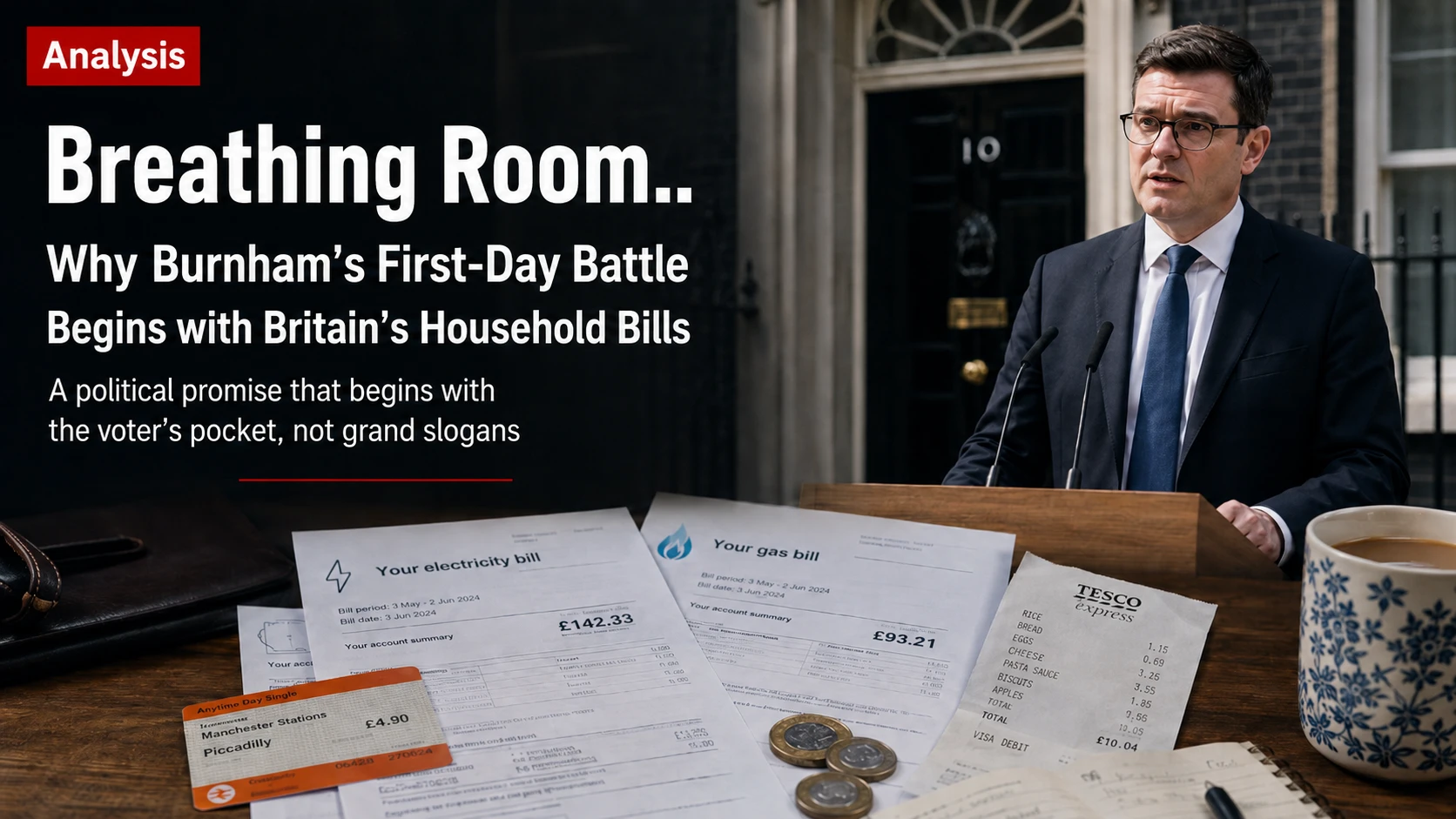
Analysis: "Breathing Room": Why Burnham's First-Day Battle Begins with Britain's Household Bills
On his first day as Prime Minister, Andy Burnham does not want to begin with grand themes alone: the state, public administration, Thatcherism, political mandates or the future shape of Britain.
He wants to begin somewhere far more immediate.
The household bill.
His promise to give Britons “breathing room” amid the cost-of-living crisis is more than an emotionally resonant phrase for a first speech outside Downing Street. It is a deliberate political choice. Burnham understands that any talk of a ten-year national renewal or economic reconstruction will remain abstract unless people quickly feel that something has changed in their daily lives.
That is why he begins not with the architecture of the state, but with the pressure on voters’ wallets.
A Small Promise Serving a Bigger Vision

According to advance reports of his inaugural address, Burnham will argue that Britain must be honest about the scale of the challenges it faces, while striking a tone that is both realistic and optimistic. Fully aware that he is the sixth occupant of Number 10 in a decade, he wants the beginning of his premiership to symbolise political stability rather than simply another change of leader.
Yet the line likely to resonate most is not about stability.
It is his promise to deliver practical improvements that offer families some “breathing room” from the cost of living.
The phrase reveals Burnham’s political priorities. He does not want to appear as a prime minister preoccupied with abstract debates about the role of the state. He wants to present himself as a leader beginning where people feel the greatest strain: energy bills, transport costs, struggling public services and the anxiety of reaching the end of the month.
From Household Bills to a Ten-Year Plan
“Breathing room”, however, is not intended as a short-term policy in isolation.
Speaking to The Times, Burnham outlined a ten-year plan to reshape both government and the economy. He argued for earlier intervention, earlier investment and a state that “sets people up to succeed” instead of continuing to “pay for failure.”
That is the larger philosophy behind the immediate promise.
Burnham is not simply saying that government should help people pay today’s bills. He is arguing that the governing model itself needs to change: investing earlier to prevent future crises, strengthening public services before they collapse, and reconnecting economic policy with the everyday realities of people’s lives rather than with statistics that few households ever feel.
In that sense, “breathing room” is an entry point into a broader political project. The bills come first, but the ambition is to present Labour as a government capable of repairing the relationship between the state and its citizens, rather than merely managing decline.
The Test Is Speed
The difficulty is that voters are unlikely to wait ten years.
Burnham may be right that national renewal is a long-term endeavour, but politically he cannot afford the luxury of time. Families exhausted by years of rising living costs will judge his government first not by the coherence of its long-term philosophy, but by whether bills become lower, transport more affordable and public services visibly more reliable.
That is why the first week’s measures matter. Plans to reduce household energy costs, cap bus fares and scrap the national digital identity scheme in order to redirect resources towards everyday priorities all signal Burnham’s determination to convert rhetoric into measurable action.
Yet this is also where the risks begin.
Every short-term promise requires funding. Every funding decision reopens questions about taxation and public spending. Every expansion of the state’s role invites criticism from both financial markets and the political right.
The unavoidable question quickly follows.
How will Burnham pay for it?
Number 10 and the Treasury

That is why the promise of “breathing room” cannot be separated from the structure of government itself.
According to the Financial Times, Burnham wants Downing Street to exercise tighter control over spending decisions and implementation. The logic is straightforward. A genuine ten-year strategy cannot succeed if the Prime Minister sets priorities while the Treasury alone defines the limits of what is possible.
But that immediately raises questions about his relationship with Shabana Mahmood, widely viewed as the leading candidate for Chancellor. Markets have interpreted the prospect of her appointment as a reassuring signal, seeing her as closer to Labour’s moderate wing than more interventionist alternatives.
Burnham needs precisely that balance: bold enough to persuade voters that change is coming, disciplined enough to reassure investors that economic credibility remains intact.
That is the political tightrope.
Too much caution risks draining the meaning from his premiership before it begins.
Too much ambition risks reviving fears of a larger state, higher spending and heavier taxation.
Legitimacy Through Experience, Not Rhetoric
For that reason, Burnham’s first test may prove even more significant than the arguments over his political mandate.
It is a test of everyday experience.
Do ordinary households feel that the new government understands where the real pressure lies? Does “breathing room” become something tangible—a lower bill, a cheaper bus journey, a public service that functions better—or remain simply an attractive slogan? Can Burnham demonstrate that a more active state need not be a heavier state, but one that intervenes sooner, before manageable problems become national crises?
If he succeeds, “breathing room” could become the opening chapter of a new political story: a prime minister whose legitimacy rests less on constitutional arguments than on practical improvements people can feel.
If he fails, the phrase itself will become an easy target.
Nothing will be simpler for his opponents than to argue that he promised people room to breathe—only to leave them trapped in the same pressures as before.
That is how Burnham’s premiership begins.
Not simply at the door of Number 10, but before a far more demanding question: can he make people feel that politics has returned not only to Westminster, but to their everyday lives?
Read more:
ShortURL ⬇