

Analysis: Fewer Jobs for More Security? The Hidden Cost of Britain’s Rearmament Plan
Crises rarely arrive one at a time.
Just as Britain’s economy is trying to catch its breath amid weak growth, high borrowing costs and pressure on public services, the security crisis adds another bill to an already crowded table.
Britain is not simply facing a question about the size of its army, the number of its aircraft or whether its fleet can keep pace with new forms of warfare.
The deeper question is this: how does an economically strained country fund a new arms race without paying for it through jobs and civilian investment?
Keir Starmer’s defence investment plan adds £15bn to military spending. The government presents it as an investment in security and industry alike. It says the plan will support around 60,000 direct and indirect jobs by the end of the decade and raise the number of jobs linked to defence spending in Britain to more than half a million.
But that is not the whole story.
Defence spending may create jobs. It does not create money out of thin air.
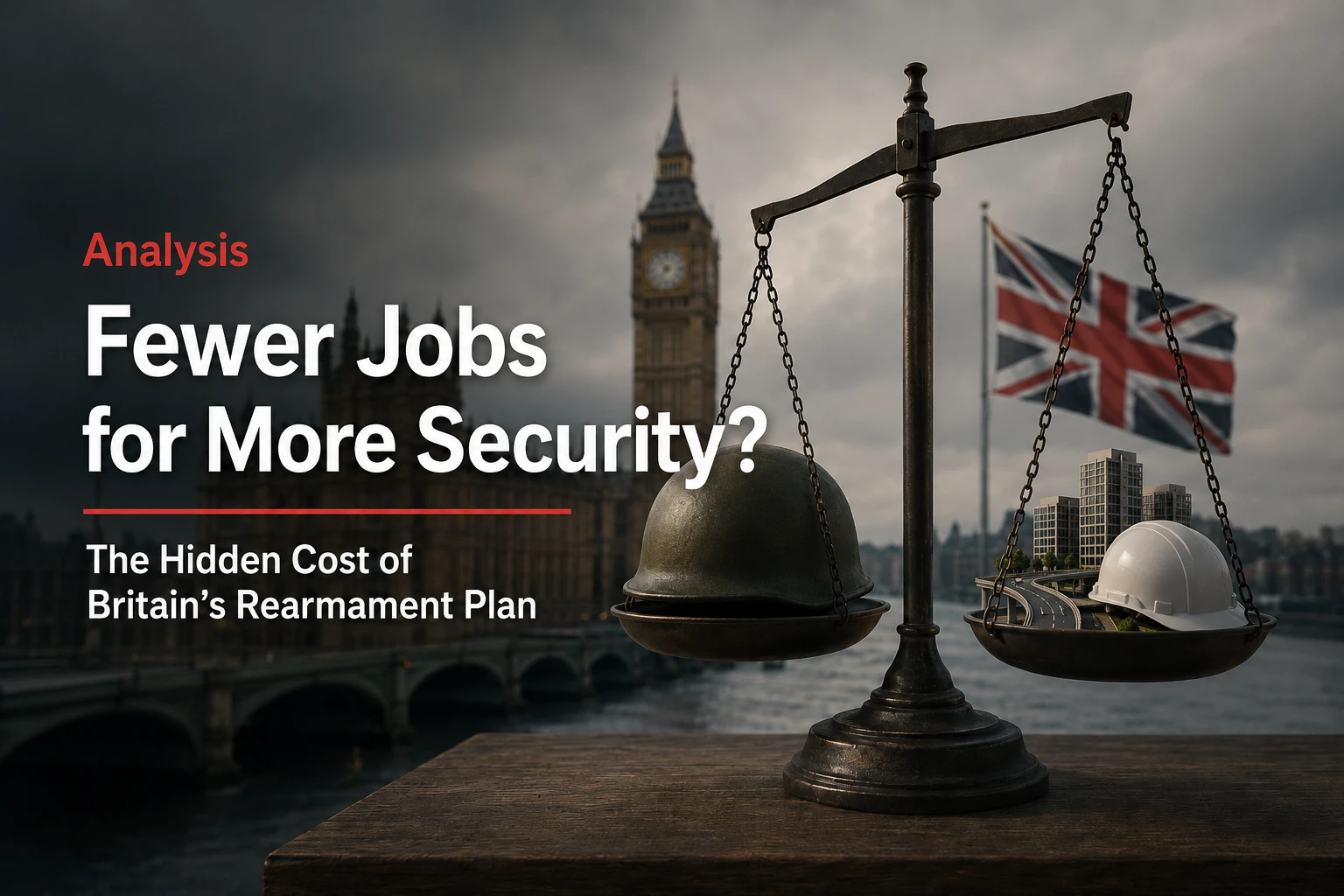
If the funding comes from cuts to energy, transport and infrastructure projects, the question is no longer simply how many jobs defence will create.
It is how many jobs other sectors may lose in return.

Security Is Not Funded for Free
There is no serious case for denying that Britain needs to rearm.
The war in Ukraine, sharper deterrence language towards Russia, the spread of drones and tensions in the Middle East have all pushed Europe to rethink what security now means.
This is no longer just campaign rhetoric about “British strength”.
But it is not a purely military calculation either.
Real security threats — and sometimes threats politically amplified — are being used to push governments towards higher defence spending at a moment when economies are already under heavy strain.
That is why the government’s argument is understandable.
Higher defence spending may be necessary.
But necessity does not abolish arithmetic.
According to Reuters and The Guardian, the plan leaves a £4.7bn funding gap whose source has not yet been identified. Much of the money is also expected to come from redirecting spending away from other departments and projects, including around £6.8bn in cuts to capital spending.
At that point, defence becomes a direct competitor with civilian investment.
A road left unfinished.
An energy project delayed.
A hospital still waiting.
A local investment that might have created jobs outside the military sector.
The paradox is that the government is selling the plan as an investment in both security and the economy. Yet the way it is funded may turn it into a raid on a civilian economy that is already struggling.
Does Defence Create Fewer Jobs?

The real argument is not whether defence creates jobs.
It does.
The question is whether it creates more jobs than the sectors from which the money is being taken.
An analysis cited by The Guardian from the Transition Security Project suggests that shifting £15bn into defence could create around 10,000 defence jobs by 2029-30. But it could also lead to the loss of almost 20,000 jobs elsewhere, particularly in energy and transport.
That would mean a net loss of close to 10,000 jobs.
This is where the government’s easy narrative breaks down.
Not all public spending has the same employment effect.
Some sectors are labour-intensive, supporting large numbers of local jobs in construction, maintenance, services and civilian supply chains.
Defence, by contrast, may rely more heavily on advanced technology, long-term contracts, international supply chains and fewer jobs for every pound spent.
In other words, Britain may gain jobs in weapons factories, drone production and shipbuilding, while losing more in energy stations, roads and local projects.
So the question becomes sharper.
Is Britain buying more security with fewer jobs?
Burnham Inherits the Fireball

The issue becomes even more sensitive because it comes at a moment of political transition.
If Andy Burnham reaches Downing Street, he will want to present himself as a leader of growth and devolution, not merely another manager of austerity.
Yet he may begin his premiership facing a brutal dilemma: a huge defence plan, an unresolved funding gap and limited choices between higher taxes, more borrowing or cuts to civilian spending.
That is an uncomfortable starting point for a leader hoping to convince voters that he has a 10-year plan to repair living standards.
How does a growth project begin if the first bill waiting on the desk involves cutting projects that might have created jobs?
How does a prime minister talk about regional development if local investment is delayed or cancelled in the name of security?
How does he balance fear of Russia against fear of a long stagnation that consumes employment opportunities at home?
This is not a simple choice between defence and jobs.
It is a choice between two forms of security.
Military security, which protects the state from external threats.
And economic and social security, which protects people from unemployment, declining services and weak investment in the future.
When Crises Collide
Britain’s problem is that crises do not form an orderly queue.
The defence crisis does not wait for the economy to recover.
Security pressures do not pause while public services rebuild.
The world does not give governments time to arrange their priorities neatly.
That is why the rearmament plan is more than another line in the budget.
It exposes the dilemma of a state that wants to be more ready for war without becoming less capable of building its civilian economy.
It wants to respond to external threats without weakening its ability to create jobs at home.
Higher defence spending may be necessary.
But necessity does not mean the cost disappears.
And the cost here is not only £15bn in Treasury accounts.
It is a deeper political and economic question: what happens when the state buys more military security while paying part of the price in roads, energy and jobs?
If the aim is to protect Britain, the question is not only how much it spends on defence.
It is what kind of Britain remains after the bill is paid.
Read more:
ShortURL ⬇