


Analysis: Gaza at the Heart of British Politics: Why Is Andy Burnham Apologising Now?
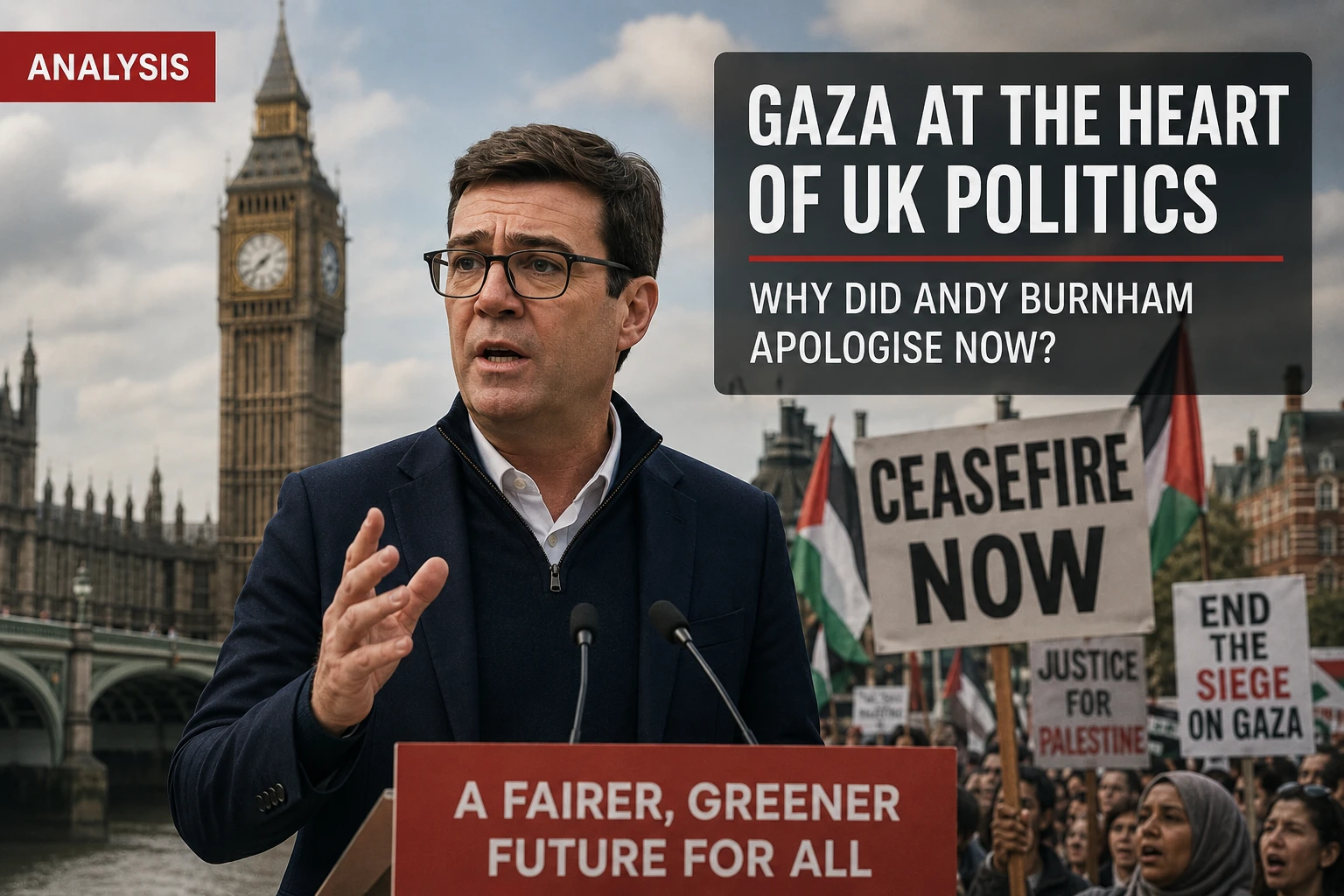
Gaza is no longer a distant foreign policy issue in British politics.
It has become an electoral issue at home.
That is the significance of Andy Burnham’s apology for Labour’s initial response to Israel’s war in Gaza. He is not simply revisiting an old political mistake or reassessing a moral position on a humanitarian catastrophe. He is responding to a growing recognition within Labour that Gaza has become an issue capable of breaking trust, shifting voting blocs and reshaping the party’s relationship with part of its traditional electoral base.
In other words, Gaza is no longer a backdrop to British politics.
It has become part of the political landscape itself.
An Apology in a New Political Language

Burnham acknowledged that many people believed Labour “got it wrong” at the beginning of Israel’s military campaign in Gaza. He said he was sorry that the party’s response “wasn’t good enough”, adding that Britain had been “far too slow” to call for a ceasefire and should have done more to pressure the Israeli government.
This is more than a simple apology.
It is an attempt to rebuild trust with voters who felt that, at one of the defining moral moments of recent years, Labour was too slow to say what should have been said from the outset: call for a ceasefire, protect civilians and hold Israel accountable for its actions in Gaza.
The apology also carries an unmistakable electoral calculation.
Burnham understands that Gaza is no longer solely a foreign policy issue, nor one confined to a particular community. It has become a measure of Labour’s political compass: will the party defend human rights when the victims are Palestinians? Can it criticise Israel without retreating behind cautious diplomatic language?
The Wound Starmer Left Behind

Burnham is not operating in a vacuum.
He is attempting to place distance between himself and Keir Starmer’s initial response to the war, when Labour appeared, to many voters, more aligned with the instincts of the British state and its Western allies than with the principles of equal protection for civilians.
The defining moment came shortly after the outbreak of the war in October 2023, when Starmer said in a radio interview that Israel had the “right” to cut off electricity and water to Gaza, before his team later argued that his remarks had been misunderstood.
By then, the political damage had already been done.
Many voters—particularly Muslims and progressive supporters on the left—concluded that Labour had not merely delayed calling for a ceasefire but had also hesitated to demonstrate political and humanitarian solidarity with Palestinians.
The subsequent internal revolt over the ceasefire, followed by the resignation of several frontbench MPs, exposed divisions that ran far deeper than foreign policy alone.
Gaza as an Electoral Liability

The election results made denial increasingly difficult.
In the 2024 general election, Labour’s support among Muslim voters fell noticeably in several constituencies. The party lost previously safe seats to independent candidates whose campaigns centred on Gaza, while Labour majorities in constituencies with large Muslim populations narrowed significantly.
The issue extends beyond Muslim voters, important though they are because of their concentration in particular constituencies.
Under Britain’s electoral system, relatively small local shifts can determine parliamentary seats. Organised political anger often matters more than national vote share.
In that sense, Gaza has become an undeclared constituency.
It elects no MPs directly.
Yet it has the power to influence many.
Burnham understands that inheriting Labour means inheriting not only its parliamentary majority but also the frustration that accumulated in Britain’s streets, universities, mosques, trade unions and among younger voters who regarded Gaza as a moral test the party failed to meet.
Far More Than a Community Issue
Reducing Gaza to “the Muslim vote” would be a political mistake.
That is only part of the story.
Gaza has united Arab and Muslim communities with sections of the political left, human rights campaigners, younger voters and many others who see the issue less as one of identity than of consistency.
Do British politicians value civilian lives by the same standard regardless of who those civilians are?
That is why Burnham’s apology matters.
Not because it seeks to placate one electoral group, but because it implicitly recognises that foreign policy can, at moments of profound moral significance, become domestic politics in its fullest sense.
When British voters believe their party has responded coldly to a humanitarian catastrophe, the question no longer concerns Gaza alone.
It becomes a question about political representation at home.
Does the party hear its voters when they speak out for Palestine?
Or does it assume that moral outrage will eventually fade?
The Limits of an Apology
An apology alone, however, will not settle the issue.
Burnham has promised to consider tougher sanctions against those responsible for violence in Gaza and measures that could include banning trade with illegal Israeli settlements.
Yet he also stopped short of describing events in Gaza as genocide. Instead, he argued that while evidence of war crimes was mounting, the final legal judgment should rest with international courts rather than politicians.
Some will regard that position as measured and responsible.
Others will see it as another form of political caution: acknowledging suffering without accepting its fullest implications.
That is where Burnham’s real test begins.
Will this apology translate into a different policy?
Will it mean greater pressure on Israel, a tougher approach towards settlement trade, tighter restrictions on arms exports and a more explicit defence of Palestinian rights?
Or will it remain an electoral attempt to win back disillusioned voters without paying the full political price?
A Political Weight That Cannot Be Ignored
The significance of Burnham’s apology lies in what it reveals.
Gaza is no longer an issue that can be overshadowed by debates about the economy, immigration or public services.
It has become a central question in British politics.
It has compelled a potential Labour leader to apologise.
It has forced the party to reassess its relationship with voters it once regarded as secure.
And it has demonstrated that moral crises unfolding thousands of miles away can ultimately shape the outcome of elections at home.
Burnham is not apologising only for the past.
He is signalling that Labour has learned a political lesson.
Gaza has become a political reality that can no longer be ignored.
Those who underestimate its electoral weight may ultimately discover its consequences at the ballot box.
Read more:
ShortURL ⬇
اترك تعليقا
التعليقات

I want to say :Palestine needs more than an apology from Prime Minister Andy Burnham. I finds it disgusting that this was all he said about Gaza and the rest of Palestine. He should be condemned for not supporting the Palestinian People in their fight against Genocidal Israel. Burnham should be condemning Genocidal Israel instead of the 7th of October 2023. By that remark he insulted the Palestinian People and i don’t condemn the 7th of October 2023 and Supporters of Palestine don’t condemn the 7th of October 2023. This shows that Burnham don’t support Palestine. He supports Genocidal Israel !