

Analysis: Trump’s Iran Chaos: Is Britain Being Drawn into a Conflict It Never Chose?
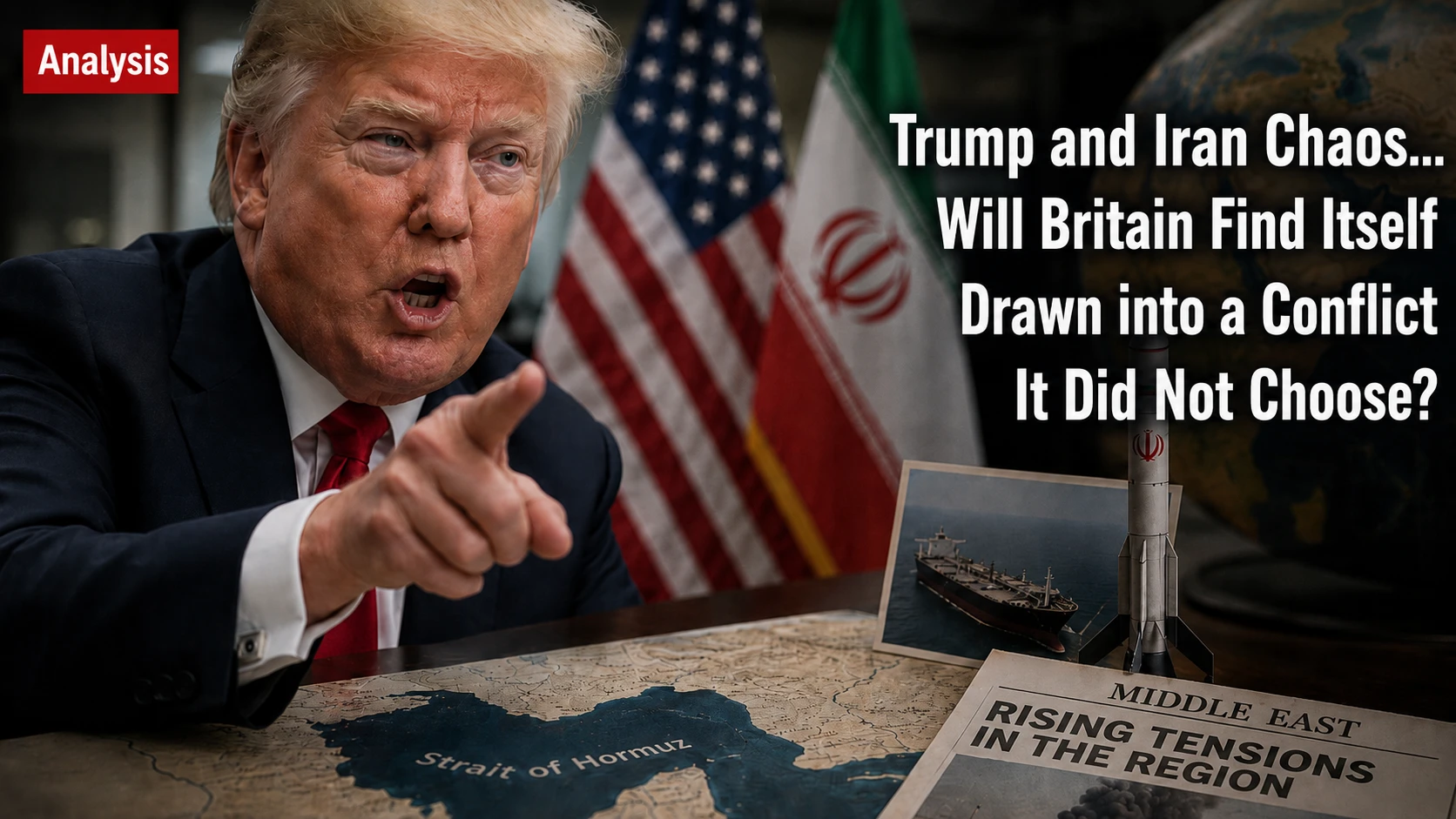
The problem is not simply that Donald Trump is threatening Iran from the stage of a NATO summit.
The larger problem is that no one seems entirely sure what he intends to do once the threats are made.
Does he want war? Another deal? A limited strike? A show of strength? Or merely another political spectacle that allows him to claim he prevented the very conflict he had been escalating?
That is the real danger behind the latest US-Iran tensions. It is not only the missiles, military strikes or the possibility of disruption in the Strait of Hormuz. It is the uncertainty created by an American president who approaches foreign policy through instinct, deal-making and political theatre.
Behind that uncertainty lies an uncomfortable question for Britain and Europe alike: what should allies do when the most powerful member of their alliance is also the least predictable?
When Uncertainty Becomes a Security Risk
At the NATO summit in Türkiye, Trump sharply escalated his rhetoric against Iran. He attacked the country’s leadership in unusually harsh terms and spoke openly about the possibility of further military strikes following signs that recent de-escalation efforts were beginning to unravel.
On the surface, this looked like another chapter in the long-running confrontation between Washington and Tehran.
The context, however, is different.
Trump has never been a leader whose agreements inspire lasting confidence. He signs deals, then walks away from them. He negotiates, then changes course. He brandishes the threat of war before asking for applause because he supposedly prevented it—only to raise the stakes again when the applause fades or the political moment shifts.
No region can build its security on the temperament of a leader who treats foreign policy like a property negotiation—or a film script that can be rewritten the following day.
Trump is not a strategist in the conventional sense.
He is political instinct in motion: quick to change direction, quick to anger and quick to abandon yesterday’s position.
That unpredictability creates problems not only for America’s adversaries, but increasingly for its allies.
The Ally Whose Next Move No One Knows
In international politics, danger does not always come from open hostility.
Sometimes it comes from ambiguity.
Strategic uncertainty encourages competing interpretations.
Iran may read American threats as preparation for a large-scale military strike and decide to act first. Israel may interpret the same rhetoric as permission for further escalation. Gulf states may move to protect their energy infrastructure and shipping routes. Europe may seek de-escalation without knowing whether Washington actually wants tensions to subside.
Uncertainty itself becomes an engine of crisis.
Not necessarily because anyone has consciously chosen war, but because every actor begins making decisions based on the worst possible scenario.
Britain Between Washington and Reality

For Britain, Iran is far from a distant problem.
Any escalation in the Gulf would place immediate pressure on energy prices, maritime trade, British strategic interests and military commitments across the region.
It would also confront London with a familiar political dilemma.
Should Britain stand firmly beside Washington because the Special Relationship demands it?
Or should it attempt to distance itself from a conflict it did not help initiate?
Neither option is straightforward.
Britain remains deeply integrated into NATO, maintains extensive intelligence and defence cooperation with the United States and retains important military interests across the Middle East.
Should American strikes expand into a wider confrontation, the question would quickly become practical rather than theoretical.
What level of British support would follow?
Political?
Intelligence?
Logistical?
Or ultimately military?
This is the cost of strategic dependence.
Washington may decide the pace of escalation.
Its allies often find themselves paying part of the price—in politics, financial markets, security and, potentially, the lives of their own service personnel.
NATO Between Deterrence and Entrapment
The timing is particularly awkward.
Trump continues pressing NATO allies to increase defence spending, arguing that Europe must shoulder greater responsibility for its own security.
Yet his own approach simultaneously risks making Europe’s security environment more volatile.
How can Washington urge Europe to build greater strategic resilience while exposing it to crises over which European governments exercise little control?
Why should Britain increase defence spending to strengthen its own security if part of that investment may ultimately be diverted towards managing American adventures rather than protecting British priorities?
A World That No Longer Knows What to Expect

Trump’s greatest impact is not that he creates individual crises.
It is that he creates a world in which prediction itself becomes increasingly difficult.
Agreements no longer guarantee stability.
Threats do not necessarily lead to war.
Periods of calm no longer signal lasting de-escalation.
Everything appears reversible within hours.
Every statement may become policy.
Every personal grievance carries the potential to become an international crisis.
That uncertainty may worry America’s allies even more than it worries its adversaries.
When foreign policy becomes a sequence of contradictory signals, every government begins preparing for a different version of the future.
Britain may not find itself at war with Iran tomorrow.
But it is already confronting a different challenge altogether.
How does an ally protect itself from the unpredictability of its closest partner before it protects itself from that partner’s enemies?
Read more:
ShortURL ⬇