

Analysis: Labour’s Pandora’s Box – The Blairite Debate Reopens
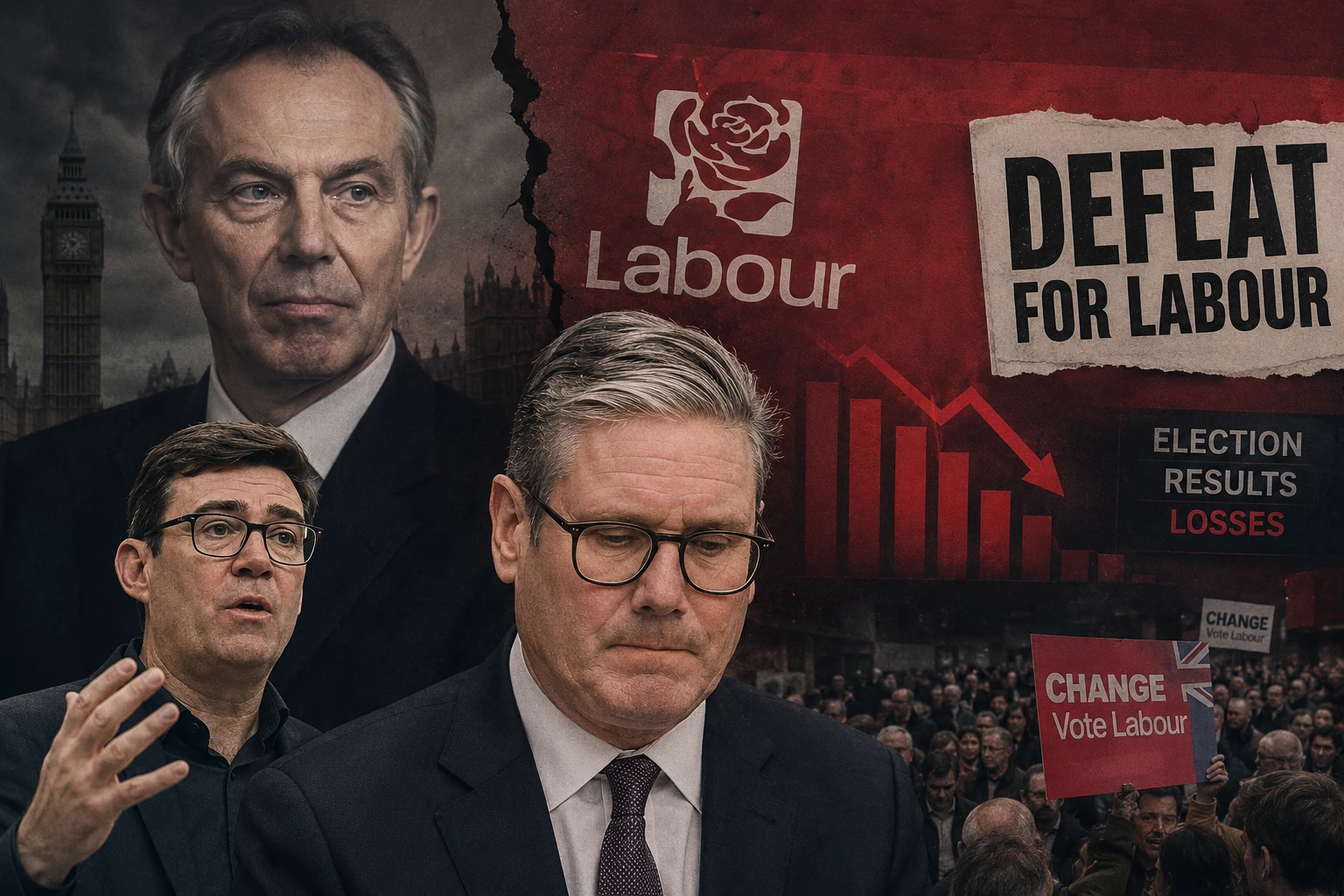
Analysis: Labour’s Pandora’s Box – The Blairite Debate Reopens
Labour’s defeat in the local elections has done more than fuel speculation about Keir Starmer’s future. It has reopened questions that many within the party believed had been settled decades ago.
Suddenly, Tony Blair is back at the centre of the conversation.
Not as a person, but as an idea.
Putting Blairism on Trial — From Within Labour

What makes this moment particularly significant is that the challenge to Blair’s legacy is not coming from Labour’s traditional critics. It is emerging from within the party itself.
Andy Burnham, the Mayor of Greater Manchester and a likely future candidate in the Wigan constituency, has reignited a debate Labour has spent years trying to avoid. His argument is not simply that Starmer’s government is underperforming. It is that the roots of Labour’s difficulties may lie much deeper.
Burnham has openly criticised Blairite neoliberalism, arguing that it has failed to deliver meaningful improvements in living standards for millions of Britons. He has instead called for a stronger role for the state in addressing economic and social challenges.
In doing so, he has revived a fundamental question: what if the problem is not the management of the Blairite model, but the model itself?
For nearly three decades, Blairism appeared to have won the argument. It did not merely reshape Labour; it became part of Britain’s broader political consensus. Even after Blair left office, the assumptions underpinning his project largely remained intact. Leaders changed. Governments changed. Yet the overall direction of travel remained remarkably consistent.
Labour’s Pandora’s Box

In Greek mythology, Pandora was instructed never to open the box she carried. Curiosity prevailed, and once opened, every misfortune escaped into the world, leaving only hope behind.
The recent local elections may prove to be Labour’s own Pandora’s Box.
What the results revealed is that a growing section of the party no longer believes Labour’s problems can be explained simply by government performance or Starmer’s popularity. Increasingly, the debate is shifting towards something more fundamental.
At the very moment Burnham was questioning Blairism, Britain was also debating the rise of the so-called “lost generation”, the housing crisis, declining opportunities for young people, and mounting pressure on public services.
These are not separate issues. Together, they form a broader indictment of the political and economic direction that has shaped Britain for decades.
The criticism levelled at Blairism today is not merely about the policies it pursued. It is about the outcomes it produced.
If Blairism promised that economic growth, market openness and modernisation would ultimately generate wider prosperity and greater opportunity, its critics now point to a different reality: young people excluded from both work and education, increasingly unaffordable housing, widening regional inequalities, and a growing sense that social mobility has become harder rather than easier.
A Debate About Britain, Not Just Labour
This is why the current argument cannot be reduced to a routine factional dispute.
At its heart lies a deeper disagreement about how Britain’s present difficulties should be understood.
One side believes today’s problems are largely the result of poor management, external shocks and temporary challenges that can be addressed within the existing model.
The other is beginning to ask a far more uncomfortable question: what if these problems are the natural consequences of the model itself?
This is what makes Burnham’s intervention politically significant.
He is not simply criticising Starmer. He is challenging the intellectual framework that has guided Labour for an entire political generation.
His question is not why Labour lost local elections. It is why Britain, after decades of economic growth, reform and market-oriented policies, is still grappling with a lost generation, a housing crisis, growing pressure on welfare provision and diminishing opportunities for younger citizens.
From Wigan to Labour’s Future

Viewed through this lens, the forthcoming by-election in Wigan takes on a significance that extends well beyond a single parliamentary seat.
The contest may become the first political arena in which this emerging debate plays out directly: a struggle between those who believe Labour simply needs to manage the existing model more effectively, and those who believe the time has come to rethink the model altogether.
The stakes are therefore larger than a leadership contest.
More Than a Leadership Battle
The most important consequence of Labour’s local election defeat may not be the pressure it places on Keir Starmer.
It may be the reopening of questions that Labour thought it had resolved during the 1990s.
Questions about the role of the state. The limits of the market. The nature of the social contract. And the direction Britain should take over the coming decades.
Political parties can change leaders relatively easily.
But when they begin to question the ideas that brought them to power in the first place, they are entering a far more consequential moment.
What Labour may now be facing is not a temporary leadership struggle, but a period of ideological reassessment that could shape not only the party’s future, but the future direction of British politics itself.
Read more:
ShortURL ⬇