

Russia and “Israel” in Parliament: Two Public Petitions Reveal the British Government’s Double Standards
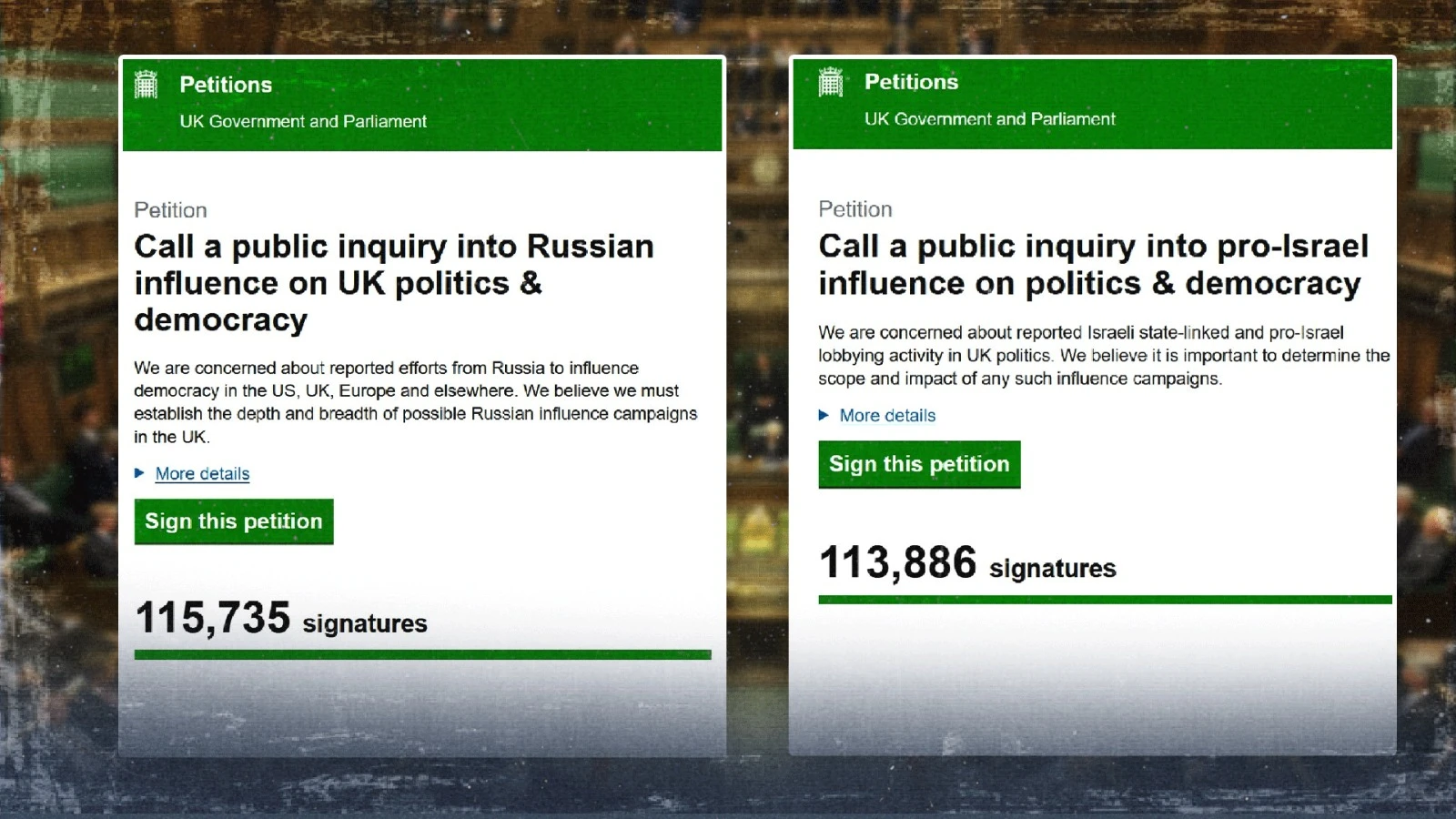
In a scene reflecting the clash between “popular will” and “political calculations,” Parliamentary Petitions No. (744215) and No.(752646) have put the British democratic system to a true test of transparency and equality.
While both petitions successfully surpassed the 100,000-signature threshold—mandating a debate on public and comprehensive inquiries into “foreign influence” in British politics—the official responses from the Government and Parliament revealed a sharp disparity in both “enthusiasm” and “procedural action.”
The first petition, launched in November 2025, focuses on countering Russian influence, citing security concerns over attempts to destabilize democracy. In contrast, the second petition, launched in January 2026, highlights “pro-Israel influence,” driven by public pressure following geopolitical developments in Gaza and the impact of lobby groups on British sovereign decision-making.
Between the “immediate response” to the Russian file and the “bureaucratic reservation” toward the Israeli one, a fundamental question arises: Do the institutions of Westminster address foreign interference with a single standard? Or does the political agenda impose a “procedural bias” that aborts popular demands before they even reach the table of actual debate?
Analysis of the Government’s Response

Upon examining the responses issued by the Cabinet Office, we observed a clear disparity in both language and mechanisms:
- Regarding Russian Influence: (Partial Adoption and Expansion of Scope) The government response was consistent with the petition’s language, as the government affirmed that it “shares the public’s concern.” While refusing to establish a parallel “Public Inquiry,” it justified this by pointing to an already ongoing review (the Philip Rycroft Independent Review). In this instance, the government utilized the petition to bolster the legitimacy of its security measures and the upcoming “Elections and Democracy” bill.
- Regarding Israeli Influence: (Categorical Rejection and Generalization) The government’s response was notably more rigid in its refusal, with the opening statement bluntly declaring: “The Government does not support a public inquiry.” While the Russian petition was referred to the Rycroft Review as a specific mechanism to “address Russian influence,” the Israeli petition was instead directed toward “general transparency frameworks” (such as the Register of Consultant Lobbyists and the Code of Conduct) and the “Ethics and Integrity Committee.” These are broad tools that do not specifically target foreign influence in the same direct manner seen in the Russian case.
The Parliamentary Path: Where Does the Bias Lie?
The widest gap appears when examining the “timeline” and the level of seriousness in legislative engagement:
- Swift Execution (The Russian Case): The Russian petition received a government response in January, and by February 9, 2026, Parliament had already held the debate. Popular demands were transformed into a subject of public parliamentary accountability in record time.
- Procrastination or “The Waiting Game” (The Israeli Case): Despite surpassing the legal quorum with over 113,000 signatures, Parliament has kept the petition in a “waiting” status for 49 days as of the last update. No date has been set for a debate yet, leaving Parliament vulnerable to accusations of deliberately “cooling off” the issue to diminish its momentum.
Comparison of the “Independent Reviews
The Government cited the “Rycroft Review” in both responses, yet employed it in two distinctly different ways:
- In the Russian Petition: The review was presented as an offensive tool to expose Russian infiltrations (such as the explicit reference to the Nathan Gill bribery allegations).
- In the Israeli Petition: The results of the review were presented as a tool for closure. The Government stated that the review concluded on March 25, 2026, and that subsequent measures—such as caps on foreign donations and a ban on cryptocurrencies—had already been implemented. Consequently, the Government considers the matter legislatively closed, dismissing the need for a specific inquiry into the influence of a “particular state,” as demanded by the petition.
The “Rycroft Review” serves as the cornerstone of Britain’s new National Security strategy. It is an independent investigation led by former senior civil servant Philip Rycroft, commissioned by the Cabinet Office to scrutinize vulnerabilities regarding “foreign financial influence” within British politics.
Is There a Bias?
From both a technical and political standpoint, the analysis indicates a “security-driven adoption” of concerns regarding Russia, contrasted with a “political reservation” toward concerns regarding “Israel.”
- Bias in Language: The government employed the rhetoric of a “Foreign Threat” when addressing Russia. In contrast, it used terms like “considering a wide range of views” and “transparency” in the Israeli case. This shift effectively rebrands the issue from one of “foreign interference” to that of “legitimate democratic practice” (Lobbying).
- Procedural Bias: This is evident in the swift scheduling of the parliamentary debate for the Russian petition, compared to the delays and freezing of the Israeli petition under the status of “awaiting debate consideration.”
- To view the petition for an inquiry into Israeli influence on British politics, [click here].
- To view the petition for an inquiry into Russian influence on British politics, [click here].
Read More:
ShortURL ⬇