


The War of Terminology and the Laundering of Crime: How Language Is Weaponised to Criminalise the Victim and Exonerate the Occupation?
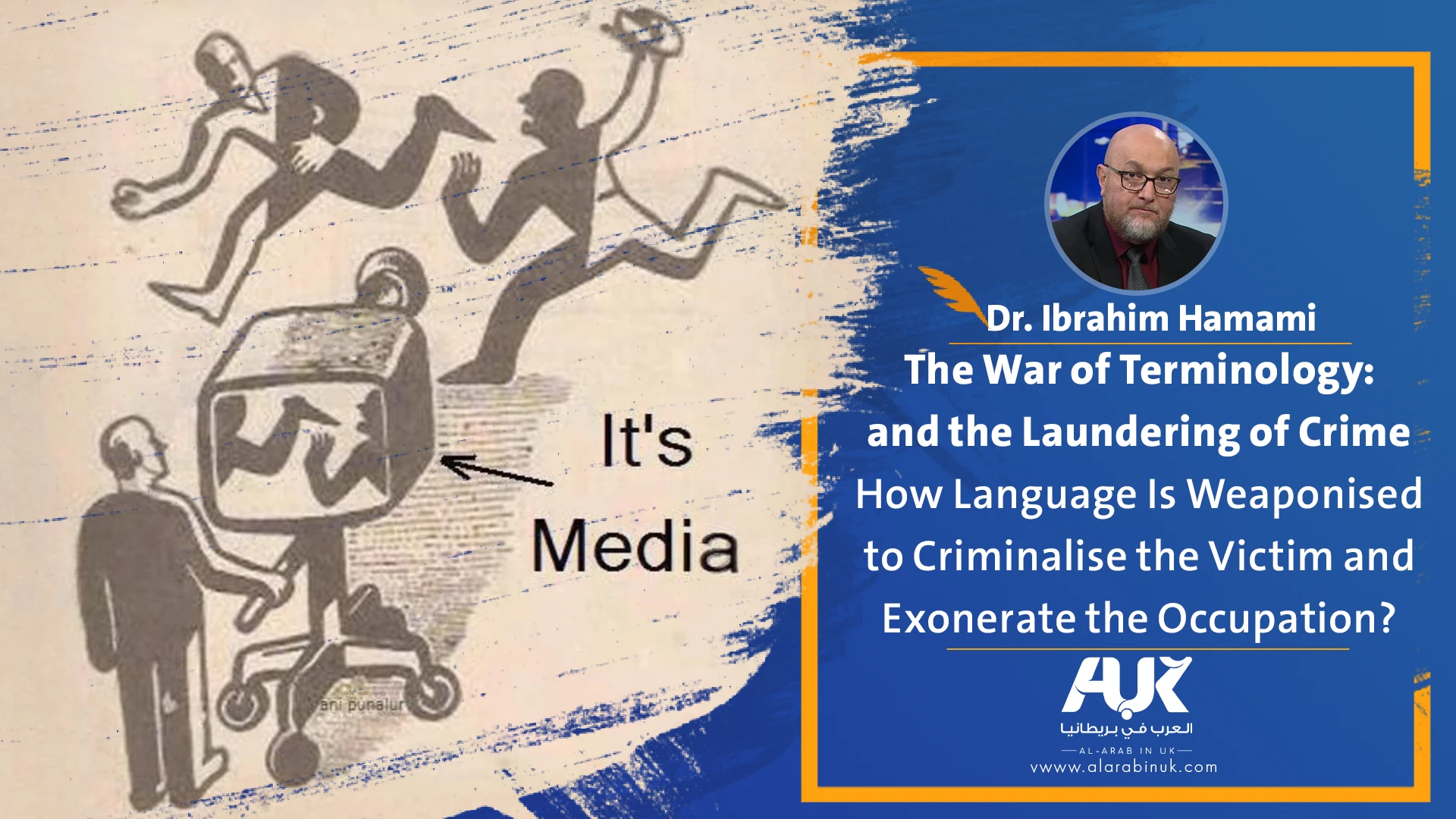
When evidence accumulates to a point where denial becomes impossible, political and media power rarely responds by contesting facts directly. Instead, it shifts the battlefield from reality to language, from events themselves to the way they are framed.
Words are not neutral tools of description; they are gateways to legitimacy, responsibility, and accountability. Whoever controls terminology ultimately controls how reality is understood, judged, and remembered.
Over the past two years, as killing, starvation, siege, and large-scale destruction in Gaza have intensified and been extensively documented, a coordinated discursive system has emerged, led by Netanyahu’s government and reinforced by Donald Trump and right-wing Western media. Its purpose is not merely to defend Israeli actions, but to strip documented crimes of their legal and moral meaning and reinsert them into a securitised, ideological vocabulary. This system goes further still: it actively criminalises the victim, transforms demands for rights into suspicious acts, and reframes solidarity itself as a threat.
In the past month in particular, this media-political system has grown markedly more aggressive. It has moved beyond linguistic manipulation into advanced stages of distortion, inversion of facts, and practical repression.
Measures have been taken to silence, deter, and criminalise those who attempt to expose war crimes or pursue accountability. These include restrictions on entry to the United States targeting Palestinians and their supporters, punitive actions against American universities that witnessed anti-genocide activism, sanctions and threats against judges of the International Criminal Court, and direct attacks on the UN Special Rapporteur on the occupied Palestinian territories, Francesca Albanese.
This marks a decisive shift: from defending Israel rhetorically to shielding it institutionally from scrutiny, and from contesting narratives to criminalising the very mechanisms of truth and accountability.
I. Engineering Language as a Political Weapon
Selective amplification of terminology
Political and media discourse has seen an unprecedented escalation in the use of terms such as:
- Islamic terrorism
- Islamic extremism
- Antisemitism
- Hatred of Jews
These terms are no longer deployed as precise descriptors of specific acts or ideologies. Rather, they function as broad accusatory umbrellas, indiscriminately applied to any expression of solidarity with Palestinians or any critique of Israeli policy. In this way, language ceases to analyse and instead becomes an instrument of discipline, where ethical positions are reclassified as security threats.
Deliberate erasure of legal terminology
At the same time, there has been a systematic marginalisation of well-established legal terms, including:
- genocide
- starvation as a method of warfare
- war crimes
- collective punishment
- unlawful siege
This erasure is not accidental. These terms are grounded in international law and carry direct legal consequences. Their use would shift the discussion from opinion to obligation, from narrative to accountability. Avoiding them is therefore a political necessity for those seeking to prevent legal exposure.
II. False Causality and the Criminalisation of Protest
Attributing violence to solidarity movements
It has become increasingly common for isolated criminal incidents in Western countries – shootings, stabbings, or other acts of violence – to be implicitly or explicitly linked to pro-Palestinian demonstrations, even where no causal connection exists. The logic employed is one of false correlation, designed not to explain violence but to delegitimise protest and discourage political expression.
Double standards in defining violence
Meanwhile, systematic settler violence in the West Bank is rarely discussed in terms of radicalisation or incitement, despite its organisation, armament, and extensive documentation by human rights organisations. Public calls by Israeli ministers for starvation, expulsion, or destruction are similarly excluded from discussions of hate speech or extremism. The determining factor is not the nature of the act, but the identity of the perpetrator.
III. Criminalising Solidarity and Inverting Moral Standards
Turning rights advocacy into suspicion
Support for Palestinian statehood, calls for a ceasefire, or demands to end occupation are increasingly portrayed as:
- incitement to terrorism, or
- ideological cover for violence
This represents a profound moral inversion. The pursuit of rights is reframed as danger, while structural violence is normalised as self-defence.
Stripping Palestinians of political legitimacy
The aim is not counter-terrorism, but the de-legitimisation of any Palestinian political project. Palestinians are reduced to a permanent security problem rather than recognised as a people with rights under international law.
IV. Reversing the Accusation and Absolving the Perpetrator
One of the most striking features of the current discourse is that the very accusations levelled against Palestinians apply directly – and demonstrably – to those promoting them.
When Palestinians are accused of glorifying violence, it is ignored that senior Israeli officials have openly called for:
- the starvation of civilians,
- the destruction of entire neighbourhoods,
- the forced displacement of populations.
Such statements are not marginal; they are issued from the highest levels of government. Yet they are framed as security policy rather than incitement.
Similarly, while Palestinian violence is labelled terrorism, organised and armed settler violence against civilians – conducted under military protection – is treated as an aberration or omitted altogether. The distinction lies not in the act, but in who holds the power to define it.
Incitement, presented as endemic to Palestinian society, is overlooked when it appears in:
- Israeli educational narratives that erase Palestinian existence,
- public chants at settler marches calling for annihilation,
- religious-political rhetoric justifying expulsion and killing.
Here, incitement becomes a selectively applied concept, designed to punish the victim and shield the aggressor.
V. The Discourse of “Reforming the Victim”
Calls to “eradicate extremism from Palestinian minds”, “re-educate society”, or “reform culture” present violence as a cultural defect rather than the predictable outcome of occupation, siege, and daily coercion. Responsibility is displaced from structural oppression onto the oppressed themselves.
No comparable discourse exists regarding settler radicalism, governmental incitement, or systemic dehumanisation within Israeli politics. This silence is not analytical failure, but an essential component of the narrative architecture.
VI. The Ultimate Function of This System
The cumulative effect of this discourse is:
- the laundering of occupation,
- the paralysis of legal accountability,
- the rebranding of systematic crimes as complex security dilemmas,
- and the permanent criminalisation of the victim.
The Palestinian cause is thus reduced from a struggle for liberation and rights to a moral and security problem blamed on those who endure it.
Conclusion
What is unfolding today is not a disagreement over description, nor a transient media controversy. It is a deliberate process aimed at manufacturing a new political and moral reality, in which crime is erased from language, victims are redefined as threats, and impunity is framed as a necessity for security or stability.
Language has become a central weapon in this confrontation: a weapon used to obscure genocide, sanitise siege and starvation, and strip war crimes of their legal meaning, only to repackage them as “complex realities” or “security consequences”. Simultaneously, this language is used to criminalise the victim – not for what they do, but for who they are, how they endure, and their refusal to disappear quietly.
The most dangerous aspect of this system is not merely what it articulates, but what it actively suppresses. When universities are punished, judges targeted, UN officials harassed, and journalists and researchers intimidated, the shift is unmistakable: from managing narratives to criminalising truth itself.
We are witnessing a struggle over meaning before it is a struggle over territory. Law is hollowed out, justice reframed as provocation, accountability treated as a threat, and the victim transformed into a perpetual suspect.
Confronting this system is neither semantic nit-picking nor academic indulgence. It is a political and moral imperative. Defending accurate terminology is defending truth. Insisting on legal language is insisting on accountability. Rejecting the inversion of blame is refusing to normalise injustice.
The greatest danger is not only that crimes are committed, but that they are re-engineered linguistically until they are no longer recognised as crimes at all. At that point, impunity is no longer accidental; it is policy. The final battle is over memory itself: what do we call what happened, and who is allowed to name it?
In this sense, the issue transcends Palestine. It becomes a test of international law, freedom of expression, the independence of knowledge, and the meaning of justice in a world that no longer denies atrocity, but seeks to normalise it through language.
ShortURL ⬇