

Analysis: Palestine is redrawing the boundaries of silence in British culture — who gets to speak?
Analysis: Palestine is redrawing the boundaries of silence in British culture — who gets to speak?
On stage in Philadelphia, British singer Ed Sheeran stood in tears, apologising to his audience after a dispute forced fellow artists out of his tour. He went on to describe what was happening in Gaza as “catastrophic and unjustifiable”.
In London, the Guardian announced that it would defend the documentary NAZA and its filmmakers against threats and attempts at censorship, after the film it helped produce became the subject of a political confrontation in Israel.
And in a television interview, British singer Paloma Faith revealed that she tells her children “Free Palestine” every night before bed, challenging the idea that keeping politics away from children or audiences is necessarily a neutral position.
Three episodes from different worlds: music, investigative journalism and an artist’s family life. Yet they converge on one question: who gets to decide what can be said about Palestine, where it can be said, and what price those who speak should have to pay?
These episodes do not establish that British cultural life has reached a unified position on Palestine. They do, however, reveal a growing struggle over the boundaries of expression — one that extends beyond artists who voice solidarity to the institutions that permit or restrict speech, and audiences increasingly willing to challenge silence.
NAZA: when presenting evidence becomes a political confrontation
In September, the documentary NAZA won the Special Jury Prize at the Venice Film Festival, following a screening that received a standing ovation lasting around 25 minutes.
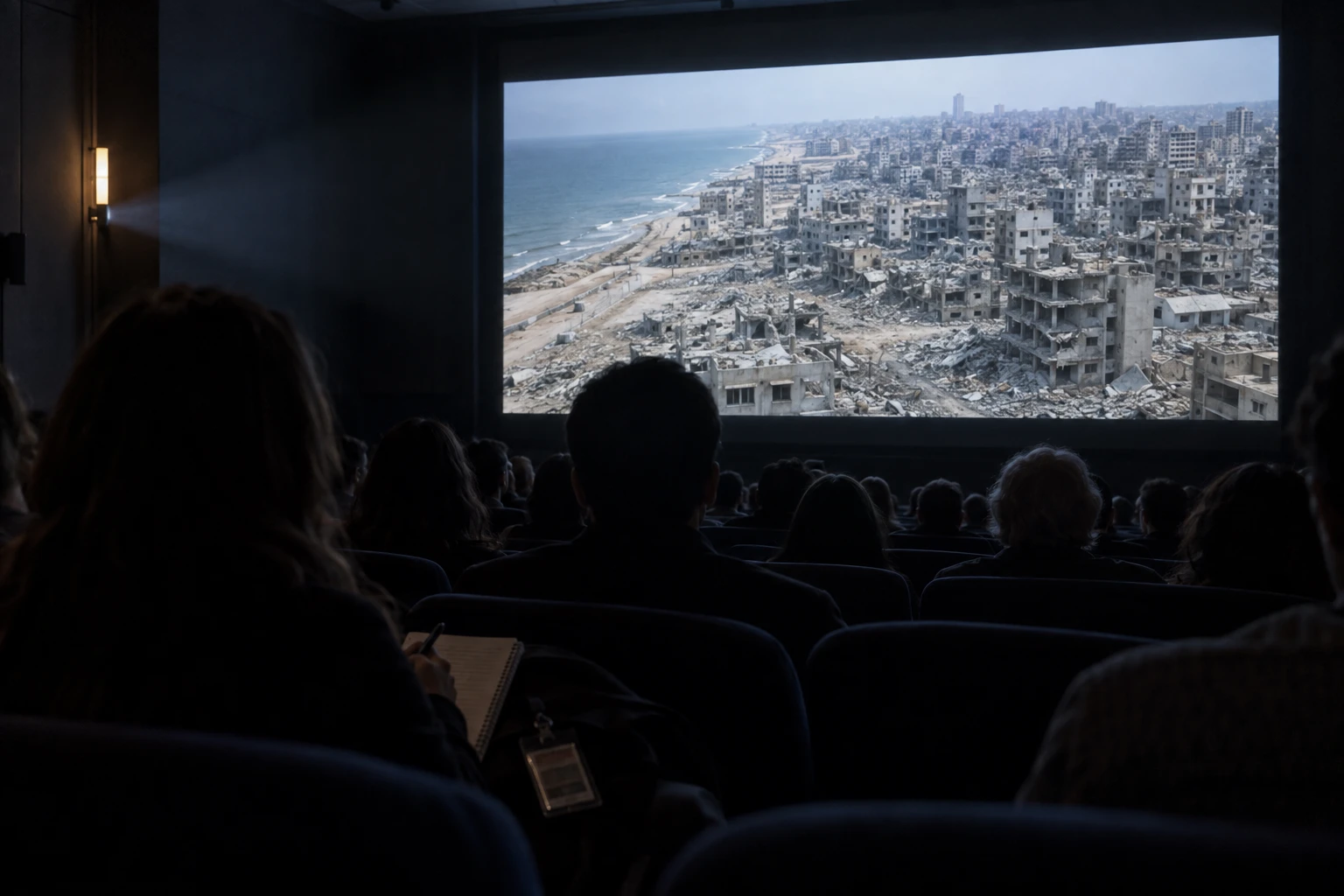
The film, produced by the Guardian and directed by Yuval Abraham and Rachel Szor, draws on testimony from 24 people within Israel’s military and intelligence establishment. It examines the targeting systems used in the war on Gaza, including AI-assisted systems, and the decisions that can result in large numbers of civilian deaths.
The significance of the film is not simply that a British cultural institution expressed solidarity with Palestinians. It is that a major news organisation helped produce an investigation challenging the account of a military establishment belonging to a state allied with the British government.
Israel’s response gave the film another dimension.
Israel’s culture minister accused the directors of treason and called for their citizenship to be revoked. Benjamin Netanyahu then announced plans to pursue legislation targeting those he accuses of defaming Israeli soldiers. The filmmakers faced threats from right-wing activists, while the Israeli military disputed the testimony presented in the documentary.
In response, the Guardian pledged to defend the film and its team against attacks and attempts at censorship, stressing that the work was grounded in years of investigative journalism and that its sources deserved to be heard.
The newspaper went further on 18 September, devoting an editorial to the defence of the filmmakers and criticising the targeting of journalists instead of investigating the allegations their work had uncovered.
This is more than an episode of cultural solidarity.
It is a confrontation over the authority to produce and present evidence. Can a news organisation publish testimony about the actions of the Israeli occupation forces and defend that work, or can exposing those actions be turned into a political accusation against those who publish them?
What makes the case particularly striking is that the film was directed by two Israelis and relies on testimony from within the Israeli establishment. Yet the filmmakers’ identities did not protect them from accusations of treason.
In this confrontation, the boundaries of permissible speech are determined not only by who is speaking, but also by what they reveal.
Ed Sheeran: when neutrality collides with commercial power
In the music industry, the conflict took a different form.
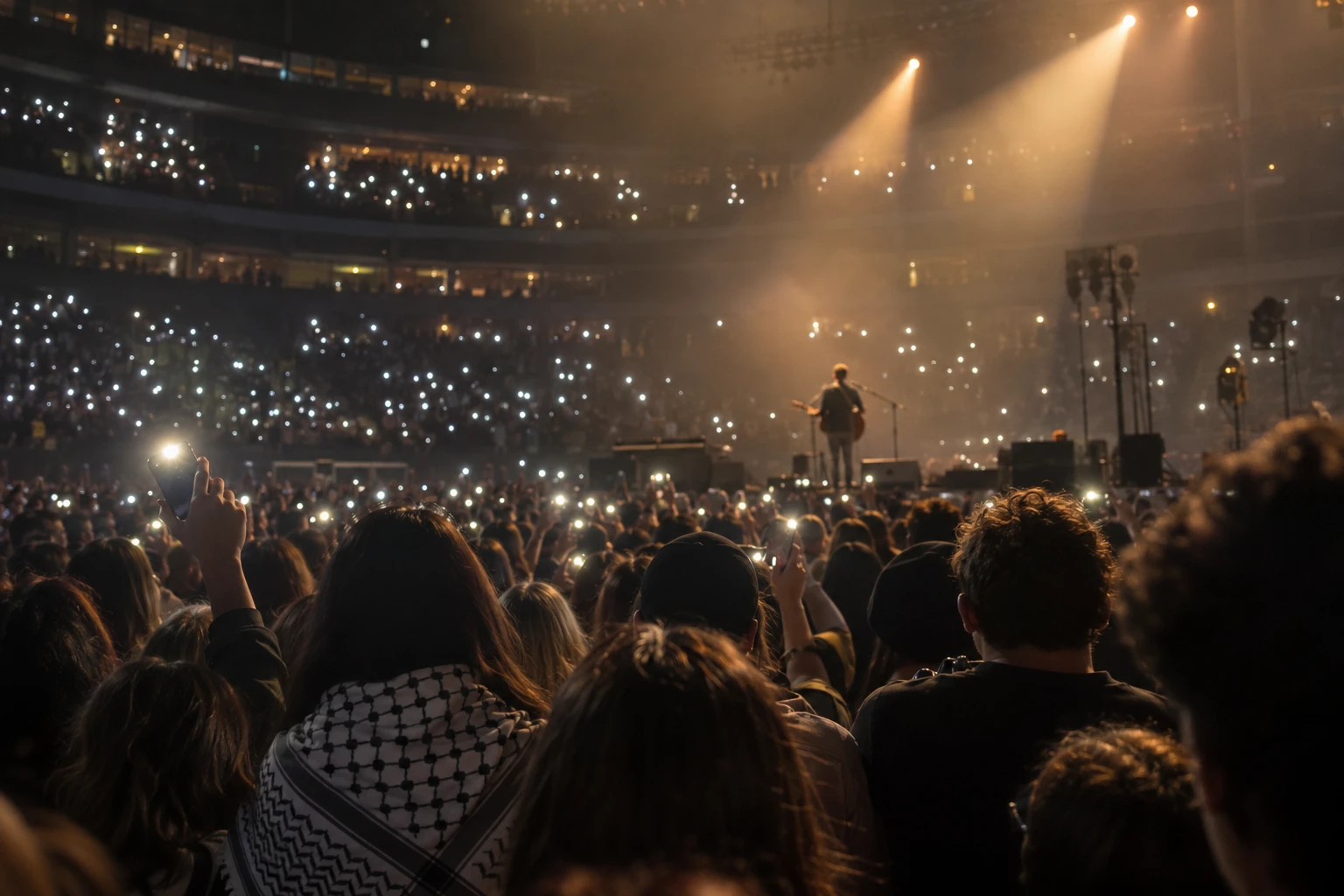
The dispute began when American rapper Macklemore expressed solidarity with Palestinians during performances on Ed Sheeran’s US tour, chanting “Free Palestine” and showing footage relating to the war on Gaza.
His statements drew objections from pro-Israel groups and some stadium owners. According to Sheeran’s account of Macklemore’s removal, venues threatened not to host the concerts if the rapper remained on the bill, before the tour promoter decided to remove him.
Among those objecting was Robert Kraft, owner of Gillette Stadium and the New England Patriots, who accused Macklemore of using antisemitic rhetoric. The rapper rejects that accusation, maintaining that his criticism is directed at Israeli policies, not Jewish people.
The cultural conflict here concerns the boundaries of permissible speech. In the past, criticism of Israel could readily be framed as antisemitism. That association is now increasingly contested, as the symbolic protection long extended to the Israeli state comes under challenge and demands grow for a clearer distinction between criticism of its policies and hostility towards Jews.
Similarly, a distinction must be made between an audience’s right to object to an artist and a venue owner’s power to impose contractual conditions on those using its facilities. But the dispute exposed something beyond both questions.
A concert is not a space controlled by the artist alone. Stadiums, promoters, sponsors, contracts, jobs and commercial interests can all influence what reaches the audience.
Removing Macklemore, however, did not bring the controversy to an end. Instead, it opened a dispute within the tour itself.
Other artists on the bill, including Finneas, Lukas Graham, Aaron Rowe and Biig Piig, withdrew in solidarity with their fellow performer and in protest at restrictions on his expression of support for Palestine.
An attempt to avoid a commercial crisis had produced a wider commercial and artistic crisis.
If excluding an artist carries a cost, silencing one can carry a cost too, particularly when fellow performers are prepared to forgo professional opportunities in defence of that artist’s right to speak.
That is the change worth examining: the power of sponsors and platform owners to set the boundaries of expression is no longer necessarily going unchallenged within the cultural industries themselves.
Who decides what belongs on stage?
Sheeran initially explained his position through his wish for his concerts to bring together audiences from different backgrounds, rather than become arenas of political confrontation.
He maintained that Macklemore’s removal had not been his personal decision and said he did not want to abandon the audiences, workers and performers whose livelihoods depended on the tour continuing.
There is a practical consideration here that cannot simply be dismissed. Major tours do not belong to the headline artist alone, and cancelling them can harm workers and musicians who had no part in the decision.
Yet that argument did not settle the question of neutrality when a commercial institution was determining what an artist could say.
At his Philadelphia concert on 19 September, an emotional Sheeran apologised to his audience for the controversy, acknowledged making difficult decisions and mistakes, and expressed concern about restrictions imposed by venue owners on freedom of expression.
He also described what was happening in Gaza as “catastrophic and unjustifiable”, while maintaining his wish for music to remain a space for unity and humanity.
This should not be read as Sheeran embracing political activism. He continued to insist on choosing his own way of expressing himself.
But Macklemore was not afforded the same freedom: venue owners and the tour promoter intervened to determine what he could say on stage.
The question therefore extends beyond Sheeran’s personal position: do artists get to choose whether to speak or remain silent, or does that decision depend on the approval of those who own the venues and finance the performances?
Paloma Faith: the dispute reaches the meaning of neutrality itself
Paloma Faith takes the discussion into another sphere.
In an interview with Channel 4’s The Fourcast podcast, she said she tells her children “Free Palestine” every night, and criticised Sheeran’s justification for avoiding political statements on the grounds that his concerts attract children and audiences from different backgrounds.
For Faith, Palestinian children themselves are living through realities that cannot be ignored. Shielding other children from discussing those realities is not necessarily a form of protection.
She summed up her position by arguing that choosing not to engage in politics can itself be a political position.
The significance is not that Faith has found a new way to express solidarity. She has spoken publicly about Palestine for years.
What matters is that the disagreement now concerns who gets to classify discussion of Palestinian suffering as political speech from which other children should be shielded.
From Sheeran’s perspective, a concert may offer a temporary space in which people can step away from the conflicts that fill their daily lives.
Faith, by contrast, challenges the assumption that acknowledging a humanitarian catastrophe amounts to politicising an audience, while avoiding it constitutes neutrality.
There is no evidence that British artists or audiences are united behind either position.
But the visibility of the disagreement shows that neutrality has itself become a contested concept, rather than a professional principle whose meaning everyone accepts.
Who protects a work — and who decides to withhold it?
The question becomes more consequential when attention moves from individual artists to media and cultural institutions.
While the Guardian chose to defend NAZA and its filmmakers, the BBC continues to face controversy over its decision to withdraw the documentary Gaza: How to Survive a Warzone.
The BBC pulled the film after information emerged about the identity of its narrator — the son of a Hamas official — raising concerns about failures in editorial checks and standards.
In an interview published on 15 September, one of the film’s directors, Jamie Roberts, acknowledged that a serious mistake had been made. He also insisted that the Palestinian stories told in the documentary still needed to be shown.
The two cases cannot simply be treated as equivalent. An editorial review of a source or documentary is not necessarily political censorship, and news organisations have obligations of accuracy and transparency.
The comparison nevertheless exposes a genuine dilemma: how can institutions address editorial failures without allowing the testimonies of those who lived through the events to disappear with them?
The question of freedom of expression thus extends beyond a director’s or journalist’s right to complete and publish a work. It also concerns the public’s access to testimony, and the right of those who gave it not to have their experiences erased by institutional failures that may be capable of correction.
Palestinians are not merely the subjects of solidarity
There is, however, a risk in reading this cultural shift solely through British celebrities and institutions.
If Palestine becomes visible in cultural life only when a British singer speaks about it, or when an Israeli journalist decides to investigate what happened there, Palestinians remain the subjects of other people’s narratives rather than producers of their own.
That is why another strand of cultural activity in London this September matters.
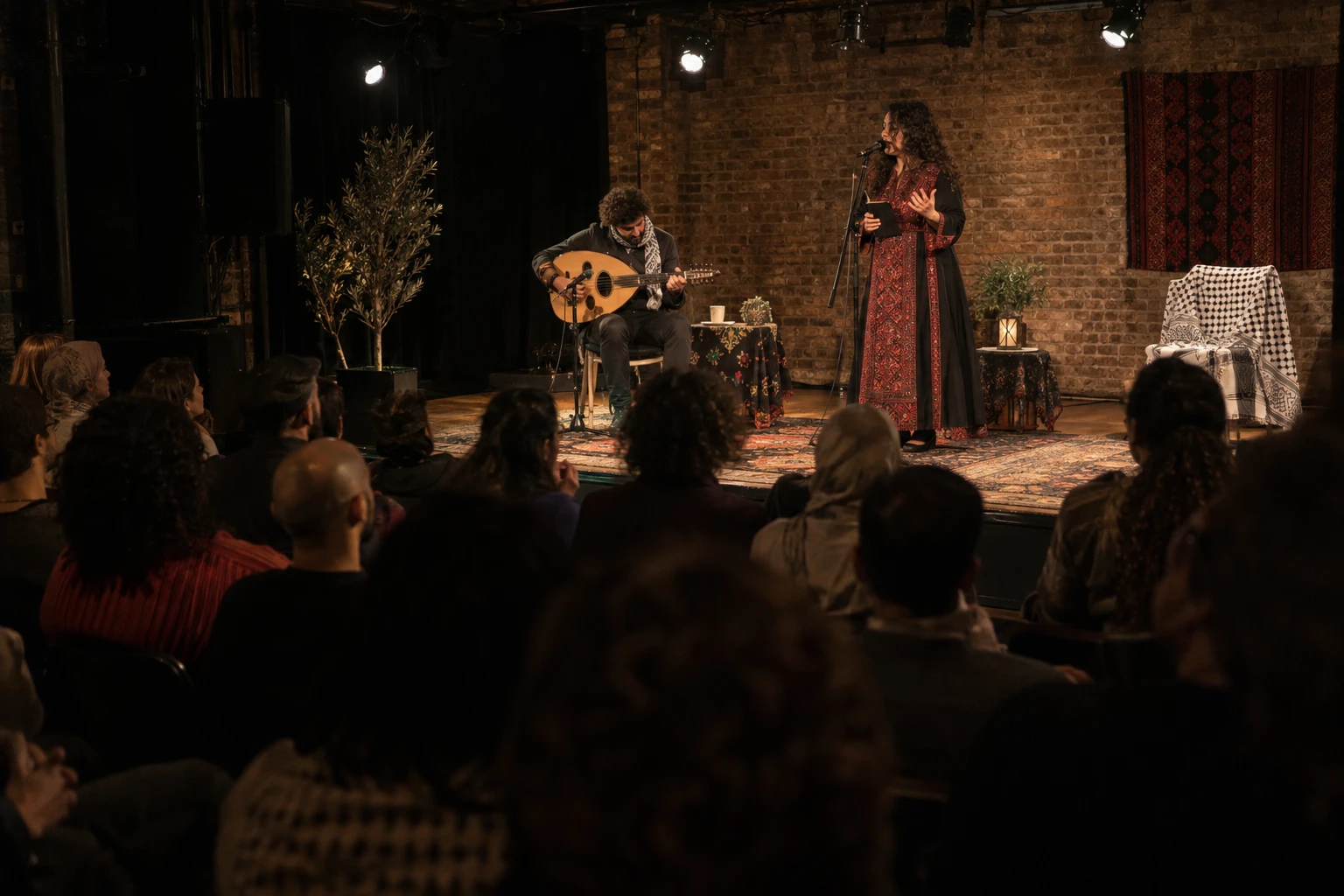
From 11 to 13 September, Palestine House hosted the inaugural Palestine House Film and Arts Festival, featuring documentary, fiction, experimental and animated films from Palestine and elsewhere, alongside conversations with filmmakers and musical performances.
The festival presented cinema as a means of preserving memory and keeping people, places and everyday life visible. Its first edition was dedicated to the memory of Palestinian photographer and journalist Ismail Abu Hatab.
From 23 September to 3 October, London’s Pleasance Theatre will host the fifth PalArt Festival of Palestinian arts, bringing together theatre, comedy and music and creating a platform for artists from Palestine and the diaspora.
The programme includes work by the Palestinian National Theatre, El-Hakawati, alongside performances by contemporary Palestinian artists, including musician Ahmed Eid.
These events do not necessarily mean that Britain’s major cultural institutions have fully opened their doors to Palestinian artists. They do, however, show the existence of spaces in which Palestinians produce the work, choose its subjects and present it to audiences themselves.
There is a fundamental difference between allowing others to speak about Palestinians and giving Palestinians a platform from which to speak for themselves.
Belated recognition does not erase the question of earlier silence
The experience of NAZA reveals another paradox.
The Guardian published an account by Palestinian journalist Mahmoud Mushtaha, from Gaza, describing his experience of watching the film and the memories its Israeli military testimonies brought back of relatives and friends he had lost.
In his article published on 17 September, Mushtaha raised a question that goes beyond celebrating the documentary: why did the world need testimony from within the Israeli military establishment before believing what Palestinian journalists had been reporting about the killing of their families and the destruction of their cities?
This is not an argument against the film or its investigative value.
Rather, it points to the limits of cultural recognition if Palestinian experience must still be validated by someone else before it is believed.
Applause for a film about Gaza cannot, by itself, change the conditions Palestinians are living through. Nor can it make up for the years in which their testimony was met with suspicion or indifference.
If Palestine’s presence in British culture is growing, the deeper test is whether that growth gives Palestinians themselves greater standing as witnesses, artists, journalists and authors — rather than leaving them as subjects of works that gain recognition when others produce them.
Who gets to speak?
Recent developments do not suggest that British culture has suddenly arrived at a unified position on Palestine.
Objections to Macklemore have not disappeared. Stadium owners retain considerable commercial power. Media institutions continue to differ over publication and broadcast decisions, while artists themselves disagree about neutrality and the limits of their public responsibilities.
What has changed is that this power no longer operates without being questioned.
When a commercial organisation excludes an artist for speaking about Palestine, it may face the withdrawal of fellow performers. When a news organisation comes under pressure over an investigative film, it can choose to defend the work rather than abandon it. And when an artist explains silence as a way of keeping politics away from an audience, other artists may challenge the very definition of neutrality on which that argument rests.
At the same time, Palestinians in Britain are expanding the spaces in which they tell their stories through their own voices and artistic work.
The significance of this shift cannot therefore be measured by the number of celebrities who have said “Free Palestine”, or by the length of the applause received by a film about Gaza.
It lies in changing balances of power within cultural life: between the artist and the sponsor, the journalist and the institution, and the witness and those who decide whether that witness deserves to be heard.
Palestine is not only redrawing the boundaries of what artists can say. It is bringing into question the authority that has long determined who gets to speak — and who gets to silence others.
Read more:
ShortURL ⬇