

Report| Beyond Farage: The Thinkers and Networks Shaping Reform UK
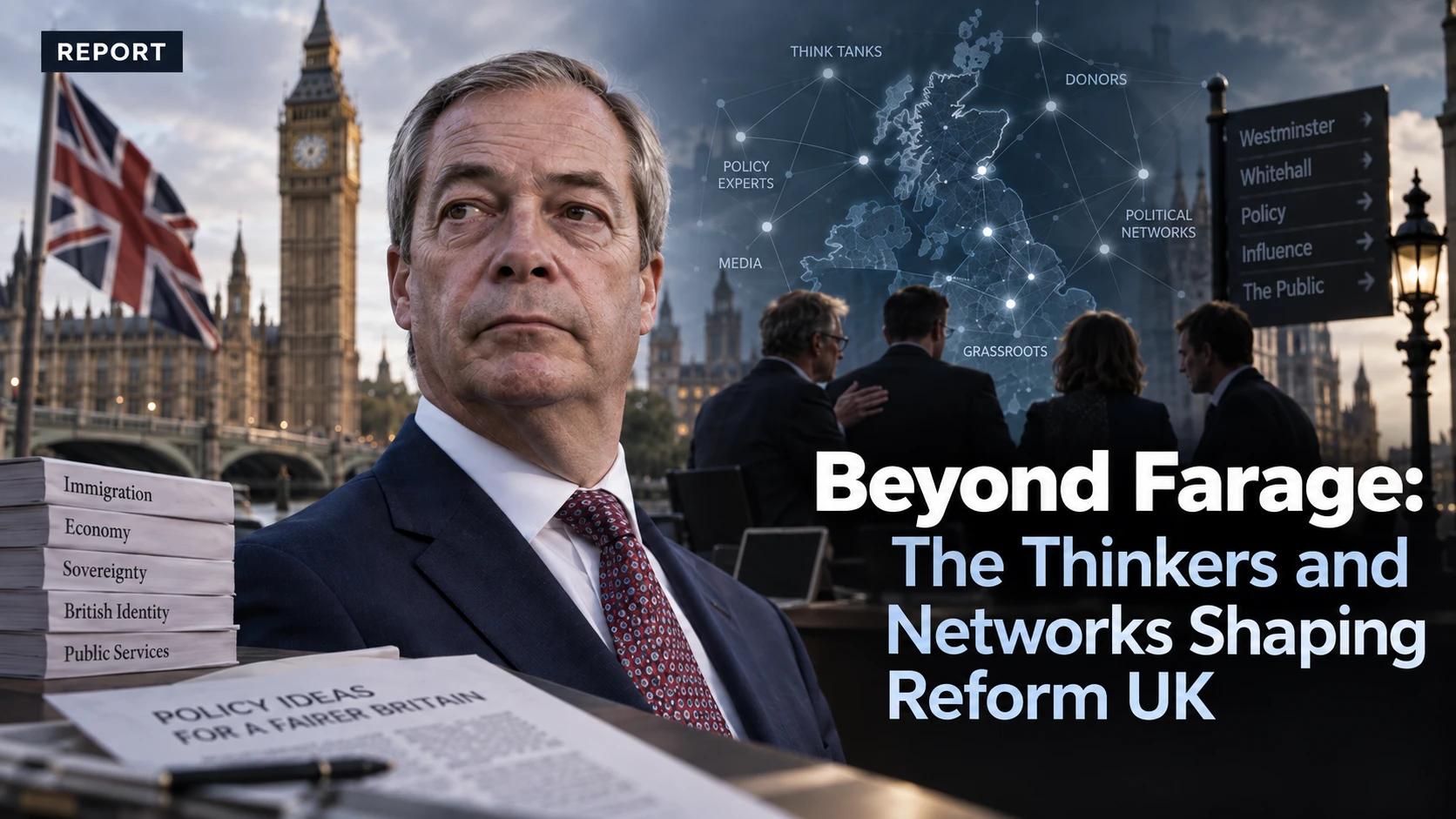
When Reform UK unveils a new policy on immigration, taxation or the machinery of government, Nigel Farage is usually the figure presenting it to the public. But behind the party leader’s dominance of the political stage, a more complicated intellectual and institutional network has begun to take shape.
It includes former Conservative politicians, specialist advisers, think tanks and figures linked to transatlantic currents of national conservatism. As Reform moves from protest politics towards openly preparing for government, the question is no longer simply what Farage wants. It is also who is shaping the ideas around him, how those ideas are being developed, and which of them might eventually be translated into a programme for power.
Three broad circles can now be identified: a political leadership that sets direction, a policy apparatus attempting to turn broad themes into governing plans, and a wider intellectual ecosystem that supplies ideas, personnel and connections. Those circles overlap, but they are not the same. Nor does an association between a Reform figure and a particular institution or thinker mean the party has adopted that institution’s entire worldview.
James Orr: a bridge between Reform and the new right
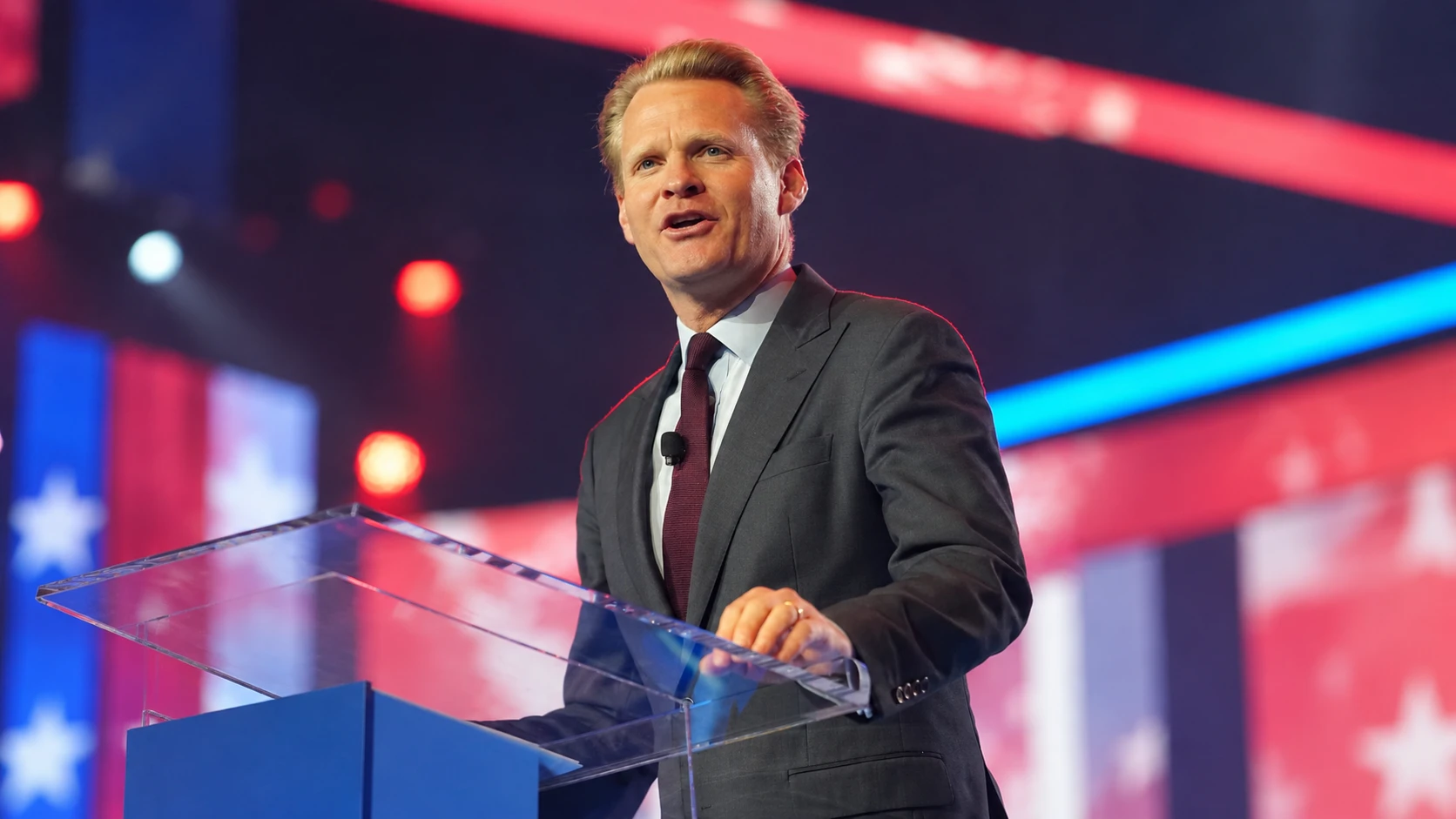
James Orr, an associate professor of philosophy of religion at Cambridge University, sits close to the point where several of these circles meet.
He moved from academic and intellectual life into Farage’s political orbit before becoming Reform’s head of policy. On 4 September, Orr stepped aside from his party role, along with adviser Dan Jukes, pending an internal inquiry following an undercover investigation into alleged arrangements involving foreign-funded polling. Reform denies wrongdoing, and the allegations have not been established in court.
His temporary departure does not diminish his relevance to understanding the development of Reform’s policy thinking.
Orr previously worked with the Centre for a Better Britain, a think tank established to develop proposals for reshaping the state and economy. More importantly, he is also the UK chairman of the Edmund Burke Foundation, the organisation behind the international National Conservatism conferences.
That gives him a formal role inside an intellectual network extending well beyond Britain, rather than making him merely an occasional conference participant. Orr also has links with prominent figures on the American right, including US vice-president JD Vance and billionaire Peter Thiel, as well as conservative networks connected to Hungary — relationships examined in detail in a recent Financial Times profile.
At that point, the story of Reform becomes larger than the story of a single British party.
A transatlantic network, not simply a British revolt

The ideas circulating around Reform are not all being produced in Britain.
Over the past decade, an increasingly interconnected political and intellectual sphere has developed across parts of the American, British and European right, organised around recurring themes: immigration, national identity, the traditional family, religion, sovereignty and hostility to liberal elites and supranational institutions.
National Conservatism has become one of the principal meeting grounds for this tendency. Its conferences bring together politicians, academics and activists who defend the nation-state as the central framework for democracy and political legitimacy, criticise political and cultural globalisation, and seek to restore a larger role for religion and inherited national traditions in public life.
Orr’s relationship with this movement matters because he has held a leadership position within its British infrastructure while simultaneously occupying a senior policy role inside Reform.
In evidence to a House of Commons committee, investigative journalist Peter Geoghegan described the network surrounding the new right as more organised than many in Britain appreciate. He pointed to Orr’s American relationships and to the Centre for a Better Britain’s interest in learning from the Heritage Foundation, the US conservative institution heavily associated with Project 2025.
That does not mean Reform is importing Donald Trump’s governing model wholesale. Britain’s constitutional system is different, as are the political status of the NHS, pensions and the welfare state.
But the comparison does reveal a shared preoccupation among parts of the new right with a question that goes beyond electioneering: what happens after victory? How can an elected government reshape institutions, reduce the autonomy of bureaucratic bodies and ensure that the state carries out its political programme?
Seen from this perspective, Reform’s rise is not adequately explained as a British reaction to immigration or Conservative failure alone. It is also developing within a broader Western current of national conservatism in which institutions, personnel and ideas travel across borders.
Some scholars go further. In an academic article published in August 2026 in The Political Quarterly, Kian Aspinall places Reform within a longer history of what he calls British “racial nationalism”. He argues that the party’s rhetoric draws on themes historically associated with the nationalist right, including demographic threat, white grievance, anti-cosmopolitanism and the recovery of sovereignty.
That is a scholarly interpretation, not Reform’s own description of itself. The party rejects accusations of racism and presents its nationalism as rooted in citizenship and British culture. Nor is the wider national conservative movement a single ideological bloc that can simply be reduced to white nationalism.
But the debate points to a larger question than whether Reform is merely “tough” on immigration. It raises the issue of what kind of nationalism the party is moving towards as it attempts to turn electoral insurgency into a governing project.
Christian nationalism moves closer to British politics
The religious dimension of this network is not incidental.
Orr is a theologian whose route into politics followed a personal religious conversion, and he has built relationships with conservative Christian academics and activists. The Financial Times has described a religious and intellectual community around him in Cambridge involving students, researchers, meetings, prayer and political discussion, with supporters seeing it as a space for cultivating a new generation of Christian conservatives.
National Conservatism itself makes little attempt to conceal this dimension. Its statement of principles describes the Bible as one of the foundational sources of Western civilisation and argues that public life in Christian-majority countries should be rooted in Christianity and its moral vision, while protecting the rights of religious minorities.
That is a more ambitious claim than simply treating Christianity as private faith or historical heritage. It assigns religion a role in defining national identity and informing public life.
Related themes can increasingly be heard around Reform: protecting churches, giving greater prominence to Christian heritage in education, and placing family and marriage more centrally within social policy. Danny Kruger, who is leading Reform’s preparations for government, has long been associated with Christian conservative politics, particularly on family issues.
That does not make Reform a fully formed Christian nationalist party, nor does it mean that all its policies flow from religion. Reform contains politicians with markedly different social, economic and religious outlooks.
The more defensible claim is narrower: some figures with significant influence over the party’s developing policy architecture belong to an intellectual world in which Christianity is treated not merely as private belief but as part of the political meaning of the nation.
How do Muslim Reform figures fit into a politics of Christian heritage?
One of the more striking features of Reform’s emerging coalition is the presence of prominent Muslim figures who themselves argue for a stronger public recognition of Britain’s Christian inheritance.
The clearest example is Zia Yusuf, Reform’s home affairs and immigration spokesman, who describes himself as a practising Muslim. In an interview with The Times, Yusuf argued that Christianity remains central to Britain’s history and national identity, linked its decline to what he described as a wider crisis of meaning, backed restrictions on converting churches into mosques, and called for Christianity to occupy a larger place in the school curriculum.
He does not present this as a conversion in his own religious identity. Rather, he frames it as a defence of the historic culture of the country to which he belongs.
A similar tension appears in the politics of Laila Cunningham, Reform’s Muslim candidate for mayor of London, who has called for a more visible celebration of Christianity while taking hardline positions on immigration and Islamist extremism.
These cases complicate any simple description of Reform nationalism as ethnically or religiously exclusive.
The form of nationalism being articulated by some minority figures inside the party does not necessarily require a person to be Christian or ethnically English. It does, however, place a strong emphasis on adopting a particular understanding of Britain’s historic culture, including its Christian inheritance.
That immediately raises another question: where does the defence of a shared national culture end, and where do the conditions of belonging become so demanding that the Britishness of some citizens is treated as suspect?
That tension surfaced recently when Yusuf posted about Sagal Abdi-Wali, the Somali-born leader of Camden council and a possible candidate for the Holborn and St Pancras parliamentary seat. Business secretary Jonathan Reynolds described Yusuf’s post as explicitly racist, while figures within Reform itself, including Cunningham, criticised his intervention.
The episode does not settle the argument over Reform’s nationalism, but it sharpens it. Is belonging ultimately defined by citizenship and political loyalty, or by conformity to a cultural model that can sometimes be used to question the legitimacy of citizens who are legally and socially British?
Danny Kruger and the state Reform wants to build
If Orr represents one of Reform’s bridges into the world of ideas, Danny Kruger is working on a more practical question: what would Reform actually do with the British state if it won power?
Kruger leads the party’s Preparing for Government project, which has produced detailed proposals for restructuring Whitehall and the civil service.
In a paper titled “Fixing the Centre”, he proposes abolishing the Cabinet Office in its current form and ending the position of cabinet secretary, replacing parts of the existing machinery with a more powerful prime ministerial office led by a political chief of staff. He also advocates giving ministers greater powers to appoint and dismiss senior civil servants.
Other proposals include reducing civil service headcount, expanding the use of artificial intelligence and returning functions from some arm’s-length bodies to government departments. In an earlier paper, Kruger estimated that civil service numbers could be cut by 13 per cent, producing annual savings of about £5.2bn.
These are not simply campaign slogans. They amount to an attempt to design a different institutional model — one in which elected ministers exert greater control over the administrative state and the independence of some public bodies is reduced.
Whatever the eventual feasibility of those plans, their existence is significant. Reform is no longer merely arguing that Britain’s institutions are failing. Parts of the party are now trying to specify how those institutions should be rebuilt.
From Tory defectors to a broader policy machine
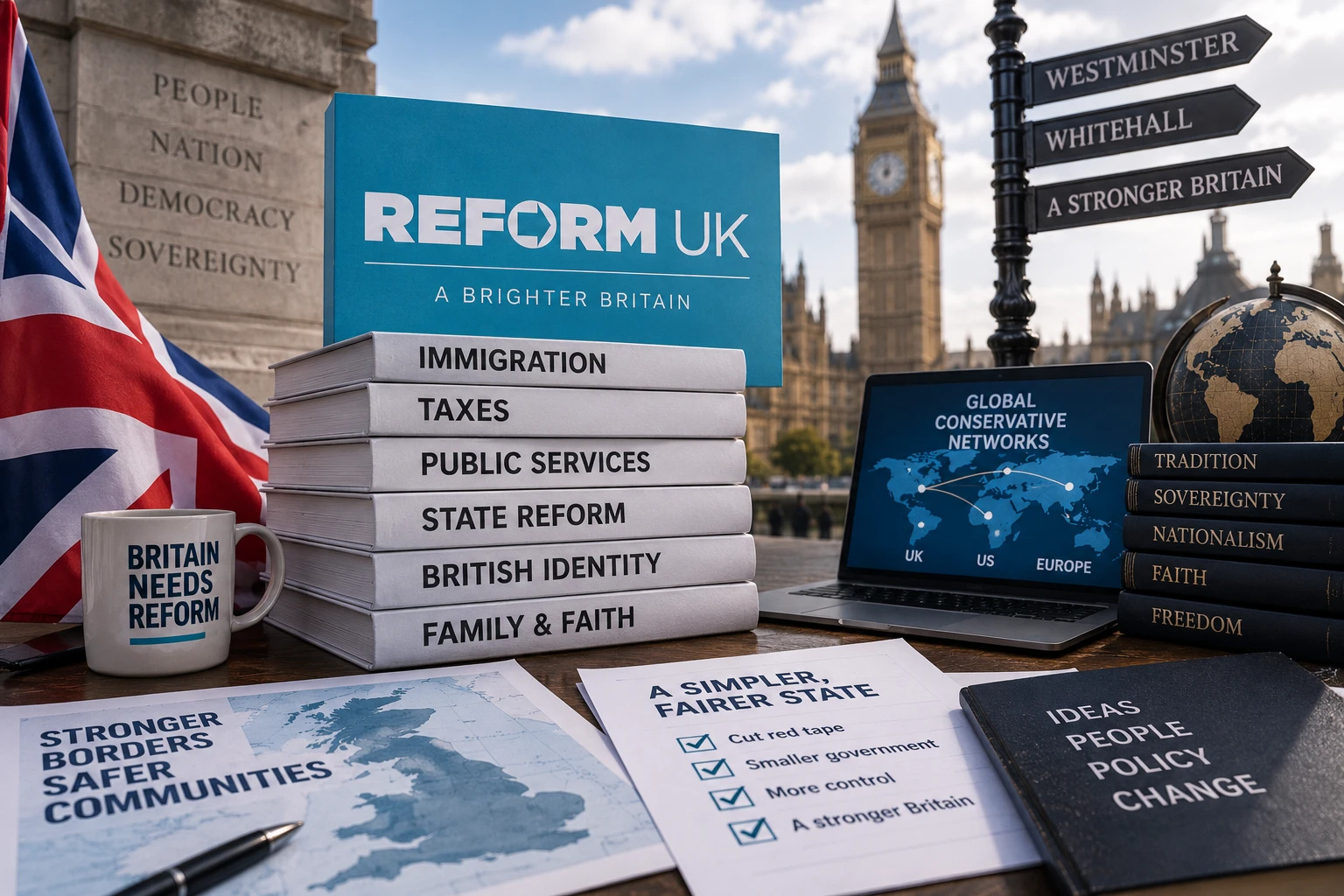
The arrival of former Conservatives has helped Reform turn broad ideological themes into more conventional departmental policy portfolios.
Robert Jenrick holds the Treasury brief, Suella Braverman covers education, skills and equalities, Richard Tice business, trade and energy, while Yusuf leads on home affairs and immigration.
But this is not an ideologically seamless front bench.
The party’s economic right tends towards lower taxes, deregulation and a smaller state. National conservatives, by contrast, can be more comfortable with intervention where it is justified in the name of strategic industry, family policy, national identity or security.
That creates a tension Reform has yet to resolve.
How does a party promise a smaller economic state while simultaneously demanding a stronger cultural and security state? How does it reconcile pressure for lower taxes and spending with protections for pensions and public services that matter to a large part of its electoral coalition?
Those contradictions may remain manageable in opposition. They become much harder once rhetoric has to be translated into budgets.
Who pays for the machine?

A developing policy apparatus also requires money.
Recent donation figures show Reform relying heavily on a small number of wealthy donors, including entrepreneur Ben Delo, who gave around £4m of the £5.3m raised by the party in the second quarter of 2026, according to figures reported by Reuters.
That concentration of funding does not establish that donors write party policy or receive decisions in return for money.
The more cautious conclusion is that substantial private funding gives Reform the capacity to hire staff, commission research, cultivate networks and professionalise its preparation for government. Any claim of direct influence over a particular policy would require separate evidence.
Farage remains at the centre — but the project is becoming larger than him

Farage is still Reform’s political centre of gravity.
He remains the figure who gives the party its mass appeal and defines many of its most recognisable themes: immigration, borders, sovereignty, opposition to net zero and hostility to the political establishment.
But around him a wider intellectual and political structure is developing.
Three broad tendencies can be identified within it: Farage’s nationalist populism; a more institutional and often Christian-inflected national conservatism; and an economic right focused on tax cuts, deregulation and shrinking parts of the state.
Those tendencies do not always point in the same direction, and there is no guarantee that they would carry equal weight in government.
That may become the central question facing Reform if its electoral advance continues. Not simply whether it can win more seats, but which part of its emerging coalition would ultimately define the party once campaign promises became government decisions.
Behind the slogan of “taking Britain back” sit more difficult questions about the state, the economy and national identity.
Does Reform ultimately want a civic nation open to anyone willing to integrate into its culture? A country in which Christian heritage is given greater political weight? A smaller economic state combined with a more assertive cultural and security state? Or some unstable mixture of all three?
The answer is still being formed.
What is already clear is that Reform is no longer only an electoral vehicle built around Nigel Farage. It is also becoming one of the British arenas in which a wider Western right is testing whether ideas developed through conferences, think tanks, religious networks and policy papers can be turned into a programme for government.
Read more:
ShortURL ⬇