

Analysis: What Happens in Ceuta Does Not Stay in Ceuta: Why a Border Crisis in North Africa Became a British Political Argument
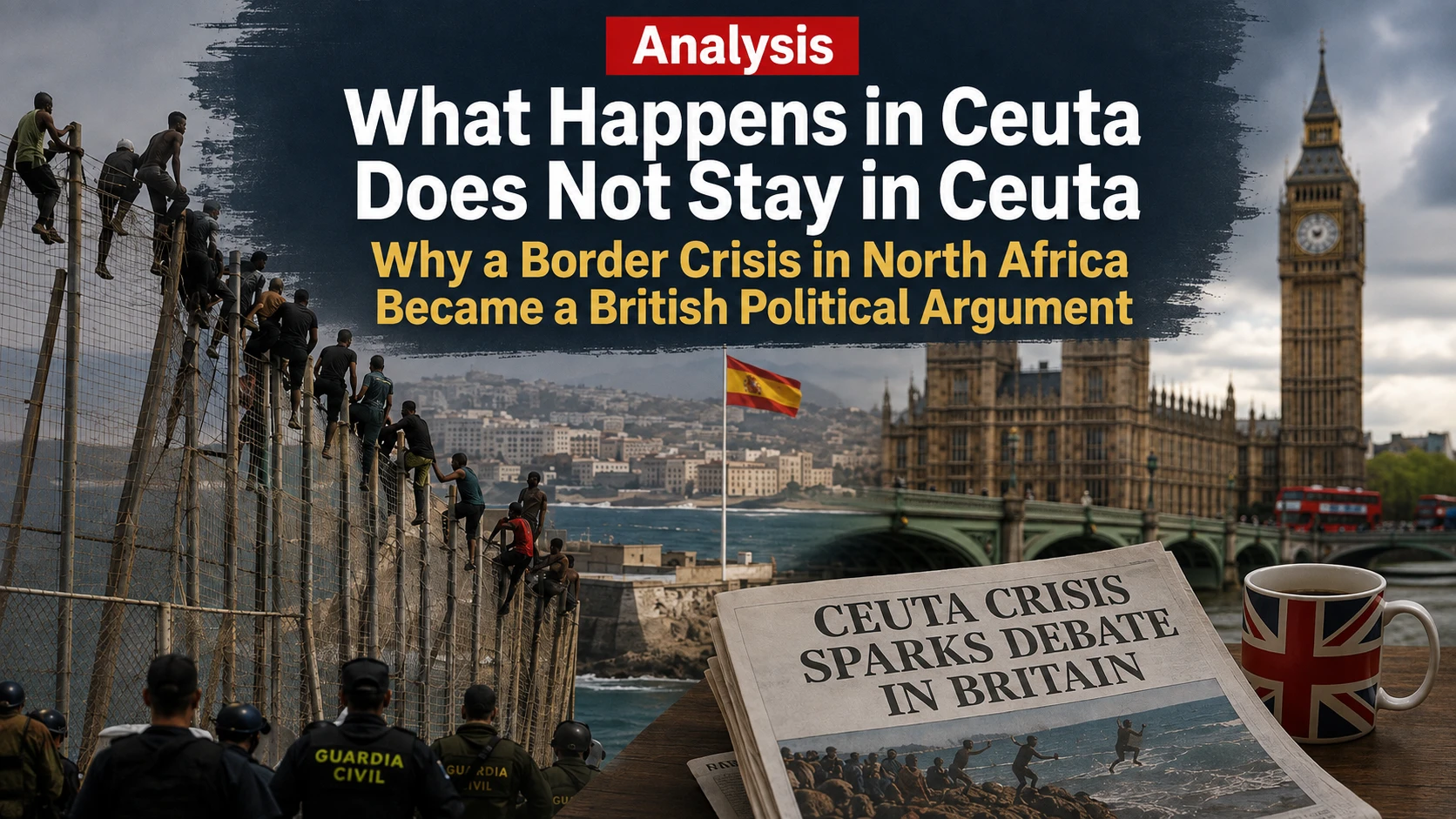
Analysis: What Happens in Ceuta Does Not Stay in Ceuta: Why a Border Crisis in North Africa Became a British Political Argument
What happens in Ceuta does not stay in Ceuta.
That is the paradox exposed by the latest border crisis in the city on Morocco’s northern coast under Spanish administration.
Geographically, the events unfolded on African soil, at the point where Morocco meets a city governed by Madrid.
Politically, it took only hours for the crisis to become a European emergency—and then a British argument about borders, migration and the security of the English Channel.
What initially appeared to be an exceptional movement of people across a highly sensitive local frontier quickly expanded into something much larger.
Spain’s prime minister, Pedro Sánchez, described the events as a violation of his country’s territorial integrity. Italy temporarily suspended Schengen arrangements with Spain. Conservative newspapers in Britain seized on the scenes as ready-made ammunition against Andy Burnham’s government.
Why Did the Surge Happen Now?
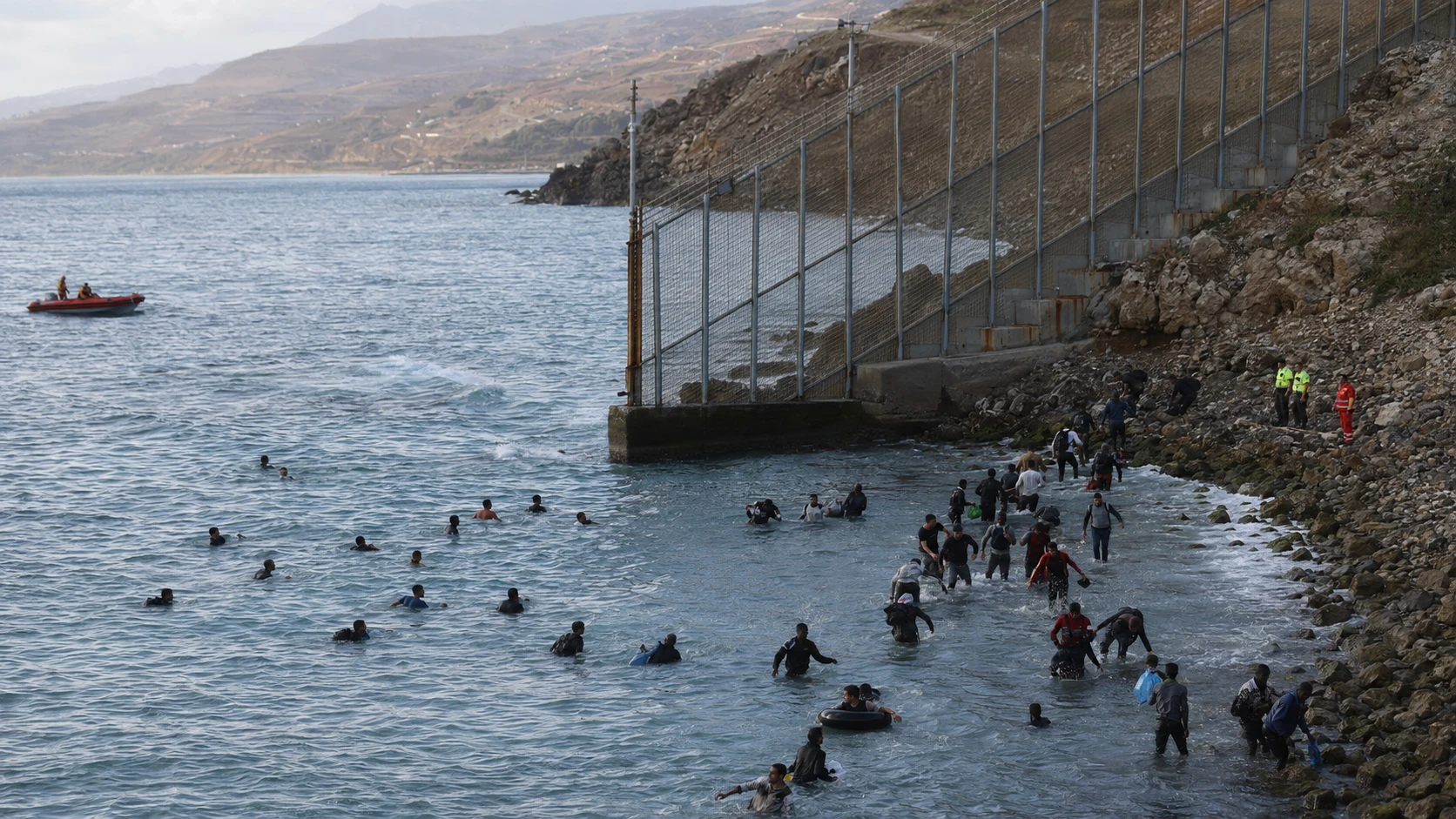
The numbers convey the scale of the shock.
They do not fully explain it.
Spanish authorities said around 50,000 people had crossed since Thursday morning, while the head of Ceuta’s local government estimated that the total had reached 60,000 within two days.
Madrid said that 48,300 people had voluntarily returned to Morocco by Friday evening. Fifty-seven bodies were reportedly recovered on the Spanish-administered side, with fears that further victims remained on the Moroccan side.
The more important question is why it happened now.
One factor was a recent ruling by Spain’s supreme court concerning people attempting to enter Ceuta and Melilla by swimming.
The ruling did not open the border. But it restricted the immediate return of those intercepted at sea in ways that differed from the treatment of people crossing fences or land checkpoints.
According to the Spanish government, people-smuggling networks exaggerated the significance of the judgment and presented it to migrants as a rare opportunity that should not be missed.
Sánchez said that interpretation spread “like wildfire” through trafficking networks.
Put more simply, the map did not change.
The perception of opportunity did.
Large movements of people are not always triggered by a completed change in law. Sometimes they begin with a powerful rumour, an exaggerated promise or a sudden belief that a previously closed door has become slightly easier to push open.
Then came the deeper forces: unemployment, economic inequality, pressure from trafficking networks and the long-standing hope of reaching Spain and, from there, the rest of Europe.
One man who crossed told the Associated Press: “There is nothing back home. I would have to work 12 hours for very little money.”
That sentence explains what the headline figures cannot.
The border does not simply separate two administrations.
It separates profoundly unequal worlds.
And the gap between them is wide enough to persuade many people to risk their lives.
From Humanitarian Crisis to the Language of “Invasion”
Border crises rarely remain humanitarian once they enter politics.
Within hours, attention shifts from the people who swam, climbed, ran or drowned to images of borders being “stormed”, states “losing control” and migrants supposedly preparing to move further north.
That happened quickly in Britain.
Some conservative newspapers treated Ceuta not as a distant European event but as a preview of what Britain could face unless it tightened its own borders.
The Daily Mail used the phrase “Spanish border invaders”, language that reveals an ideological judgment before it explains the facts.
The migrant is transformed from someone risking death into an invading threat moving towards Britain.
Nor is this language uniquely British.
Donald Trump said the scenes in Ceuta looked “like an invasion”, warning that something similar could happen in the United States “but worse” unless Republicans won the midterm elections.
The populist right increasingly shares a common political vocabulary even before it shares a common policy.
One crisis.
One language of fear.
One message about collapsing borders.
Ceuta therefore becomes a symbol rather than simply a place.
And symbols often travel further than geography.
The crisis does not need to begin on the Kent coast or near Dover to enter the heart of British politics.
It requires only an image of a European border under pressure, a sufficiently large number and a government that appears to be losing control.
That is enough to turn it into political ammunition.
Why Does It Matter to Britain?
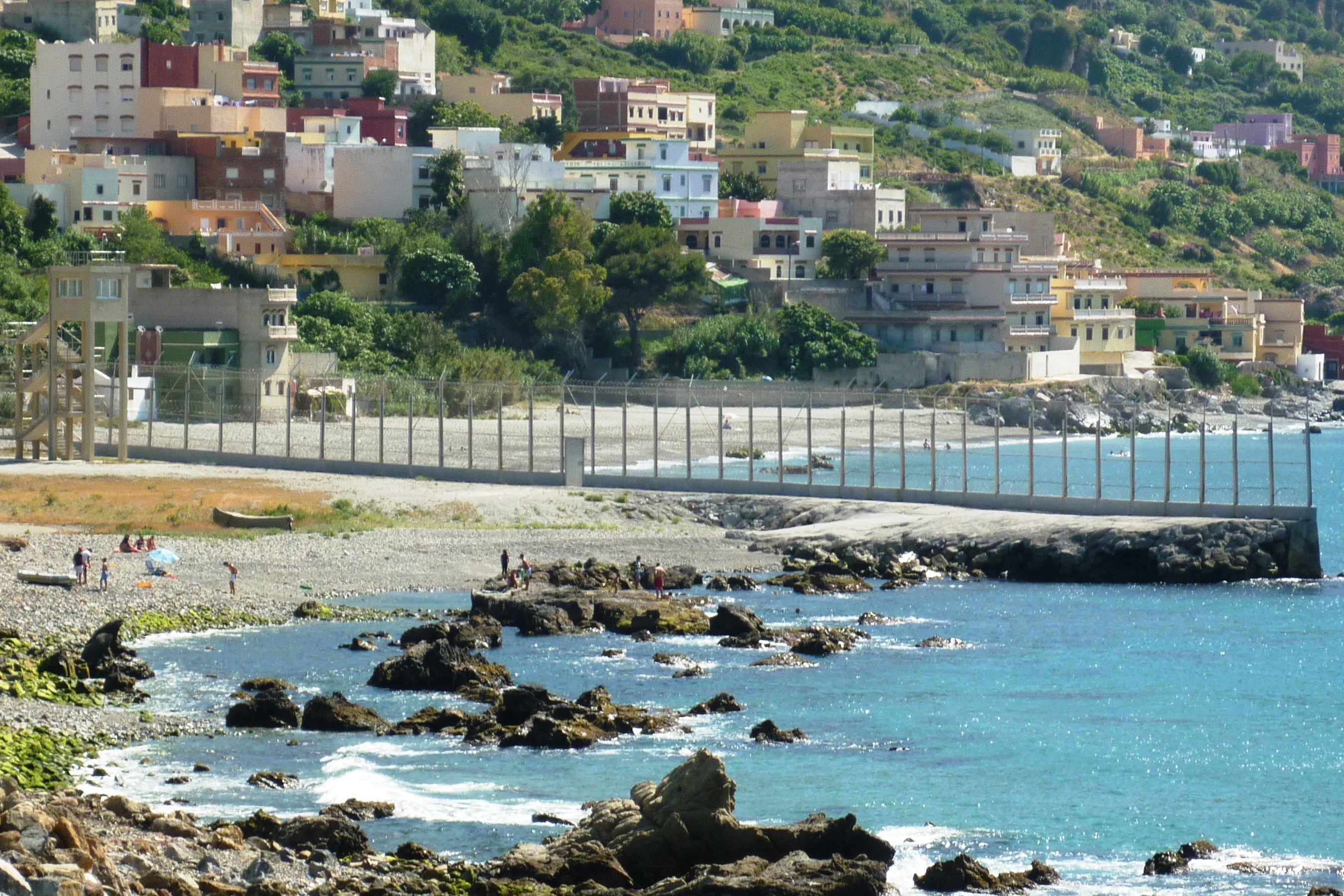
Britain is outside the Schengen area and outside the European Union.
There is no simple or direct route from Ceuta to the English Channel.
Yet the crisis reached London almost immediately because it touches a deeply rooted political fear.
If one European state cannot control its border, does Britain become the next destination?
That is the question Burnham’s opponents want to impose.
For them, the precise circumstances matter less: the Spanish court ruling, Ceuta’s status, the role of trafficking networks and the complicated relationship between Rabat and Madrid.
What matters is turning the crisis into further proof that “Europe is losing control” and that the British government must become tougher before the consequences reach its shores.
That is why opposition figures spoke as though the distance between northern Morocco and southern England barely existed.
The warning is not really about Ceuta itself.
It is about the possibility that any European border crisis could produce wider movement across the continent and eventually create new pressure on Britain.
In that sense, the events become an early test for Burnham, even though Britain is not directly involved.
Burnham’s Test: Who Controls the Language of the Crisis?
The challenge for Burnham’s government is not limited to monitoring events in Madrid or exchanging intelligence with Spanish authorities.
The larger question is who controls the language of the crisis inside Britain.
If Burnham allows conservative newspapers and Reform UK to define Ceuta as an “invasion”, he will immediately find himself on the defensive, forced to prove that he is sufficiently tough even when the crisis does not begin at Britain’s borders.
If he responds only with general humanitarian language, he will be accused of minimising the risks.
If he overreacts, he will hand his opponents an early linguistic victory by accepting their framing and speaking in their vocabulary.
Burnham therefore needs a difficult balance.
He must acknowledge that what happened in Ceuta was a major crisis and that instability on Europe’s borders can have wider consequences for Britain.
But he must also resist the attempt to turn every migrant into a threat and every European emergency into an excuse for a coordinated rightwing attack.
The lesson from Ceuta is not that Britain will necessarily face the same scenes tomorrow.
It is that migration has become politically transnational in much the same way that it is geographically transnational.
Every image from Ceuta, every statement from Madrid and every decision by Rome or Paris concerning travel with Spain can be transformed within hours into a question at Westminster.
Is the government doing enough?
Distant Geography, Immediate Politics
Ceuta reached London not because the route from northern Morocco to the English Channel is direct, nor because everyone who crossed intends to reach Britain.
It reached London because it gave the British right exactly what it always seeks in the migration debate: a dramatic number, images of a border in disorder, a European government struggling to restore control and fears that can be lifted from one context and placed into another.
Burnham may be benefiting from an early polling bounce.
That will not stop his opponents from searching for the first issue capable of bringing him back down to earth.
Migration, as every recent British prime minister has learned, is one of the fastest ways to drag a government away from broad promises and into arguments about control, deterrence and borders.
What happens in Ceuta does not stay in Ceuta because migration is no longer a local event confined to one place.
It is a travelling political language.
It begins at a fence, a beach or a border crossing.
Then it moves through headlines until it reaches wherever fear is already waiting to receive it.
That is the real warning for Burnham.
Not that Ceuta will inevitably become Dover.
But that his opponents will try to turn every troubled European border into the opening scene of Britain’s next political battle.
Read more:
ShortURL ⬇