

Analysis: Burnham and Trump: Is a New Tone Enough to Repair a Relationship Damaged by Trump’s Impulses?
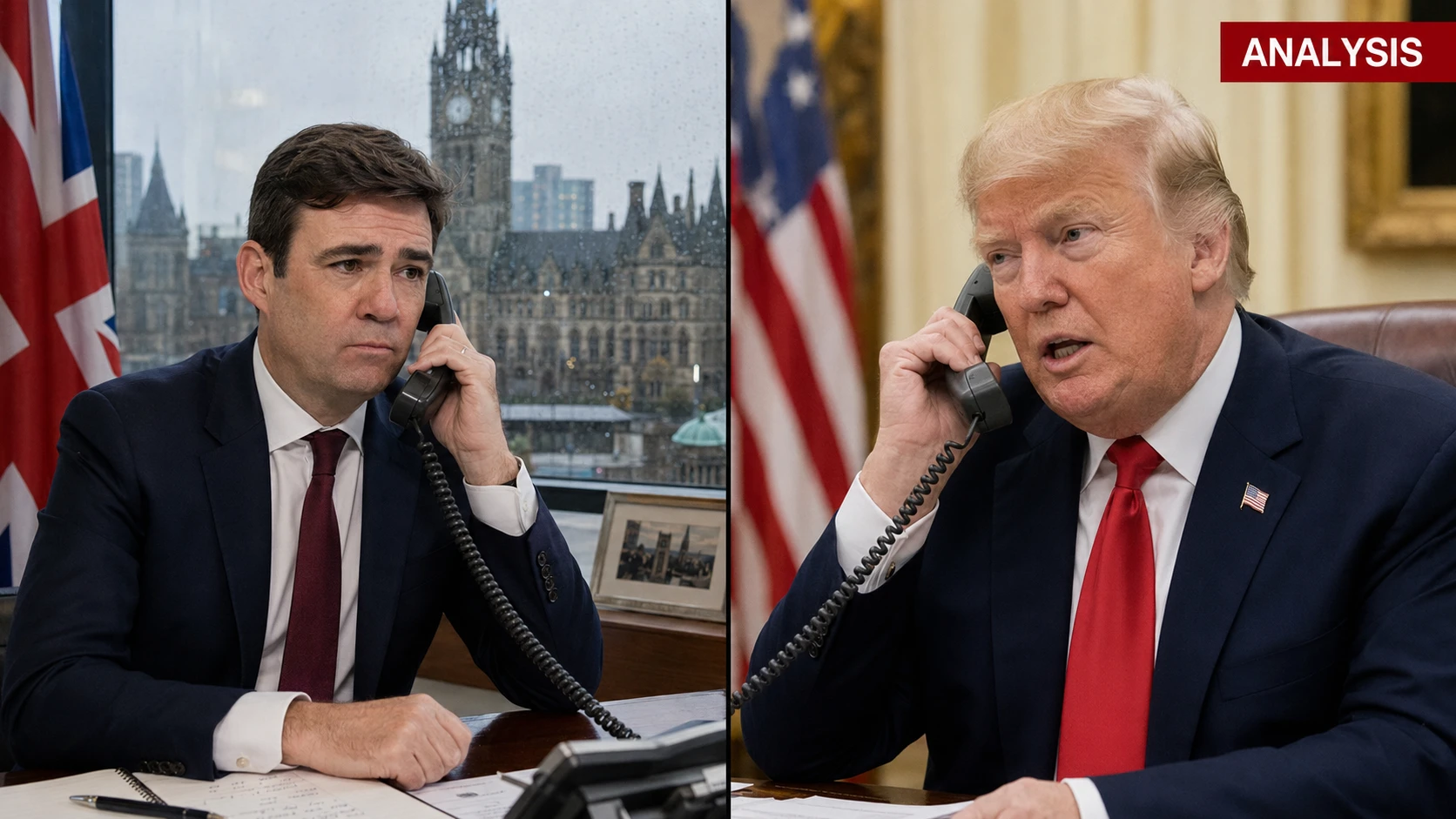
Andy Burnham is trying to begin his relationship with Donald Trump on a different note: an early phone call, warm public language, talk of a future presidential visit to Manchester, and a new defence secretary arguing that the first duty of a serious ally is not to flatter an American president but to know how to disagree with him openly.
At first glance, this looks like a sensible attempt to repair what deteriorated between London and Washington during the final months of Keir Starmer’s premiership.
But Britain’s problem with Trump was never simply one of diplomatic tone.
It was not a communications failure or a protocol mishap that could be corrected by a cordial conversation or an invitation to Manchester.
At its core, it reflected a clash with political reality: the Iran war, the use of British military bases, American frustration with hesitant allies, a British public deeply reluctant to be drawn into another Middle Eastern conflict, repeated criticism from Washington over Britain’s immigration policies, disagreements over Labour’s energy agenda, the Chagos Islands settlement, defence spending—and, above all, the unpredictability that defines Trump’s approach to foreign policy.
Burnham is therefore confronting far more than a public relations challenge.
He is dealing with an American president whose instincts remain volatile, a war that continues to escalate, and a military alliance Britain can neither abandon nor follow without conditions.
A New Tone: Friendship Without Flattery
The first distinction between Burnham and Starmer lies not yet in policy, but in political language.
Burnham moved quickly to establish a personal connection with Trump, speaking publicly about showing the president what Manchester has to offer during a future visit.
That was no casual remark.
Trump once dismissed Burnham as little more than “the mayor of a town.” Burnham is now attempting to turn that very city into the symbolic stage for a different relationship with the American president who mocked both him and Manchester.
Manchester therefore becomes more than a venue.
It becomes a political message.
Burnham is welcoming Trump not simply as Britain’s prime minister in London, but as the politician of England’s north who wants his city placed at the centre of the special relationship.
It is an attempt to turn insult into opportunity.
Yet Burnham also understands that warmth towards Trump can quickly become a political liability at home.
That is why he told the BBC he could never promise to avoid disagreements with the American president and would express “a different view” whenever Britain’s interests required it.
In other words, he wants to appear friendly towards Trump—not subordinate to him.
Wes Streeting has articulated the defence version of the same approach.
He rejects any rupture with Washington but equally rejects the image of Britain chasing Trump’s approval. Britain, he said, neither supported offensive military operations against Iran nor intended to do so. Yet he added that London and Washington still had much they could accomplish together.
Most importantly, he offered what may become Burnham’s governing principle.
The Trump administration, he argued, is not looking for allies who flatter it.
It wants allies confident enough to express disagreement.
That is Burnham’s opening strategy: friendship without flattery, disagreement without rupture.
Starmer’s Problem Was Never Simply Style
However elegant that formula appears, it cannot erase the reality that Starmer’s difficulties with Trump were never primarily about tone.
Starmer did not lose Trump’s confidence because he sounded cold or insufficiently diplomatic.
He lost it, at least in part, because he attempted to manage the Iran conflict within political constraints Trump simply did not recognise.
Initially, Britain refused to participate in the first wave of strikes against Iran.
Later, London authorised the use of British bases for what it described as a narrowly defined defensive purpose: countering Iranian missile capabilities threatening shipping and Western interests.
Between that initial refusal and later acceptance lay the limits of British power.
London could not afford a complete break with American policy, even when that policy generated fresh controversy and new strategic risks.
It was never an easy balancing act.
Washington wanted a faster and more unequivocal ally.
Meanwhile, British public opinion remained firmly opposed to another war.
One Chatham House analysis suggested that most British voters opposed military involvement against Iran, meaning Starmer’s position reflected domestic political realities as much as Britain’s strategic constraints.
That is why it was naïve—as The Guardian argued at the time—to imagine Starmer as Trump’s trusted whisperer, capable of persuading the American president to abandon reckless decisions simply through calm diplomacy.
The problem was never that Starmer failed to find the right words.
The problem was that Trump was directing a war that could not be managed through words alone, while Britain found itself trapped between alliance obligations, domestic opinion, military commitments and the possibility of Iranian retaliation.
Burnham therefore inherits a crisis that cannot be solved merely by being more personable than his predecessor.
He may already have realised that the challenge extends well beyond political chemistry.
It lies in the nature of an American president whose impulses shape every major issue touching Britain’s foreign policy.
Hormuz: Where Honesty Is Tested
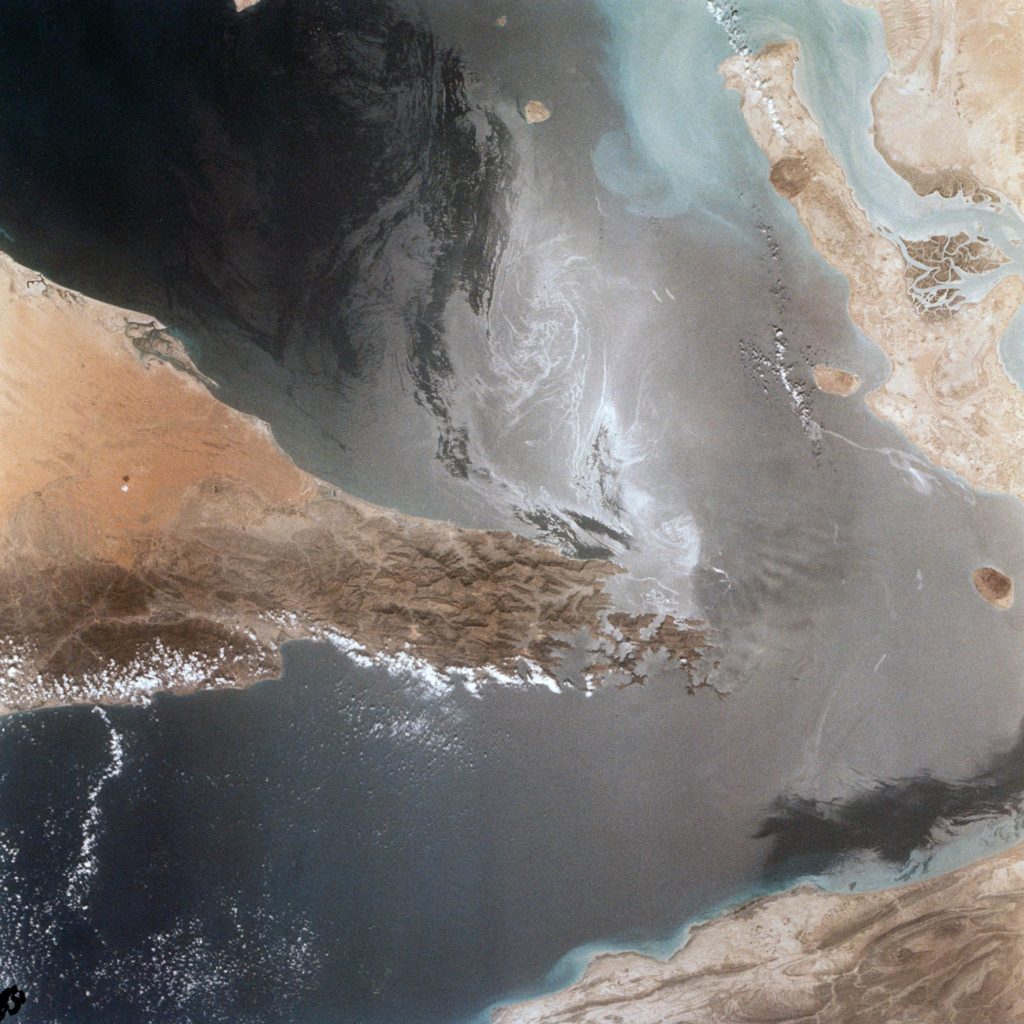
The Strait of Hormuz quickly exposes the limits of this new diplomatic language.
Burnham’s government can argue that cooperation with Washington is not participation in war but protection of commercial shipping, safeguarding trade routes, limiting costs for British families and securing one of the world’s most important energy corridors.
That argument makes domestic political sense because it transforms Hormuz from a distant military theatre into a British cost-of-living issue.
Yet it cannot remove the underlying danger.
What London describes as protecting navigation may be interpreted in Tehran as military support for the United States.
What Trump regards as allied cooperation may be viewed by many Britons as the beginning of another unnecessary military entanglement.
Hormuz will therefore test not Burnham’s ability to flatter Trump but his ability to deliver a carefully qualified “yes”.
Yes to protecting shipping.
Yes to securing trade routes.
Yes to limiting the impact of the crisis on energy prices.
But no to open-ended offensive operations.
No to vague military commitments.
And no to turning Britain into another front in an American war.
That is the moment that will reveal whether Burnham’s promise of honest disagreement is genuine policy—or simply reassuring rhetoric for domestic audiences.
The Right Wants Actions, Not Conversations
The difficulty is that neither Trump nor Britain’s conservative press judge alliances through language alone.
The message from the political right is already clear.
A friendly phone call is insufficient.
Streeting’s attempt to repair relations is insufficient.
What matters are actions: faster increases in defence spending, greater exploitation of North Sea oil and gas reserves, tougher immigration policies and more visible support for the United States during wartime.
That makes rapprochement with Trump politically expensive.
Not because Burnham must publicly pledge loyalty to the American president, but because every attempt to improve relations immediately raises uncomfortable questions.
How much more will Britain spend on defence?
How far will it permit the use of British bases?
Will it move closer to Trump’s energy agenda?
Will Britain’s reliability ultimately be measured by its willingness to follow Washington’s lead?
The right is unlikely to be satisfied simply by hearing Burnham speak respectfully about Trump.
It will demand proof—in defence budgets, military cooperation, energy policy and strategic commitments.
Every step towards Washington may reassure conservative critics while simultaneously convincing many on Britain’s left that alliance has become dependency.
The North Sea: A Useful Gesture, Not a Grand Bargain
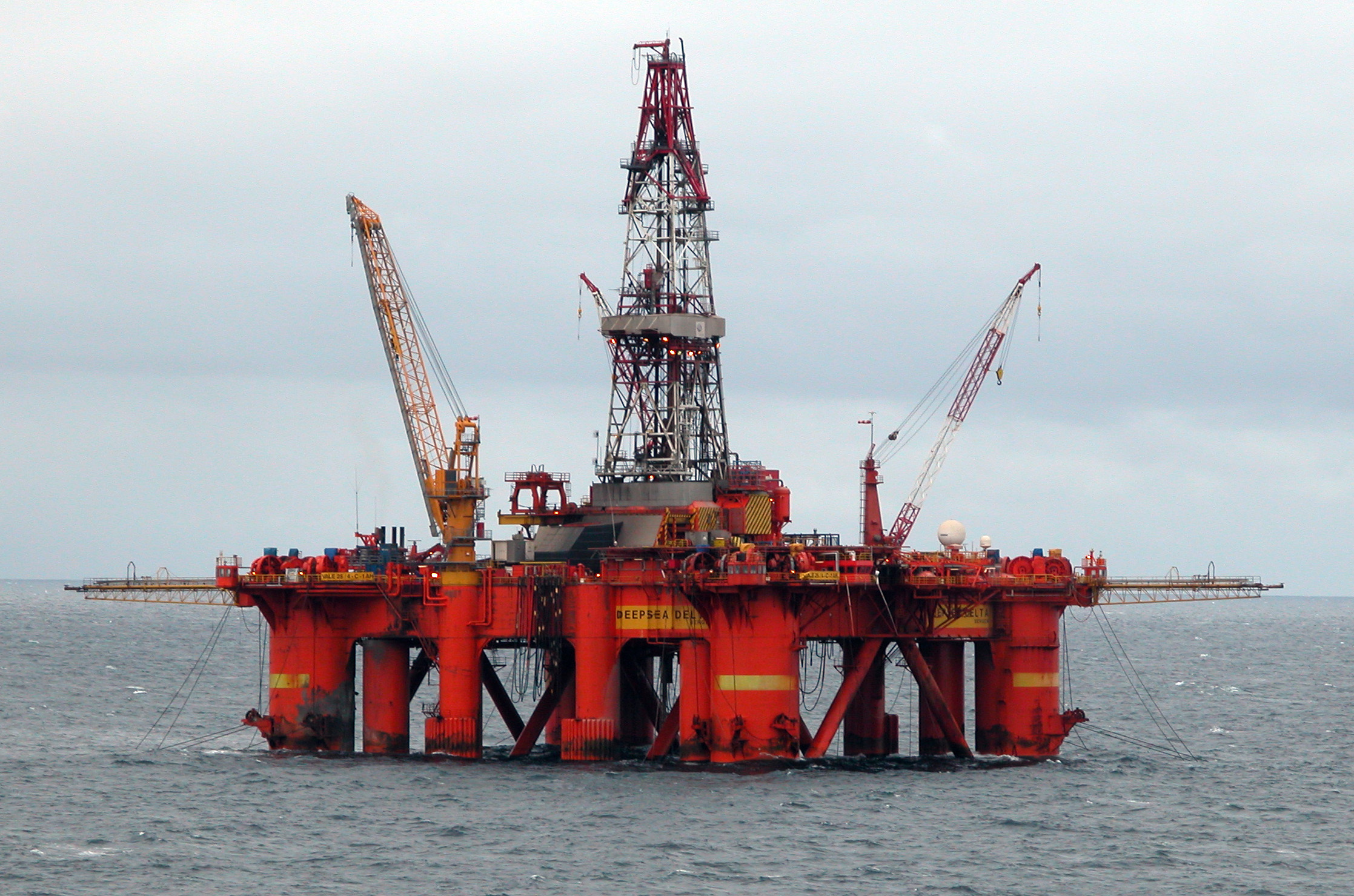
This is where the North Sea enters the picture—carefully.
Burnham’s willingness to accelerate or facilitate oil and gas projects offers Trump an early point of approval because it aligns neatly with one of the president’s political instincts: drill more, produce more and reduce reliance on foreign supplies.
Yet it would be simplistic to conclude that Burnham is reshaping Britain’s energy policy solely to please Trump.
Britain’s calculations are considerably broader.
Household energy bills.
Security of supply.
Employment across north-east Scotland.
Market pressures.
And the political danger that promises to reduce living costs become little more than empty rhetoric.
The North Sea therefore functions as a useful diplomatic signal rather than evidence of a wider political bargain.
It offers Burnham something Trump may appreciate.
It does not resolve the deeper relationship.
Trump may welcome expanded drilling today, only to demand tomorrow a firmer British stance in Hormuz, more aggressive rules of engagement towards Iran, higher defence spending or broader military access.
Small diplomatic gifts have limited value in dealing with a president who rarely remains satisfied with symbolism for long.
Between Honesty and Dependency
Burnham is therefore attempting to accomplish three difficult objectives simultaneously.
He wants to tell Trump that Britain has returned to pragmatism—that it approaches defence, energy and maritime security through the language of national interests rather than moral lectures.
He wants to reassure British voters that pragmatism is not dependency, and that Britain will not support offensive military action against Iran simply because Washington requests it.
And he wants to reassure financial markets that his government will not allow Hormuz, energy security and defence policy to drift into disorder.
It is an exceptionally delicate balance.
Lean too far towards Trump and Britain appears to repair the special relationship at the price of another war.
Move too far away and Washington sees another example of the European hesitation Trump has criticised for years.
Rely too heavily on ambiguity and that ambiguity will collapse during the first serious crisis—whether a strike on a British base, an attack on commercial shipping or another American request that cannot simply be described as “defensive cooperation.”
Ultimately, it is not enough for Burnham’s language to sound warmer than Starmer’s.
A more cordial phone call is not enough.
An invitation to Manchester is not enough.
A gesture towards North Sea oil is not enough.
Nor is Streeting’s promise of friendship without flattery.
All are useful diplomatic tools.
None addresses the heart of the problem.
Because the central challenge in dealing with Trump has never been one of diplomatic management alone.
It lies in Trump’s own political character: a president who routinely blurs the boundaries between security and energy, alliance and loyalty, disagreement and betrayal—and who can move from threats to negotiation, or from de-escalation to confrontation, faster than Britain can build a stable policy around him.
Burnham’s question is therefore not whether he can open a new chapter with Trump.
It is whether he can fill that chapter with a strategy that does not look like hesitation in Washington, dependency in London or hostility in Tehran.
The special relationship cannot be rebuilt through courtesy alone.
Nor can it be managed through confrontation alone.
It requires a government capable of recognising precisely when Britain’s interests lie alongside Washington’s—and when they stop at the gates of the White House.
Read more:
- Analysis: Burnham and the North Sea Battle: When Energy Bills Collide with Climate Promises
- Analysis: Burnham’s Summer of Chaos: Europe’s Fires, Iran’s War and Britain’s Energy Crunch
- Analysis: Burnham and Trump at Hormuz: Where Does Protecting Shipping End and War Begin?
ShortURL ⬇