

Analysis: Burnham and Trump at Hormuz: Where Does Protecting Shipping End and War Begin?
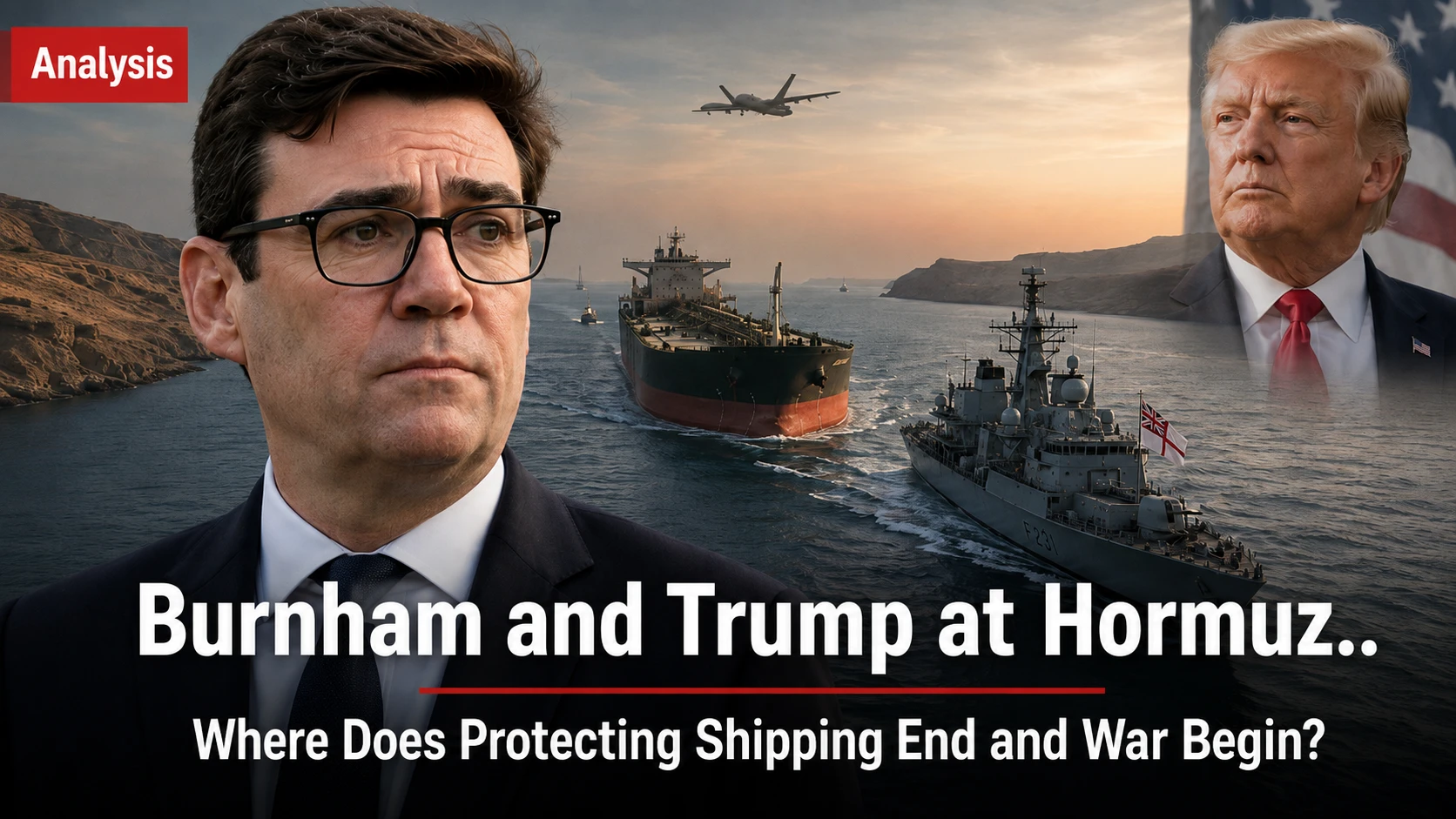
Britain’s Defence Secretary, Wes Streeting, is not operating in a vacuum, nor is he opening channels with Donald Trump’s administration on his own initiative. When London offers cooperation over the Strait of Hormuz, and when discussions emerge about hosting an international conference in the British capital to secure the vital shipping route, it reflects government strategy rather than ministerial enthusiasm.
The real question, however, is not whether Andy Burnham’s government wants to rebuild relations with Washington.
The larger question is the military price of doing so.
At what point does Britain’s role in “protecting freedom of navigation” end and its role in — or at least its appearance as — a participant in Trump’s confrontation with Iran begin?
This is the grey zone surrounding the Hormuz crisis.
Governments naturally favour broad language: freedom of navigation, energy security, protecting global trade, multinational defensive operations. Yet what London presents as the defence of commercial shipping may be viewed in Tehran as military support for the United States. What Washington sees as an allied contribution to keeping the Strait open could easily become, within Britain itself, a debate about being drawn into a war the government insists is not its own.
War carries an ethical burden when it begins—and a political burden when it ends.
Many Britons would inevitably ask, should their country become involved: why enter a conflict that even the United States itself appears unable to bring to a close?
Hormuz Is Not a Distant Waterway

The Strait of Hormuz is not merely another strategic location on a map of the Middle East.
It is one of the world’s most critical maritime chokepoints, carrying roughly one-fifth of globally traded oil. Britain therefore cannot treat disruption there as simply another regional crisis. Every day of instability feeds into energy prices, shipping costs, insurance premiums and inflation before eventually reaching British households through higher bills.
From that perspective, Burnham’s government can reasonably argue that cooperating with the United States serves a direct British national interest.
Keeping Hormuz open is not a favour to Trump. It is about protecting one of the trading routes upon which the global energy system depends.
But that argument does not eliminate the political dilemma.
If Britain participates, how exactly will it do so?
Mine clearance?
Naval patrols?
Counter-drone operations?
Escorting commercial shipping?
Or supporting broader American operations against Iranian military capabilities along the Gulf coast?
These are not merely military distinctions.
They are the difference between a defensive mission that can be politically justified and a grey zone capable of pulling Britain into the logic of war.
Defensive Mission—or Supporting a War?
The safest political course for Burnham would be to define Britain’s role narrowly: protecting commercial shipping, clearing mines, monitoring threats, intercepting drones, escorting civilian vessels and contributing to an international maritime mission that is clearly presented as separate from any American offensive campaign.
London has previously indicated that its contribution to a multinational Hormuz security mission could include independent mine-hunting capabilities, counter-drone systems, Typhoon fighter aircraft, a Royal Navy destroyer and an additional £115 million in funding, describing the deployment as “defensive, independent and credible.”
That language is carefully chosen.
It attempts to draw a clear line.
Britain is not going to war with Iran.
Britain is safeguarding international shipping.
Yet this is precisely where language—and interpretation—becomes dangerous.
What is read in English as a defensive maritime mission may be read in Persian as preparation for war.
The dividing line that appears clear in London may look very different from Tehran.
Iran’s Islamic Revolutionary Guard Corps has warned that Britain would become a “legitimate and certain target” should it support the United States in military action against Iran. In that context, logistical assistance becomes politically significant. Opening bases, providing intelligence or supporting operations described as defensive may not appear to British audiences as participation in combat.
From Tehran’s perspective, however, they could easily be viewed as part of the American war effort.
Trump Wants an Exit. Britain Wants Balance.

Washington wants its allies to help shoulder the burden of securing Hormuz.
London, however, is attempting to sell the mission to its own public using a different political vocabulary.
Downing Street has linked activity in the Strait to “keeping shipping moving” and “reducing costs for businesses and families across the country.” Hormuz is therefore presented not primarily as a military operation but as an extension of Britain’s cost-of-living challenge.
That is both politically skilful and politically risky.
Burnham’s new government needs to demonstrate that Britain remains a reliable ally of Washington without appearing to sign Donald Trump a blank cheque—and without convincing Tehran that Britain has become an active belligerent.
Between promises of lower costs for British families and the risk of Iranian retaliation, Britain is navigating an exceptionally narrow channel.
That is why the phrase “protecting freedom of navigation” is politically comfortable—but ultimately insufficient.
Every naval mission requires rules of engagement.
It requires clear decisions about what happens if Iran attacks a commercial vessel, targets an aircraft or strikes a base providing logistical support.
At that point, the question ceases to be theoretical.
The issue is no longer whether Britain has entered the conflict.
It becomes how Britain responds once the conflict reaches it.
Burnham’s First Foreign Policy Test
Until now, Burnham has sought to present himself domestically as a prime minister focused on easing pressure on ordinary households.
Hormuz is a reminder that British living standards are shaped not only by Treasury decisions but also by maritime chokepoints, military bases and strategic alliances.
The greatest risk lies not simply in what Britain does—but in how Britain’s actions are interpreted in Tehran.
The Revolutionary Guard’s warning that Britain would become a “legitimate and certain target” if it supported American military operations may contain an element of political messaging, but it also exposes the central dilemma.
Britain may enter the mission speaking the language of protecting commercial shipping, only to find itself operating within an entirely different vocabulary—one of deterrence, retaliation and escalating war.
Hormuz therefore tests more than Burnham’s relationship with Trump.
It tests his ability to draw a credible boundary between alliance and dependency, between defending trade and participating in combat, and between protecting British interests and being drawn into a conflict whose direction London may no longer control.
Geographically, the Strait of Hormuz lies far from Westminster.
Politically, it sits remarkably close to Burnham’s new government, which is attempting to distinguish itself from the Starmer administration without paying a greater strategic price.
In that narrow waterway, one of the defining equations of Burnham’s premiership may already be taking shape: how Britain remains America’s ally without becoming another front in Trump’s war.
His government cannot afford strategic ambiguity in Hormuz.
Every military signal sent there can be read in more than one language.
And every miscalculation could carry political, moral and military consequences that extend far beyond the reassuring phrase of “protecting freedom of navigation.”
Read more:
ShortURL ⬇