

Analysis: Burnham’s Summer of Chaos: Europe’s Fires, Iran’s War and Britain’s Energy Crunch
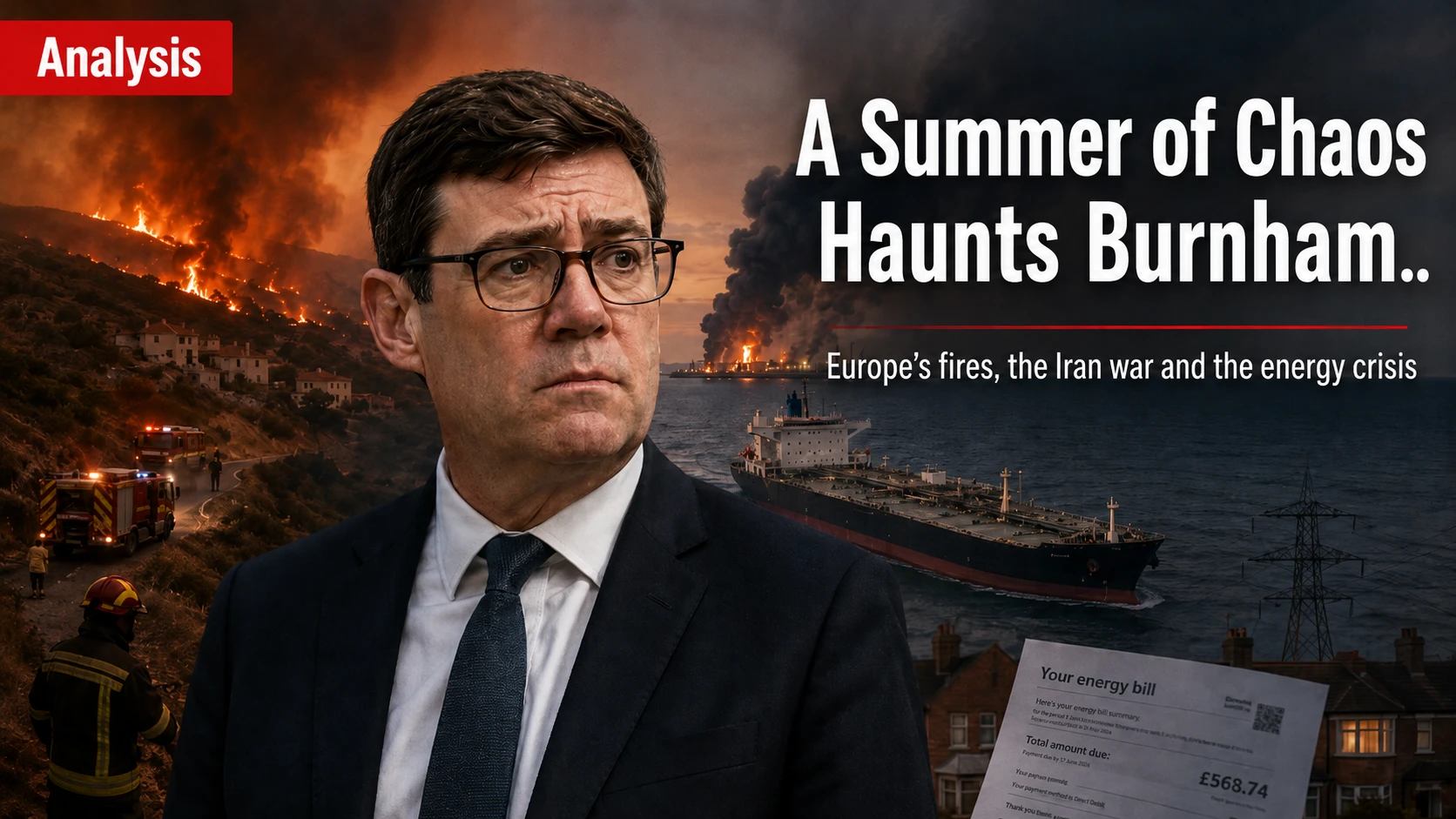
Politics can sometimes resemble walking through a field of fire: the skilled politician must keep moving without being consumed by the flames. For Britain’s new prime minister, Andy Burnham, that metaphor has become uncomfortably literal.
Burnham did not inherit a government in calm conditions. He arrived in Downing Street promising to contain the political fires left behind by Keir Starmer, only to discover that those political flames were now surrounded by real ones: wildfires sweeping across southern Europe; a conflict in the Strait of Hormuz, where the United States and Iran remain trapped in a confrontation from which neither appears able to find an exit; nervous energy markets; and an electricity system attempting to navigate the transition from fossil fuels to net zero without losing its balance.
In that sense, the phrase “summer of chaos”, used by several British newspapers to describe this extraordinary season, is about far more than disrupted holidays or smoke-filled Mediterranean skies. It may prove to be the defining political backdrop to Burnham’s premiership. He wants to begin with the everyday pressures facing households, yet those pressures now sit at the intersection of climate change, war, energy security and strained public finances.
When Climate Stops Being Tomorrow’s Problem
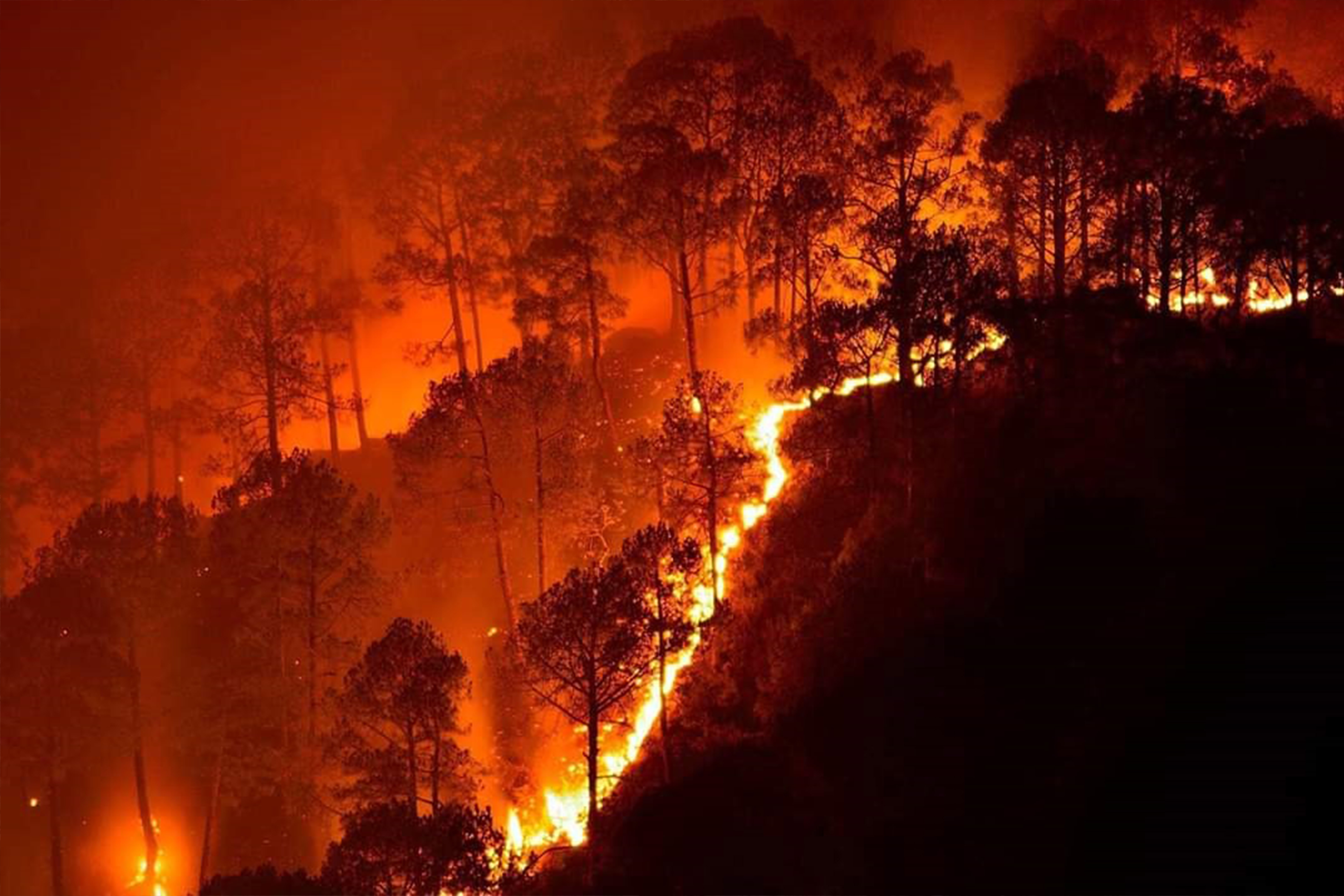
The wildfires consuming southern Europe are no longer a distant environmental story.
When more than 200,000 people are evacuated or ordered to remain indoors because of major fires in France and Spain, and Madrid declares its first national emergency over wildfires, climate change ceases to be a subject reserved for scientific conferences or distant 2050 targets. It becomes daily news.
Nor is Britain insulated from the same pressures.
Parts of north Wales and the Upper Severn catchment have entered drought status after exceptional heat and prolonged dry conditions, while large areas of England received barely 3% of their average July rainfall. The political meaning is unmistakable. Climate change is no longer a background issue. It now reaches directly into water supplies, electricity networks, agriculture and public health.
This is the first dilemma confronting Burnham.
A government seeking to reduce household energy bills and provide rapid relief for struggling families cannot ignore that part of today’s energy crisis is rooted in yesterday’s energy model. Every hotter summer and every larger wildfire makes climate commitments appear less like environmental idealism and more like practical economic policy.
Yet the green transition carries its own risks.
Warnings that Britain’s race to net zero could leave the electricity grid more vulnerable to disruption do not necessarily suggest the transition itself is mistaken. Rather, they highlight the complexity of replacing a system built around conventional power stations—facilities that can be switched on and carefully controlled—with one increasingly dependent upon wind, solar generation and battery storage. Such a transformation demands enormous investment, sophisticated grid management and far greater forecasting capability.
The government therefore faces a delicate political challenge.
It must persuade voters that the green transition will shield them from both rising bills and worsening climate disasters—not add another source of anxiety in the form of unreliable electricity supplies.
Iran Enters Britain’s Ledger

Climate is only one side of Britain’s energy dilemma.
The conflict surrounding Iran, rising oil prices and mounting instability across global energy routes have turned the Middle East from a foreign policy concern into a direct factor in Britain’s domestic economic calculations.
When Brent crude climbs above $100 a barrel for the first time since May, the story quickly escapes the business pages. Higher oil prices feed inflation expectations, transport costs, household energy bills and the Bank of England’s monetary calculations before eventually reaching consumers’ wallets.
In that sense, Iran’s war becomes part of the Treasury’s balance sheet.
If Chancellor John Healey’s fiscal headroom has narrowed to roughly £7bn while ten-year government borrowing costs hover around 5.03%, instability in the Gulf no longer remains confined to diplomatic briefings. It shapes decisions about taxation, public spending, borrowing costs and the government’s capacity to finance its promises to households and small businesses.
This is one of Burnham’s defining political tests.
He does not have the luxury of separating foreign policy from domestic policy. Rising energy prices mean either higher support costs or greater public anger. Higher borrowing costs leave the Treasury with less room to spend. And if the government promises relief for struggling families, it must somehow find the money at a moment when the international environment offers little stability.
In that sense, Iran’s conflict has become part of Britain’s domestic political debate.
Should taxes rise?
Should spending be cut?
Should some promises be delayed?
Or should ministers search for new sources of revenue while financial markets watch every move and the opposition waits for any mistake?
Energy as a Test of Government
Energy has therefore become something much larger than a technical policy portfolio.
It is becoming a test of government itself.
Burnham wants to present himself as a practical prime minister rather than a prisoner of ideology. Yet pragmatism in energy policy demands walking an exceptionally narrow path. He cannot ignore household bills. He cannot dismiss climate change as a luxury concern. Nor can he construct an economic strategy on the assumption that the Middle East will remain stable or that financial markets will grant him unlimited time.
If his broader political project rests on restoring the state’s capacity to act, energy will be its first real examination.
The government must simultaneously guarantee supplies, reduce bills, protect the electricity grid from disruption, pursue net zero and absorb shocks created by volatile global oil and gas markets.
Failure in any part of that equation would quickly become a crisis of confidence.
Voters rarely experience “energy strategy” through government white papers.
They experience it through their household bills.
Through whether their homes stay warm in winter.
Through whether the lights stay on.
And through whether they believe the government is asking them to pay for crises they did not create.
A New Government in a World That Will Not Wait
What makes Burnham’s opening months unusually difficult is that today’s crises do not arrive one after another. They arrive all at once.
As he attempts to project a different style of government, the outside world is testing that promise far sooner than he might have hoped.
The question is no longer simply whether Burnham can offer Britons the “breathing space” he promised.
It is whether such breathing space truly exists when Europe is burning, war is reshaping the Treasury’s calculations and energy costs are pressing on every household simultaneously.
That is the defining challenge of his first summer.
Chaos is not merely the backdrop to his government.
It is the environment in which his ability to govern will be judged.
If Burnham wants to demonstrate that politics can once again improve people’s lives, he must also prove that the state is capable of navigating an increasingly unstable world without passing every one of its costs directly on to its citizens.
The summer of chaos, in that sense, is not simply a test of the weather or the markets.
It is an early test of Burnham’s entire political promise: that government can still protect ordinary people at a time when the line between a distant fire and the next household energy bill has almost disappeared.
Read more:
ShortURL ⬇