

Analysis: Five Years or Ten? The Permanent Residence Battle Testing Burnham’s Government Before It Begins
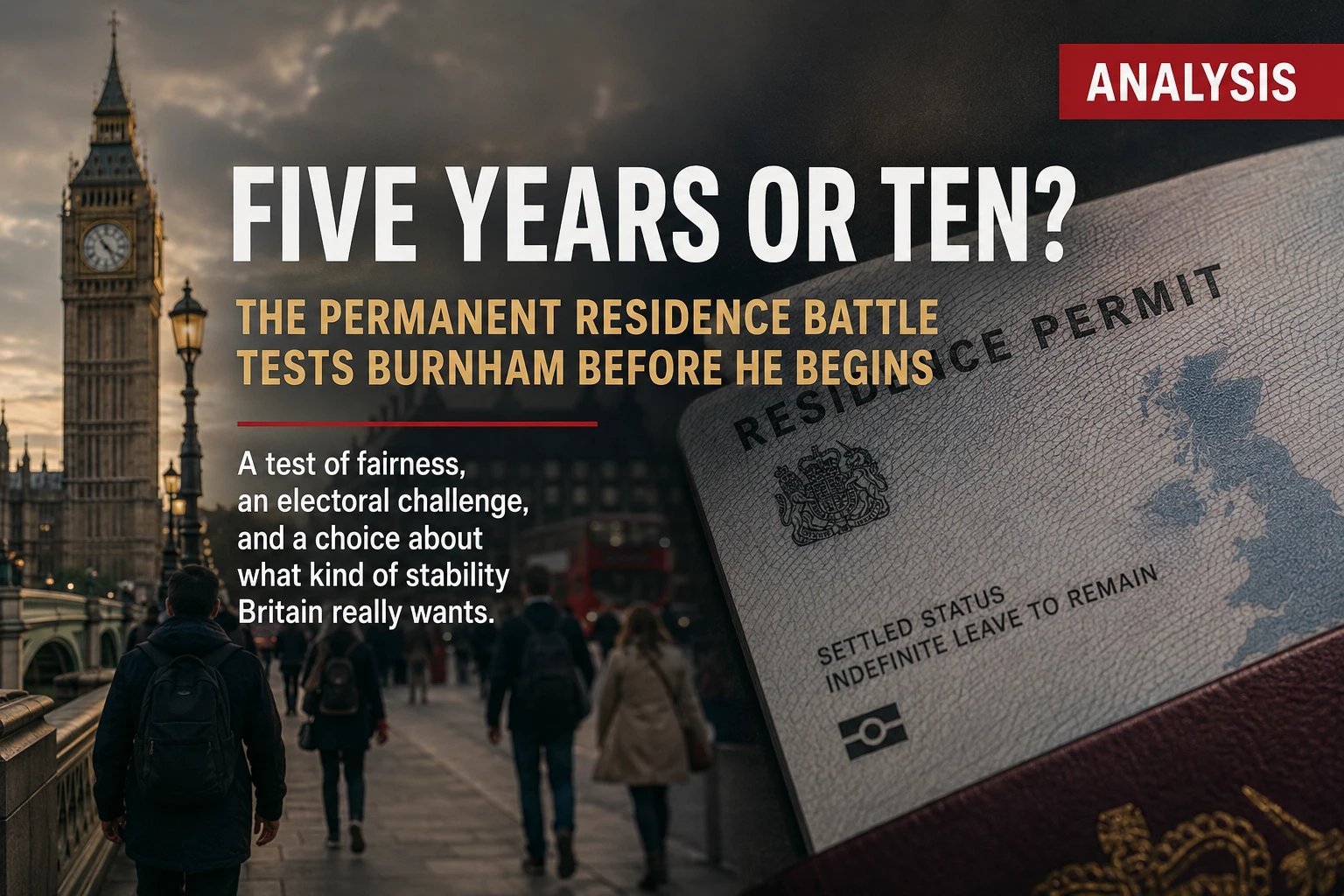
Britain’s debate over permanent residence is no mere administrative dispute inside the Home Office.
It has become an early test of what an Andy Burnham government would actually look like before it has even begun. Will it pursue a harder immigration policy to blunt the electoral threat from Reform UK and the Conservatives? Or will it try to balance tougher border controls with protecting the lives of hundreds of thousands of people who built their futures around the rules that already existed?
The debate begins with a deceptively simple phrase carrying an entire political philosophy.
Permanent residence, ministers argue, is “a privilege, not a right.”
Through that language, the state is making a broader claim: long-term security in Britain should be earned rather than arriving automatically after years of work and legal residence.
For millions of migrants, however, permanent residence has never looked like a political reward. It is simply the natural conclusion of years spent working, paying taxes, renewing visas, waiting and building lives in a country they no longer regard as temporary.
Which is why the question—five years or ten?—is about far more than a number.
It is about the meaning of stability itself.
Immigration Between Political Messaging and Reality

The government wants to demonstrate greater toughness on immigration. Politically, that is understandable in a country where migration has become one of the most contentious issues, fuelled by pressure from Reform UK and public concern over housing, schools, healthcare and overstretched public services.
Political messaging, however, is one thing.
Reality is another.
A skilled worker who arrived legally, spent years employed, paid taxes, rented a home, enrolled children in school and planned life around the expectation of applying for permanent residence after five years does not see themselves as part of an abstract immigration statistic.
They see themselves as someone who followed Britain’s rules.
Someone who made life-changing decisions based on promises the state itself made.
If those rules are rewritten halfway through the journey to satisfy an increasingly anxious electorate, people stop feeling like participants in a legal system and start feeling like instruments of electoral politics.
The question therefore becomes not simply whether Britain wants tighter immigration control.
It becomes whether it intends to pursue that goal fairly.
A Possible Retreat
Home Secretary Shabana Mahmood’s original proposal would have extended the standard route to permanent residence from five years to ten, tying settlement more closely to economic contribution, social integration and criminal record.
Recent reports, however, suggest ministers are considering a softer approach.
Up to 1.6 million migrants who have arrived since 2021 may be allowed to remain on the existing five-year settlement pathway, while facing longer waiting periods before becoming eligible for benefits such as Universal Credit or housing support.
That is not a complete retreat.
It is a compromise.
The government wants voters to believe immigration rules are becoming tougher, while simultaneously reassuring increasingly uneasy Labour MPs that it will not impose retrospective hardship on people who entered Britain under a different set of expectations.
That is where Burnham’s real political test begins.
The Real Issue: Retrospective Change

The problem is not simply that ten years is a long time.
It is that the proposal could apply to people who have already built their lives around a five-year route to settlement.
Retrospective policymaking is never merely technical.
It damages trust in the state.
When governments change rules for future arrivals, people remain free to decide whether Britain is still the right place to move, invest or build a future.
Changing the rules for people already here is something different.
It penalises decisions made in good faith under a previous legal framework.
That lies at the heart of Labour’s internal criticism.
Many MPs are not arguing for unrestricted immigration.
Nor do they deny the pressures facing public services.
Their argument is simpler: extending uncertainty for people who already work, pay taxes and contribute to British society is less an act of firmness than one of administrative unfairness.
The difference between five years and ten may appear insignificant inside a government consultation paper.
For migrant families, it means another five years of visa renewals, expensive application fees, legal uncertainty, vulnerability to changes in employment and hesitation over buying a home or making long-term plans.
Stability is not simply a legal status.
It is the ability to plan a life.
Labour Between Reform and Its Own Coalition
Labour therefore finds itself caught in a familiar political dilemma.
Appear too relaxed on immigration, and Reform UK and the Conservatives will accuse it of losing control of Britain’s borders.
Move too far towards restriction, and it risks alienating parts of its own parliamentary party, the trade union movement, migrant communities and those who believe governments should not rewrite people’s lives after they have complied with existing rules.
If Burnham enters Downing Street, he will inherit a policy designed to project toughness but capable of triggering his first major internal rebellion.
The timing makes the challenge even more acute.
Burnham wants to present himself as a practical politician focused on living standards, regional inequality and rebuilding public services rather than governing through punitive symbolism.
Immigration offers little comfortable middle ground.
Every compromise looks weak from the right.
Every restriction appears harsh from the left.
Every attempt at balance risks satisfying neither.
What Kind of Stability Does Britain Want?

Ultimately, the question is not whether settlement should come after five years or ten.
It is what relationship Britain wishes to build with the people who live and work within it.
Does it want workers who fill shortages across healthcare, social care and essential services while remaining legally and socially temporary for an entire decade?
Does it want integration?
Or prolonged uncertainty that makes integration harder to achieve?
Describing permanent residence as “a privilege” may make sense from the state’s perspective.
From society’s perspective, however, stability benefits Britain as much as it benefits migrants.
People who feel secure are more likely to work, pay taxes, raise families, invest in communities and participate fully in public life than those left indefinitely suspended between legal presence and permanent uncertainty.
That is why this debate will become one of Burnham’s earliest political tests.
Not because it is Britain’s biggest policy challenge.
But because it reveals the government’s governing philosophy.
Will it choose the political simplicity of punishment?
Or will it pursue an immigration policy that combines control with fairness, protects public confidence without undermining legal certainty and avoids rewriting the rules for people who built their lives by following them?
Before Britain asks migrants whether they deserve stability, it may first have to ask itself a different question.
Can a country expect people to contribute, belong and invest in its future while continually extending the moment when it is finally prepared to let them stay?
Read more:
ShortURL ⬇