
Surviving Genocide: Powerful Testimonies of the Suffering and Resilience of Gaza’s Women
Surviving genocide is a reality reflected in Gaza women’s testimonies—voices that carry memory, loss, and resilience. The International Centre of Justice for Palestinians, in cooperation with Al-Arab in uk (AUK), organized a deeply moving humanitarian seminar on Friday, December 19, 2025, bringing together Palestinian women who shared firsthand accounts of oppression and systematic violence in the Gaza Strip, as well as the brutal conditions that have turned education and work into daily acts of resistance, amid a war that targeted people and every condition necessary for survival.
SOAS University of London hosted the gathering in central London. What began as a conventional seminar quickly transformed into an open space for testimony and memory, confronting attempts to erase the Palestinian narrative within Western academic and media spheres.
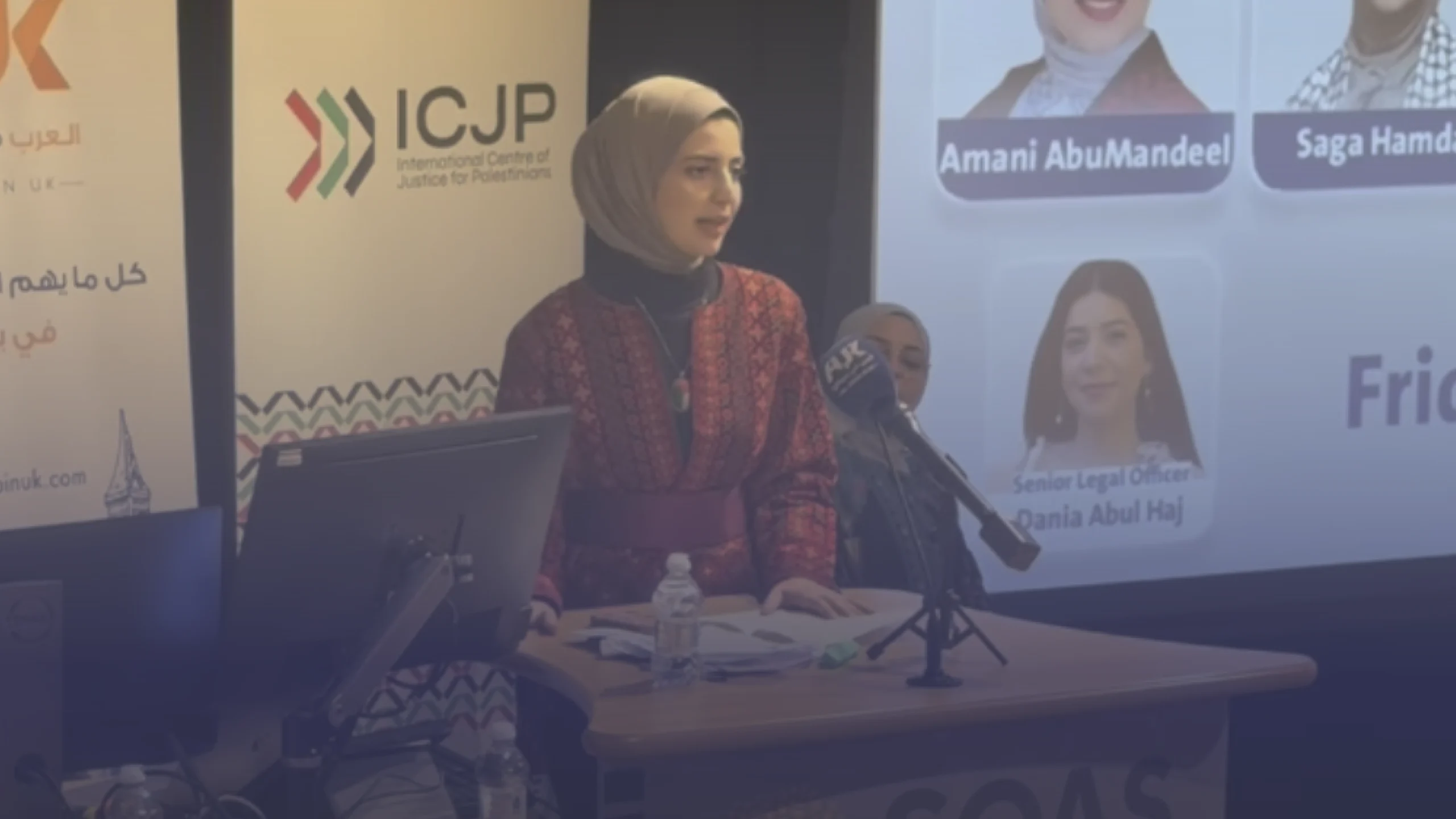
The seminar opened with a powerful speech delivered by Palestinian activist and teacher Zainab Kamal. She emphasized that this gathering was neither an academic exercise nor a symbolic event, but rather a moral space for listening and assuming responsibility. She stressed that the Palestinian women present were not numbers or symbols, but living witnesses to a reality described by legal experts and international human-rights organizations as genocide.
She added that testimony in this context is not merely storytelling, but an act of resistance at a time when Palestinian pain is questioned and massacres are rebranded as “collateral damage.” She called on the audience to listen as an ethical stance that requires awareness and accountability.
Testimonies from the Heart of the Wound
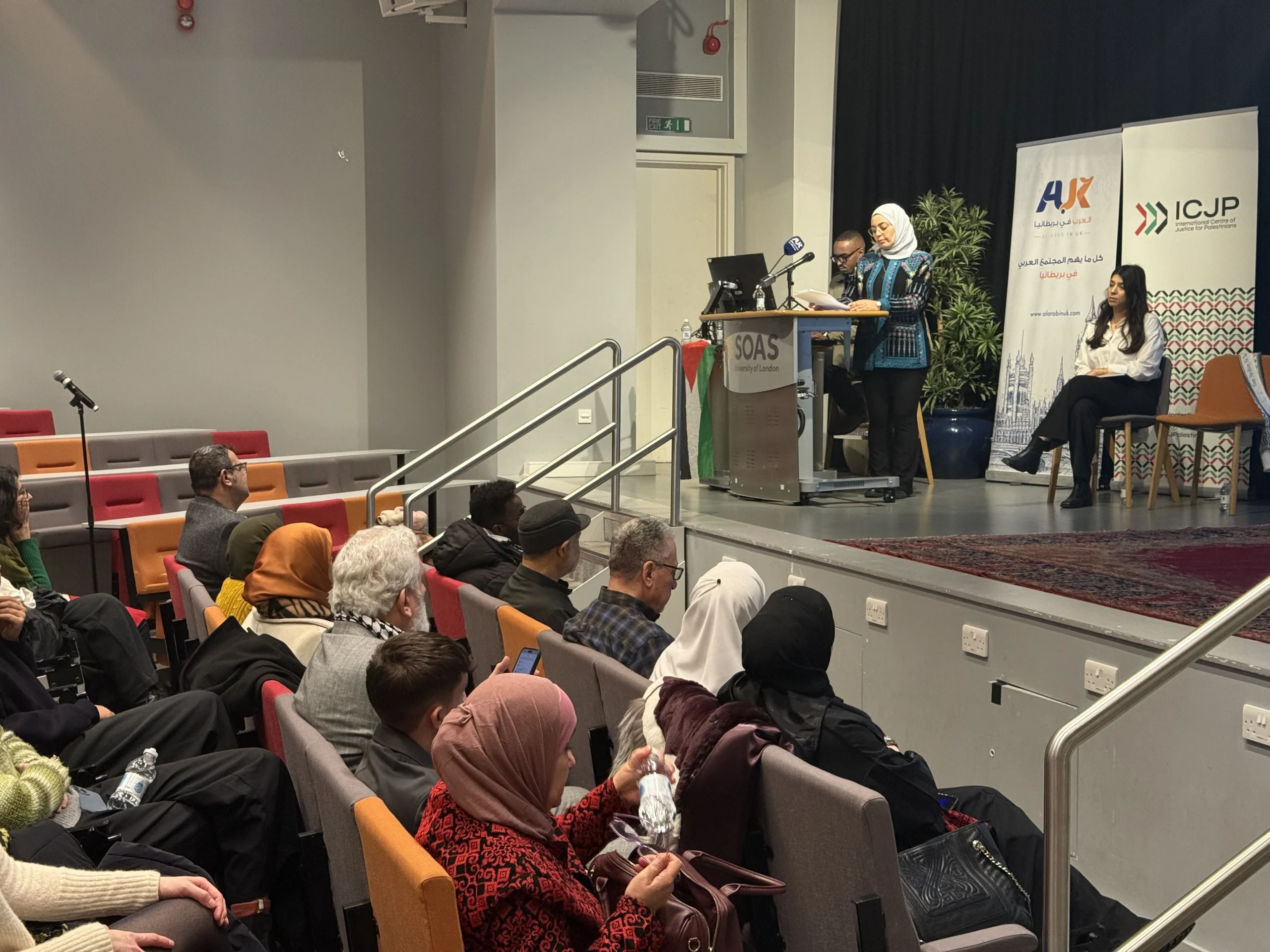
The testimonies of Palestinian students then followed, personal accounts that reflected the scale of psychological and social destruction left by the war, and how education became a battle for survival amid bombardment, displacement, and the targeting of educational infrastructure.
Student and writer Saja Hamdan spoke at length about the suffering of girls in Gaza during the war, explaining that the targeting was not random, but struck them in a double sense, as women and as students at the same time. She pointed out that constant insecurity, scarcity of food, and the loss of shelter turned daily life into an open arena of struggle, draining girls’ psychological and physical energy before they could even begin to think about studying.
Hamdan affirmed that the girl in Gaza was expected to keep learning under brutal conditions: no electricity, no stable internet connection, and no safe places to focus or study, while the sounds of bombardment and surrounding death besieged every attempt to learn. She added that separating the demands of daily survival, from searching for water and food to caring for younger family members, from academic pursuit was nearly impossible, turning education from a normal path into a daily act of resistance, practiced by girls with steadfast will despite accumulating fractures.
Hala Shoman, a PhD student who was preparing to submit her dissertation just one day after the seminar, delivered a testimony that clearly reflected the shocking contradiction between the two realities Palestinian students live: the reality of war and devastation on one hand, and the requirements of scientific research and academic discipline on the other. She explained that pursuing scholarship in Gaza is no longer merely a personal ambition, but has become a direct act of defiance in the face of the destruction of universities, the targeting of students and professors, and the systematic erasure of educational structures.
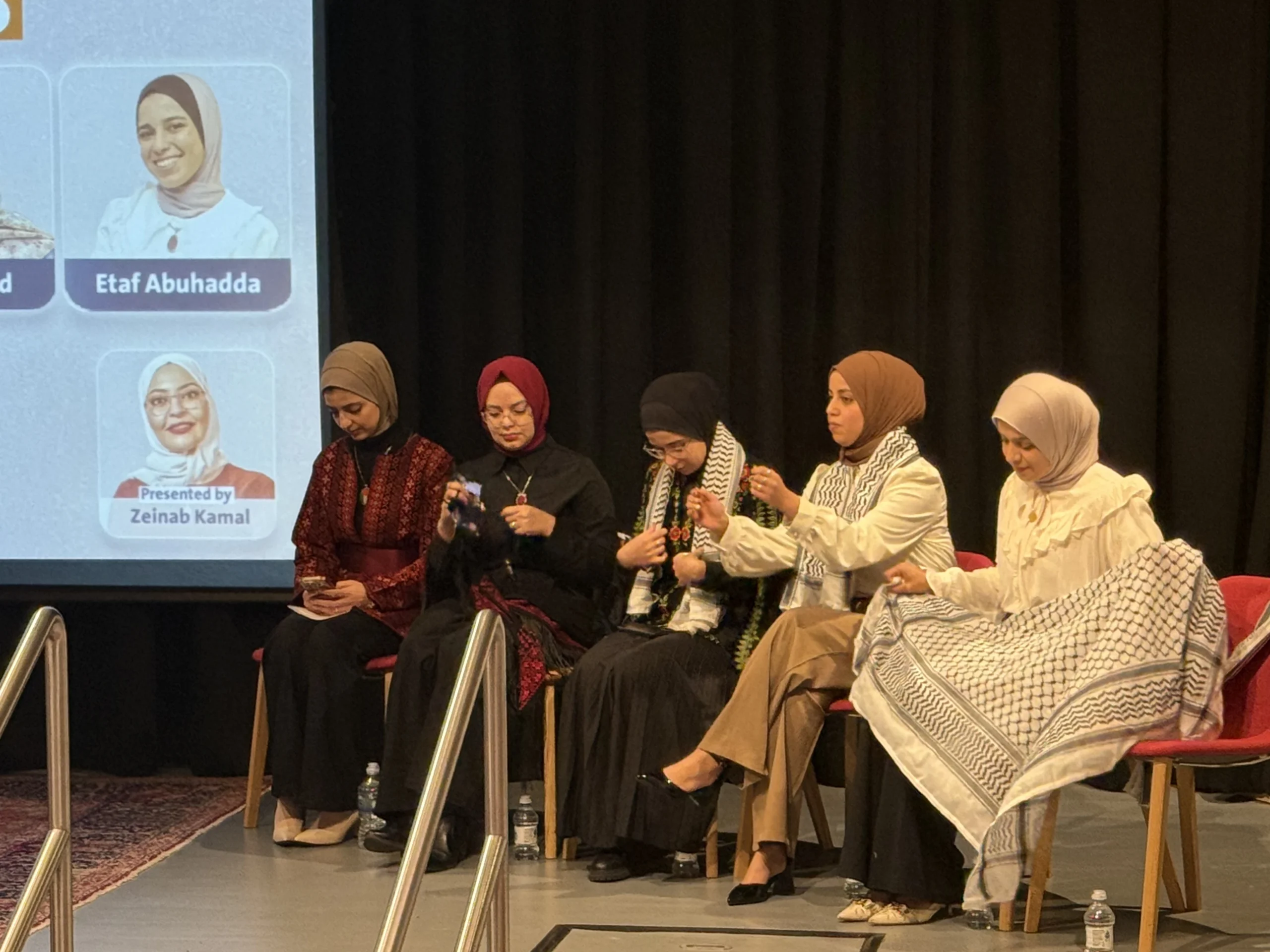
Shoman emphasized that the occupation treated knowledge as an existential threat, seeking to dismantle academic institutions as incubators of awareness, memory, and critical thinking. She noted that Palestinian female students continued their research and studies under conditions lacking even the most basic stability, while carrying in their memories images of classmates who lost their lives, professors who were killed, and universities reduced to rubble. She affirmed that insisting on completing the academic journey is a form of defending the right to knowledge, and defending the future itself.
Student Suha Abu Eid delivered a profoundly affecting testimony in which she recalled the story of her childhood friend Reem Al-Khatib, the Palestinian nurse whose life became a mirror of collective loss in Gaza.
Suha recounted the details of Reem’s life: from her childhood in a modest family whose father worked in fishing, to her academic excellence, to her work as a nurse in neonatal and pediatric departments, and finally to her martyrdom while she was seven months pregnant, after she refused to leave her family home in order to protect her elderly mother.
The testimony was not a narration of an individual tragedy, but documentation of compounded loss: the loss of a human being, the loss of a rare professional, the loss of a mother, an unborn child, and a future that could have been. Suha emphasized that Reem should be remembered for how she lived, not for how she was killed.
Student Amani Abu Mandil spoke about her experience as a Palestinian woman trying to hold on to education at a time when life itself was threatened at every moment. She said the war did not only rob her of safety, but tried to steal the future, when thinking about studying became a luxury, and persisting in it a daily challenge.
She explained that Palestinian women in Gaza carry a doubled burden: they find themselves responsible for the family amid bombardment, displacement, and lack of resources, while being expected at the same time to remain strong and capable of continuing. She affirmed that insisting on learning was not a personal choice, but a collective message of resistance in the face of attempts to erase Palestinian existence.
For her part, student Dana Hamdan focused on the deep psychological impact of the war, noting that pain does not end when one leaves Gaza. She said the Palestinian memory crosses borders, and that images of destruction, the sounds of aircraft, and the names of martyrs accompany students even inside British university classrooms.
She spoke about survivor’s guilt, and the difficulty of reconciling academic demands with ongoing grief for a homeland being destroyed in real time. She affirmed that conveying these testimonies is not a request for sympathy, but a call to recognize the truth as it was lived by those who experienced it—far from justification or fragmentation.
Student Etaf Abu Hdeh delivered a detailed and painful testimony. She said she is 26 years old—two of those years under genocide, and twenty-four years under dozens of wars and hundreds of challenges.
Etaf recounted that she was displaced five times, one of them in a tent that lasted eight months—about 250 days of forced life without the foundations of human dignity. She took the audience on a journey through a single day in the life of a woman in Gaza: a day that begins with fear that morning may not come, with the heat of a tent turning into hell, and with trying to protect children from flies, before the struggle to secure water, food, and privacy begins.
She described how simple daily tasks become a race for survival: waiting for a water truck, carrying heavy jerrycans, cooking with primitive means, and standing in long lines to bathe with water unfit for use. She also addressed the particular suffering of women during menstruation, amid the absence of sanitary pads, privacy, and rest, affirming that the woman in Gaza is not granted the luxury of collapse, because she is the last pillar the family leans on in a time of genocide.
Legal Commentary
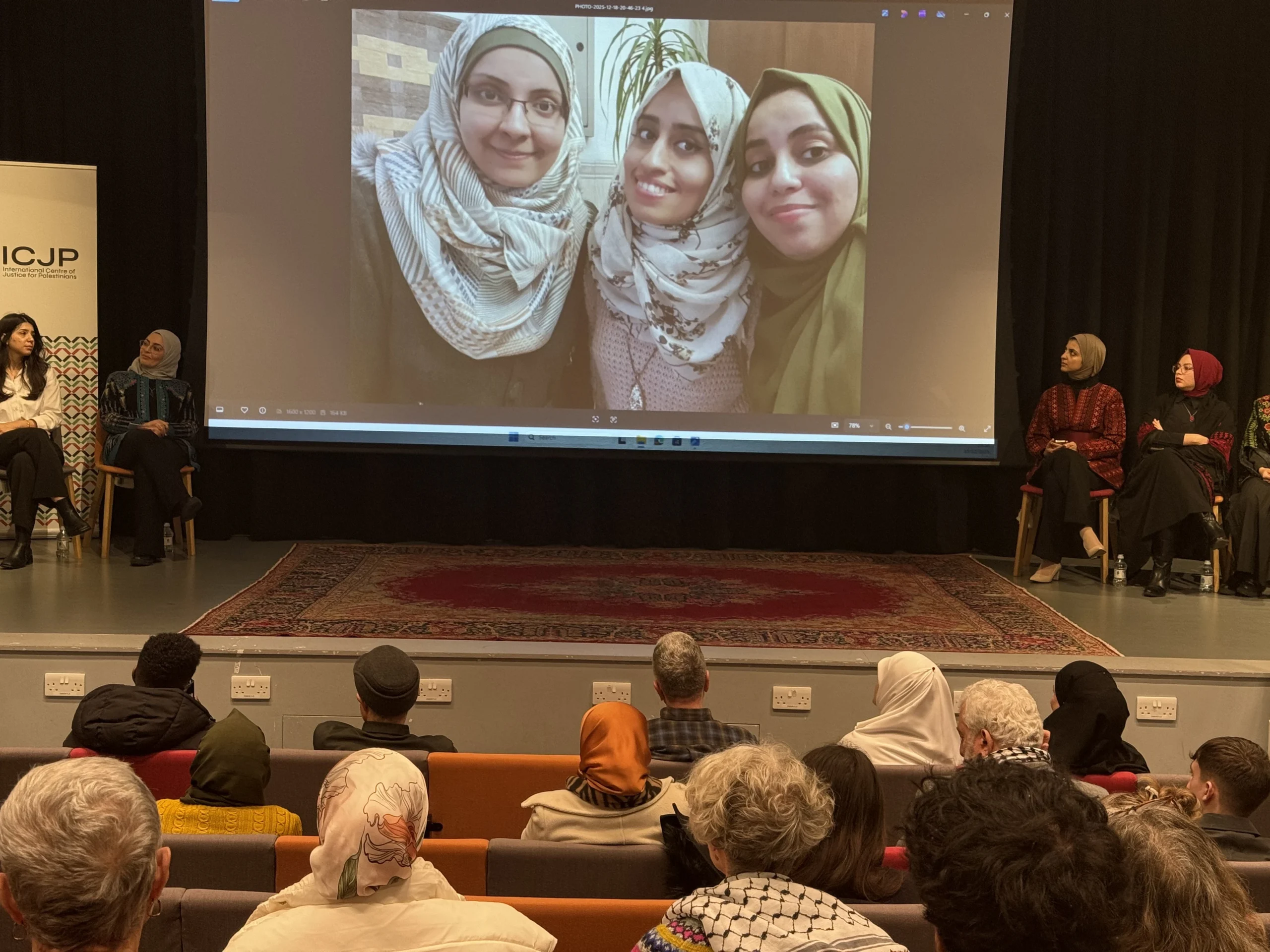
Following the testimonies, lawyer and legal adviser dania Abu Al-Haj from the International Centre of Justice for Palestinians provided a legal reading. She affirmed that what was presented in the testimonies falls within grave violations of international humanitarian law, and that documenting these voices constitutes an essential element in the path toward international legal accountability.
The gathering was not free of tears, which expressed the depth of accumulated pain in the memories of Palestinian women, and the anguish left by scenes of bombardment, loss, starvation, and the violation of human dignity. The hall became a purely human space that transcended language and politics, reaffirming the centrality of testimony.
Closing of the Seminar
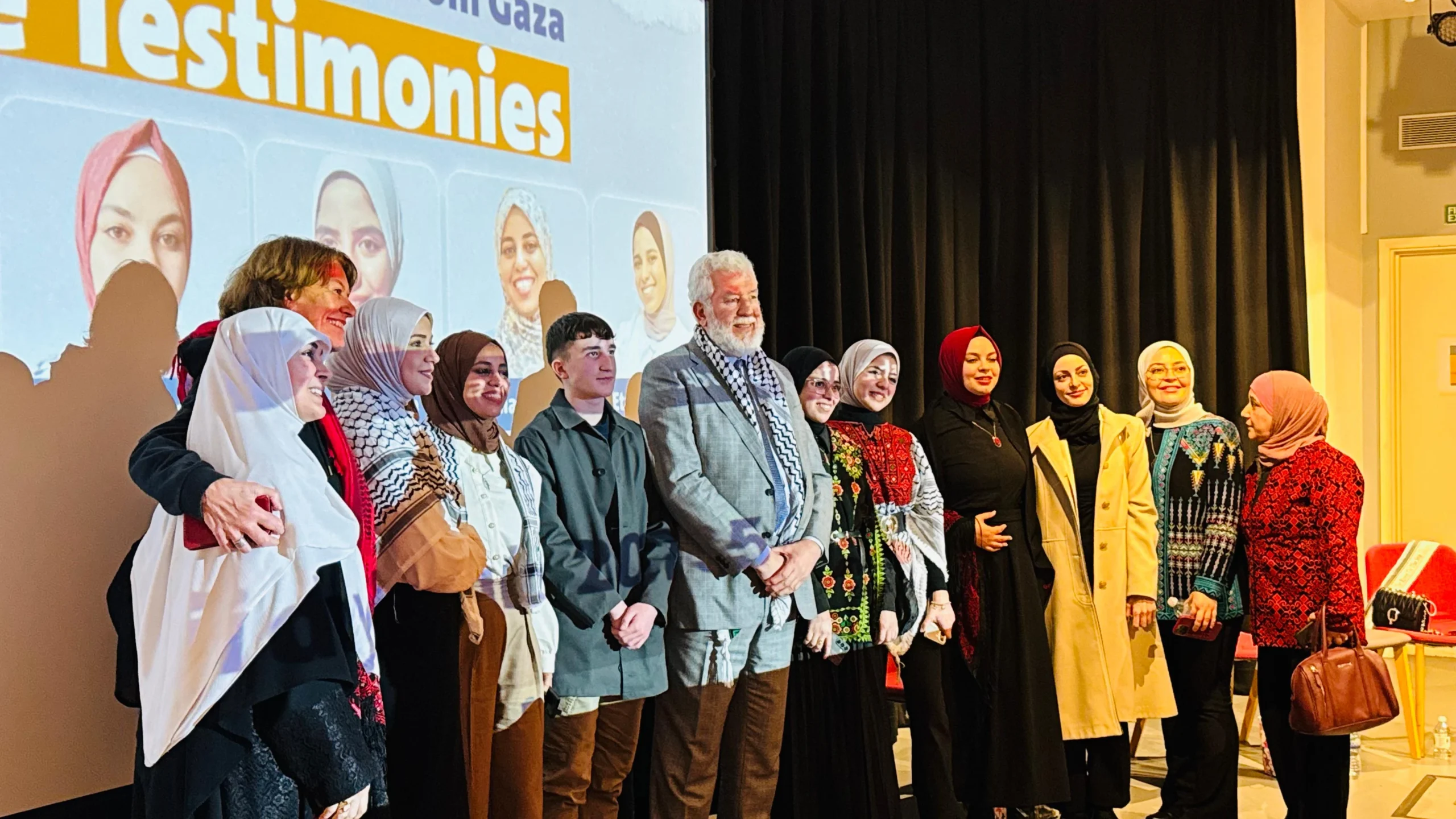
The seminar concluded with Adnan Hmidan, a prominent Palestinian-British media figure in the UK and the founder and Executive Editor of Al-Arab in Britain (AUK)—honoring the participating students and posing for a commemorative photograph, capturing the meaning of resilience and the recognition of testimony.
Al-Arab in uk (AUK) platform believes that such seminars represent a necessary humanitarian and ethical act in confronting attempts to silence the Palestinian narrative within the British public sphere. Listening to the testimonies of Palestinian women from Gaza—away from political and media noise—restores the human dimension of the Palestinian cause and affirms that supporting these voices is not a political stance as much as it is a commitment to the fundamental values of justice, human rights, and freedom of expression.
Read More:
ShortURL ⬇